The Deployment Checklist That Separates Safe From Unsafe AI for Confidential Professional Data
Seven safeguards determine whether AI tools can safely handle confidential professional data.
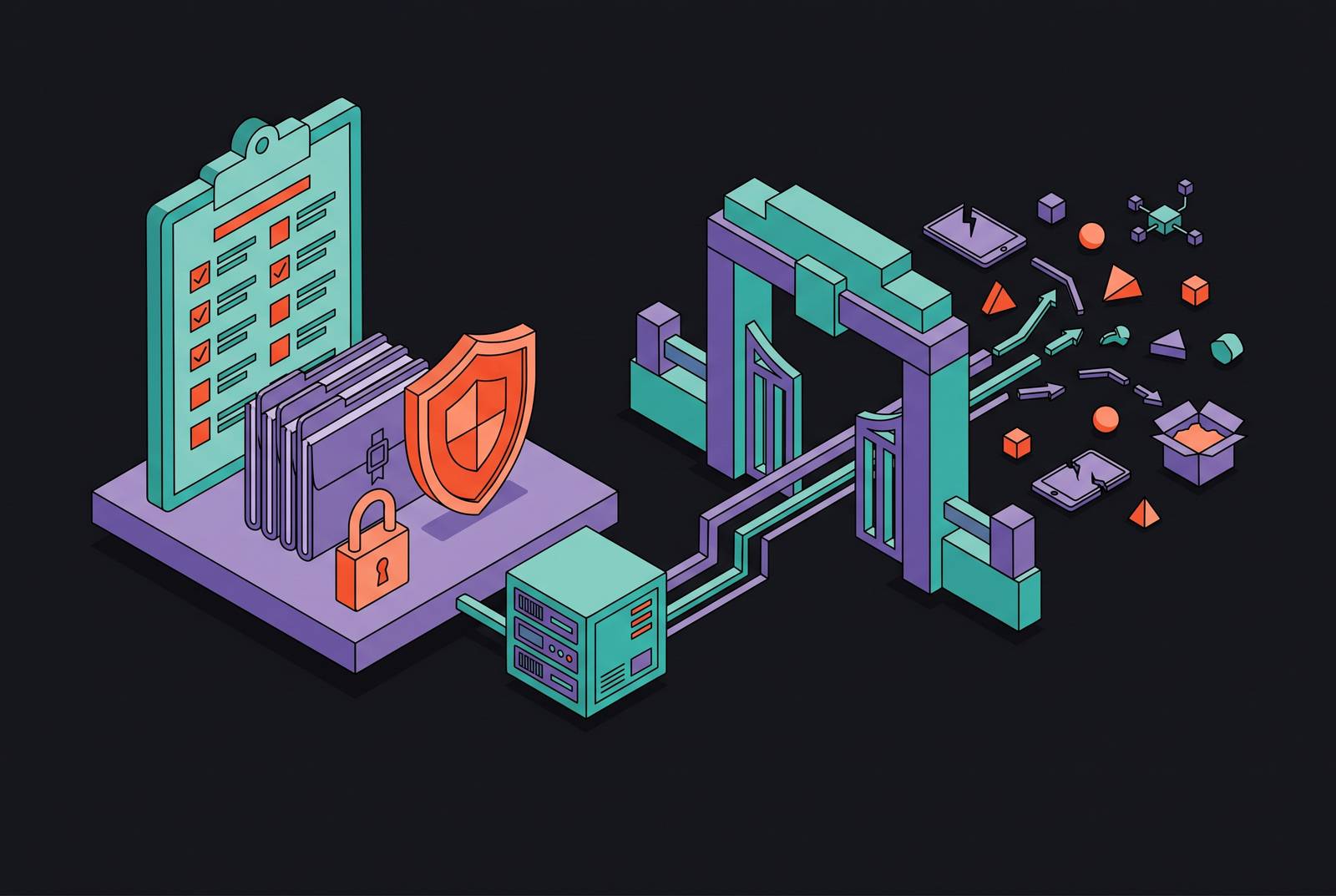
AI tools for privacy-conscious professionals should be selected by their data boundaries. For lawyers, accountants, and other professionals handling sensitive client information, a no-training promise is only one requirement. This deployment checklist explains why safe use depends on seven connected gates, and why the most sensitive data calls for architecture that keeps it within a controlled environment.
Why professionals keep underestimating how much confidential data leaves their organization through AI tools
An employee sees a productivity task where a provider receives data. A salesperson pastes a customer file to draft an email, an HR officer summarizes a performance review, or an accountant submits an invoice export. None of these acts requires an attacker. The confidentiality failure begins when information crosses a boundary the employee has not considered.
Three mechanisms make that boundary consequential. Prompt leakage sends sensitive information to outside providers who may keep it. Model memorization can allow training data, including source code, health notes, and financial records, to be reproduced later. Prompt injection uses crafted inputs to manipulate an application into revealing sensitive information. Personal accounts add to these risks because people use them outside the systems their organization has approved and monitors.
This happened in Samsung’s semiconductor division in March 2023. Within weeks after the division allowed ChatGPT, three employees sent it equipment-measurement source code, defect-detection code, and a transcript of an internal meeting. Each submission served a good-faith work task.
Why banning the tool does not solve the problem Samsung actually had
Samsung initially responded with a ban, but blocking OpenAI’s website on corporate networks did not stop the submissions. Employees continued through personal devices and other channels. The data flow became harder to monitor.
The distinction behind Samsung’s subsequent direction was contractual. Enterprise agreements provide protections that consumer accounts do not, governing training use, processing location, and retention rights.
Yet the strongest objection survives that distinction. An enterprise agreement does not prevent the service from processing sensitive data or inadvertently including it in responses. How can an organization verify a promise about operations it cannot inspect? The gates address that problem through complementary controls rather than treating a signed agreement as the finish line.
Gate 1: Classifying data before selecting any tool
The first decision is what information the organization handles. Vendor selection cannot be calibrated before that is known. A workable classification has three levels and fits on one page, keeping ordinary decisions out of recurring case-by-case debates.
Free data includes public website copy, published job ads, and generic text without names or confidential figures. Internal data includes procedures, anonymized minutes, and tables without identifiable people, and belongs only in a validated business tool. Forbidden data must never go into a non-validated tool. It includes identifying personal information, health and banking data, trade secrets, contracts under negotiation, sensitive source code, and logins and passwords.
For law firms, medical practices, and accountancies, professional secrecy broadens the forbidden category and requires a written inventory. The label alone is not protective. People need to have read the classification and be able to apply it to the information in front of them.
Gate 2: What a vendor contract must actually say before any confidential data is processed
A marketing promise not to train on corporate data is not a legal instrument. Before personal data is processed, a Data Processing Agreement must be in place. The commitment must be signed and auditable. Its purpose is to establish enforceable obligations.
The agreement or terms must cover all five checks. The terms for training must say whether the organization’s data is used to train or improve models. The terms for location and transfer must say where data is hosted and processed and what mechanism covers transfers outside the European Union, including Standard Contractual Clauses or an adequacy decision. Retention provisions must define storage periods and explicit deletion rights. The terms for Sub-processor access must include an up-to-date list of who else can access the data. Security provisions must commit to encryption at rest and in transit, access management, and logging.
Business plans usually have training off by default, while personal or free accounts may have it on. That distinction needs contractual review. Before going ahead, teams should also check that the underlying model provider has SOC 2 Type II, ISO 27001, or an equivalent certification that has been independently audited.
Gate 3: Scoping permissions and access before the agent touches any system
An agent that retrieves information, calls tools, and acts autonomously crosses a wider security boundary than a chat interface. It can reach across systems a human would not touch in one session. Agents can be remarkably effective at accessing data they should not have. Permissions therefore need to be locked before deployment.
Each agent should have a distinct identity without credentials shared with humans or other agents. Least privilege means granting only what its defined task requires and removing inherited or default permissions. Data sources should default to read-only. Write access requires explicit justification, secondary approval, and audit logging, while fields containing personal, financial, or health data should be blocked unless strictly necessary.
Teams should enumerate allowed external APIs, block all others at the network or policy layer, and review the list regularly. Zero-trust micro-segmentation should restrict reachable network segments. Session data, tool-call logs, and outputs also need defined storage locations, retention periods, and deletion procedures.
Gate 4: Keeping secrets and credentials out of agent prompts, memory, and logs
A credential in a prompt is effectively no longer secret. Prompt injection can exfiltrate secrets from prompts, memory, or logs, while access to the memory layer creates another exposure route. This is how a prompt-level weakness becomes a lateral-movement problem.
API keys, passwords, and credentials belong in a dedicated secrets manager and should be kept out of code, configuration files, and prompts. Teams should set maximum credential lifetimes, automate rotation, and test that rotation works without downtime. Agents receiving webhooks must validate HMAC signatures on every inbound request and reject unauthenticated payloads. Dependency scans should run before deployment, with unpatched critical vulnerabilities blocking release.
Gate 5: Requiring human approval before any action that is hard to reverse
An agent can send communications, modify records, call APIs, or move money faster than an incident response process can intervene. Speed changes the control required. A review after execution cannot serve as the brake for an action that is difficult to undo.
Mandatory approval should precede irreversible actions, financial transactions or commitments, and actions touching regulated personal data, health records, or legal documents. Escalation is also needed when instructions are unclear, confidence falls below a defined threshold, or a new situation falls outside the agent’s scope. When financial, legal, and medical outputs have high stakes, a human must review them before the agent goes ahead, even if they have a confidence flag.
A kill switch must have written instructions, be tested, and revoke credentials and shut down the agent at once. The January 2026 incident in which CISA’s acting director uploaded contracting documents marked “for official use only” to public ChatGPT illustrates the submission boundary. Multiple automated warnings were triggered. An approval step before submission would instead have intercepted the action before disclosure.
Gate 6: Building tamper-evident audit logs from the moment the agent goes live
Establishing what happened when a control fails requires an audit trail whose integrity can be tested. Logs must be tamper-evident from launch, because records created after an incident cannot reconstruct a trustworthy contemporaneous history.
Every session should record inputs, tool calls, outputs, latency, token counts, and user identifiers. Append-only storage using hash chains or Merkle trees makes modification detectable. Agent logs should feed a SIEM, with alerts for authentication failures, scope violations, and data-exfiltration signals. Excessive API calls, unexpected data access, output spikes, and rising error rates need thresholds calibrated against baseline behavior before go-live.
The EU AI Act’s six-month minimum for applicable automatically generated logs is a floor. HIPAA and financial-services contexts require their own sector checks. Visibility must also extend to outputs. A dedicated filtering layer should scan for personal information and off-topic content before delivery.
Gate 7: Making AI literacy an organizational requirement, not an optional training module
Correctly configured controls still depend on people understanding their boundaries. A well-intentioned employee can select an unapproved account or submit information under the wrong classification. Training makes the earlier gates durable over time. It is not a substitute for them.
EU AI Act Article 4 requires organizations deploying AI to provide a sufficient level of AI literacy among staff, including when they did not build the system. For professional teams, that means knowing how to apply the classification without asking for help on each routine case and why consumer accounts differ from enterprise agreements. It also means recognizing prompt injection in documents, emails, and tickets, as well as in openly adversarial requests. Staff must know which actions require approval and when to escalate, while non-technical staff need awareness of phishing and social engineering aimed at privileged accounts.
The regulatory exposure that now runs in parallel to every deployment decision
The GDPR and EU AI Act each impose duties that must be met alongside those of the other. The GDPR applies when personal data is processed for training or use, and the deploying organization is the controller for what it submits. Data Protection Impact Assessments are required when AI assesses or ranks people, processes sensitive data at scale, or monitors employees. A deployment decision can therefore create obligations before an agent takes its first autonomous action.
The CNIL’s finalized recommendations draw on the December 2024 EDPB opinion explaining that the GDPR often applies to models trained on personal data because of memorization. Controlling inputs reduces dependence on what a model might later reproduce. The AI Act also requires the literacy and logging steps described above where they apply.
US privacy obligations also require attention. Indiana, Kentucky, and Rhode Island added assessment, notice, and transparency obligations effective in 2026. The relevant legal requirements must be established for the particular deployment rather than inferred from a vendor’s general compliance claim.
What AI assistant can handle sensitive client information — and when is architecture stronger than a contract?
Privacy guarantees fall into distinct tiers. Consumer accounts come without the protections in enterprise contracts discussed earlier. Enterprise agreements establish meaningful restrictions on training, retention, access, and transfers. On-premises or privacy-by-architecture deployments address a different question by keeping data within the organization’s controlled environment.
From outside a vendor’s system, an organization cannot confirm whether processing is isolated, retention exceeds the agreed period, or provider personnel can access the data. A contract creates obligations concerning those practices. Architecture that prevents data from reaching a third-party system removes that particular exposure path.
Enterprise controls can be a meaningful improvement where sensitive-data volume is low or the DPA has been rigorously reviewed. For the most sensitive legal, health, financial, or source-code categories, however, architectural controls are needed to close the verification gap. This changes which privacy claim the organization must trust, while permission, credential, and oversight risks remain inside the controlled environment.
How to run the checklist in practice: a sequenced decision path for professional teams
Teams should first write and share the three-level classification, before choosing a tool. The resulting inventory determines what the vendor agreement must cover and whether external processing is acceptable at all. Contract review then establishes the permitted processing boundary. Only after that should the team map data sources, assign the agent’s identity, and document any justified departure from read-only access.
Before production access, credentials should move into a secrets manager and rotation should be tested. Written approval triggers and a tested kill switch must precede real-data handling. Tamper-evident logs, SIEM integration, calibrated alerts, and applicable retention periods must be ready at launch. Literacy training should make these controls usable, with completion a condition of access.
For forbidden-tier information, does the proposed assistant keep data within a controlled environment, or does confidentiality still depend on promises about what happens after it leaves? A completed checklist can reduce the risks of external processing. It cannot turn that processing into a boundary the data never crossed.