The Training Data Opt-Out Is Not Enough and Here Is Why
Opt-out policies let companies train on your data first and ask permission later.
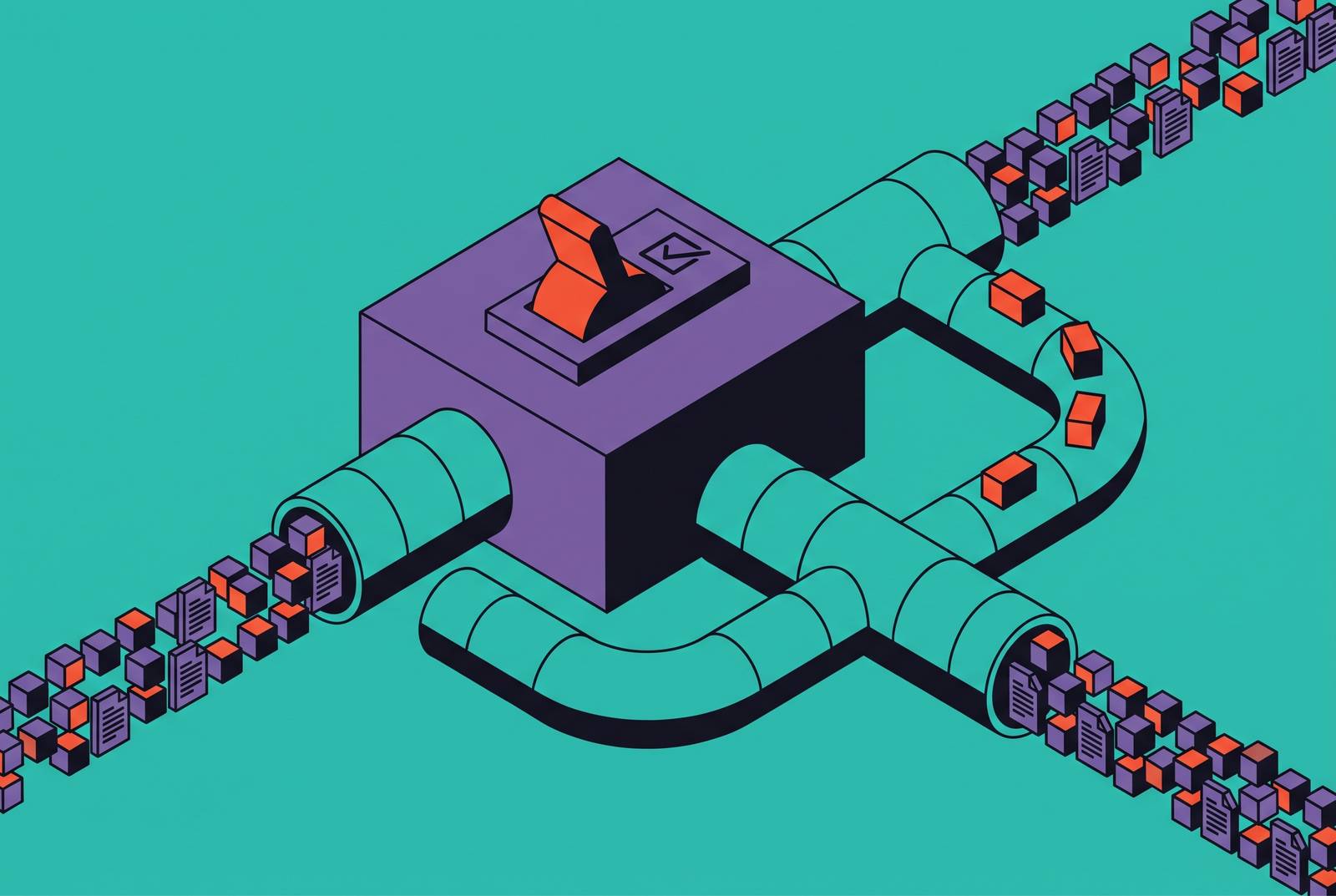
Training data opt-outs are not enough because they leave past use untouched and future compliance in the provider’s hands. For readers seeking an alternative to ChatGPT, an architecture designed to keep user data with the user and prevent its collection or retention for training offers a different approach. The distinction is between declining extraction and using a system designed not to perform it.
How opt-out became the industry's default answer to a consent problem it created
The wave of copyright litigation against AI companies made the acquisition of training data a governance problem that providers could no longer leave unanswered. Opt-out gave them a response they could defend politically without having to ask for permission before collecting data. The default remained mass ingestion of unlicensed material. Berkeley Technology Law Journal describes this arrangement as a “veneer of compliance,” under which a concession to creators leaves the underlying practice intact.
That origin explains the mechanism’s central asymmetry. The company can proceed unless the rights holder intervenes, while the rights holder must discover the use and find a way to object. What has the creator agreed to before collection begins? Under this model, nothing affirmative is required, because permission is inferred from the absence of resistance.
What opt-out actually means in practice — silence counted as yes
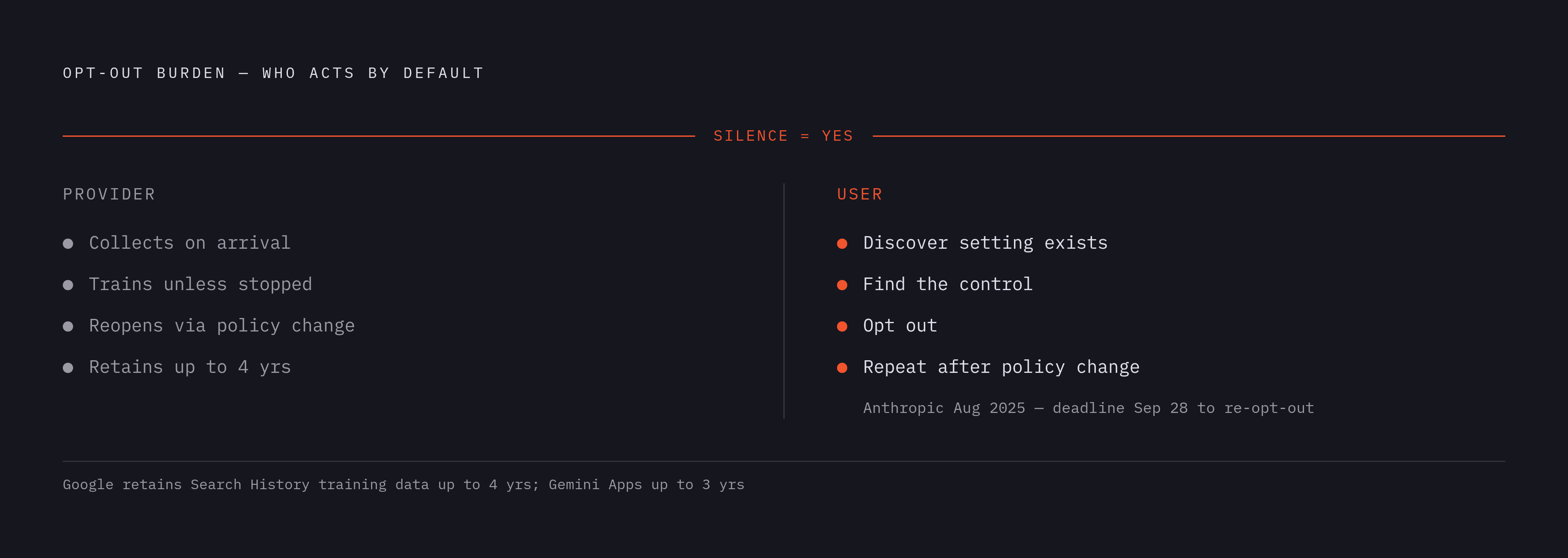
Under Anthropic’s August 2025 policy change, Claude.ai consumer conversations would be used for training unless users opted out by September 28, 2025. The change allowed conversations to be used for training for up to five years. Previously, the absence of training on user conversations had been a selling point. Someone who chose the service on that basis therefore had to respond to a new policy to preserve the earlier boundary.
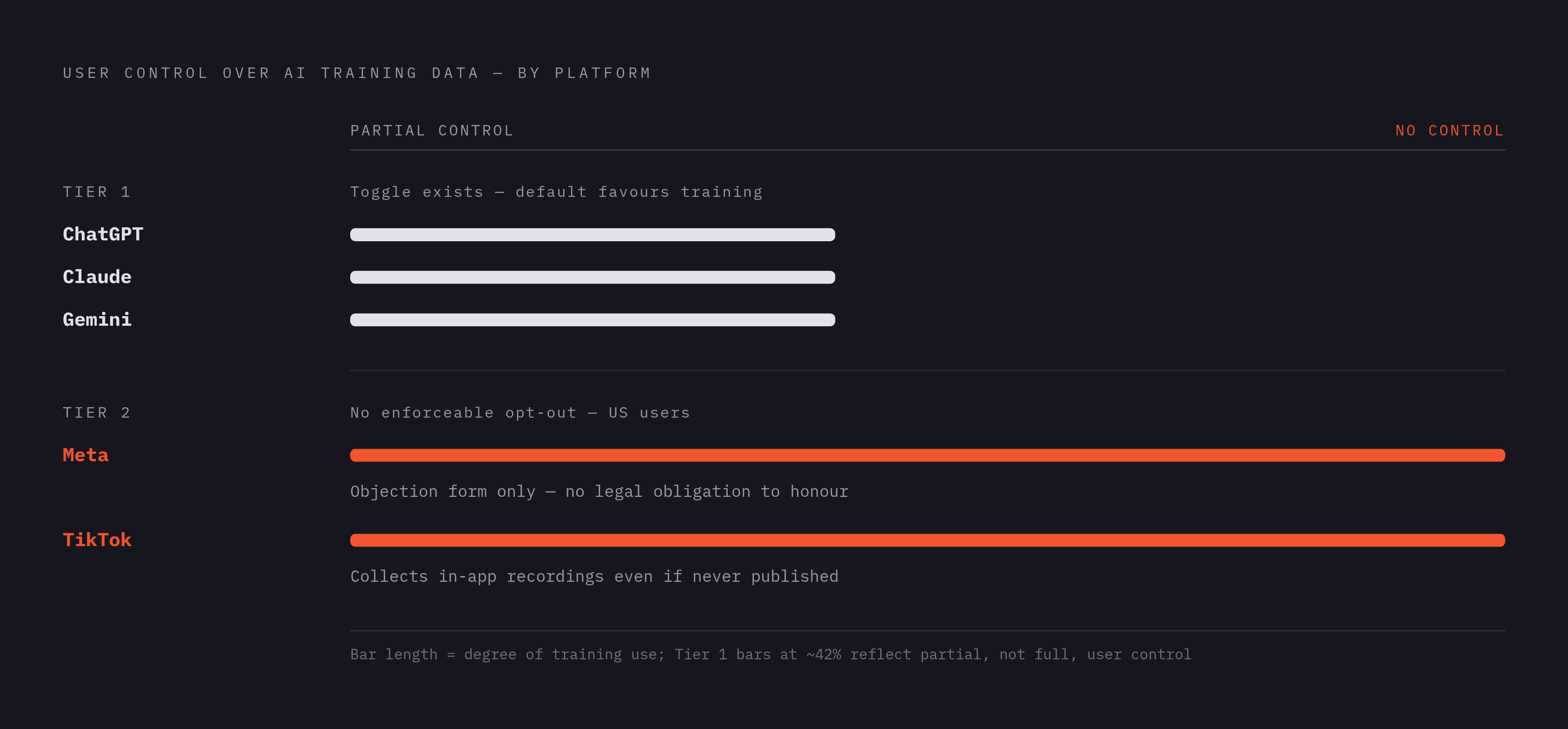
ChatGPT and Google also place the burden of changing training defaults on the user, with controls in different menu paths. LinkedIn and X follow the same general pattern. A person must know that the setting exists, understand what it permits, and locate the relevant control rather than assume that using a service and authorizing training are separate decisions.
A functioning toggle can still embody an uneven bargain. The setting that permits collection is active on arrival, while the setting that restricts it requires attention and action. Policy changes can reopen that task after a user thinks it is finished. The resulting record may show no objection, but that is not evidence of an informed yes.
Why opting out after the fact cannot undo what has already been taken
A successful opt-out stops future ingestion. Once material has been absorbed into model weights, changing an account setting does not extract its contribution. The journal’s analysis argues that truly honoring such withdrawals would require companies to retrain their algorithms each time. The toggle therefore governs a different period from the one in which the user may already have lost control.
Google’s documentation describes a related limit in its retention practices. Search Services History media pulled into training can be disconnected from the user’s account and kept for up to four years, while Gemini Apps reviewed data can be kept for up to three years regardless of subsequent user action. Control over the account is already separate from control over the training data. Deleting or changing something on one side does not necessarily change the other.
The problem also extends beyond the first model. Material used to train Model A can influence synthetic data that trains Model B, making the original contribution harder to trace through later generations. The Reddit v. Anthropic lawsuit, filed June 4, 2025 in San Francisco Superior Court, shows how hard this can be to trace. Claude’s responses acknowledged training on at least some Reddit data but could not establish whether that content had since been deleted or distinguish deleted from active sources. Those responses show why asking the model cannot recover a reliable history of consent.
Where no opt-out exists at all
For some platforms, even prospective refusal is unavailable. As of mid-2026, Meta provides no enforceable training opt-out for US-based users of Facebook, Instagram, or Threads. Its Privacy Center has a formal objection form, but Meta is under no legal obligation to honor it for those users. No guaranteed setting prevents training use, and making an account private or posting less offers only partial mitigation.
TikTok likewise offers no clean training-consent toggle. Its data practices extend to content recorded or created in-app but never published, although saved Drafts remain locally on-device and are not uploaded to its servers. That distinction is important when considering unpublished material. It also shows the coverage problem with an opt-out framework, because a person cannot exercise a choice that the service does not provide.
Why the technical workarounds creators have built don't hold
Creators can say no outside a platform’s settings, but that alone cannot make a platform comply. The robots.txt standard, formalized as RFC 9309, requests particular crawler behavior without technically blocking access or having legal force itself. Access is blocked at the server or CDN. OpenAI’s documentation says robots.txt rules “may not apply” to ChatGPT-User, while Perplexity’s documentation says Perplexity-User “generally ignores robots.txt rules.”
The 2025 AI Agent Index found that only 6 of 30 deployed agents explicitly stated that their crawler bots respect robots.txt. Another 16 of 30 gave no clear account of how they deal with robots.txt or CAPTCHA, or how they access the web. That silence leaves creators without a clear basis for predicting how their preferences will be handled. A restriction on an artist’s own domain also cannot govern copies already posted on Instagram or an aggregator.
The University of Chicago’s Glaze cloaks artistic style, while Nightshade aims to poison training data through image perturbations. Researchers presented LightShed at USENIX Security in 2025, demonstrating detection and removal of perturbation-based protections, with near-perfect detection of Nightshade protections. The near-perfect accuracy applies specifically to detection. These tools remain worth using as friction and signals of refusal, but their exposure to countermeasures prevents them from substituting for structural protection.
The administrative burden opt-out places on individuals is not accidental
The creator must identify relevant systems, locate their procedures, submit objections, and revisit them when policies change. The journal makes the inversion concrete through music interpolation. Under a comparable opt-out regime, a songwriter would have to hunt down unauthorized uses rather than expect the person using the work to obtain a license first.
Research on queer artists documents how this overhead falls on marginalized creative communities. Tracking, filing, and re-filing objections consume time and resources that individual artists do not have, while large intellectual-property holders can afford litigation. The burden is not evenly distributed. A system that gives everyone the same formal opportunity to object can still grant effective protection mainly to those able to administer it.
This is a consequence of the default. Each additional system expands the creator’s workload while leaving the developer free to treat silence as permission. The journal also notes resistance from technology companies to opt-out schemes that would concede any material might be unauthorized.
No US federal law backs up any of these opt-out rights
In the United States, no federal law establishes a general right to demand an AI-training opt-out or verify that one has been honored. The American Privacy Rights Act would have introduced GDPR-style data rights, including training opt-out, but stalled in Congress in 2024. As of mid-2026, no replacement federal privacy law exists. A provider’s toggle is therefore a product commitment rather than this kind of statutory right, and its terms can be qualified or redefined through policy changes.
Reddit alleges that Anthropic’s bots repeatedly crawled its site after an Anthropic spokesperson publicly said scraping had stopped. Its claims include breach of contract, unjust enrichment, trespass to chattels, tortious interference, and California unfair competition. These are allegations. They also rely on state-law theories rather than a federal statutory training opt-out right.
A user lacks a general federal entitlement requiring the provider to accept and demonstrate compliance with a training refusal. The ordinary user has no independent way to check. Without one, the party that benefits from collecting the data also supplies the assurance that collection has stopped.
What EU enforcement and the opt-in alternative reveal about the opt-out model's structural limits
The strongest defense of opt-out combines it with enforceable transparency. EU AI Act enforcement began August 2, 2026, allowing the European Commission’s AI Office to ask for information and access to models and the Commission to impose penalties. The General-Purpose AI Code of Practice, published July 10, 2025, requires signatories to follow robots.txt and honor machine-readable rights reservations. These rules come with powers to investigate what providers do.
The European Parliament’s 2026 proposals would go further through an EUIPO-managed opt-out register, an itemized list of copyrighted training works, and disclosure of scraped websites. The case for disclosure deserves serious consideration. If rights holders can establish that their work was used, they have a firmer basis for enforcing rights or seeking licensing deals. The journal acknowledges this argument, which addresses the obscurity that otherwise makes a claim difficult to formulate.
Yet disclosure does not distribute the ability to act on it. Major rights holders have resources that individual creators lack, and a record of past use cannot undo what a model has absorbed. Transparency can expose the decision without transferring control over it. Even when opt-out rules are well enforced, the developer still decides to collect data before the creator can step in.
Sony AI researchers’ 2026 paper, Yes, But Not Always. Generative AI Needs Nuanced Opt-in, proposes a different point of control. Its agent-based architecture would check at inference whether a specific user request meets conditions the rights holder has consented to. Conditional permission replaces the binary training decision. This approach could accommodate the distinctions familiar in creative licensing, rather than asking creators to accept all future uses or withdraw entirely. As a proposed direction, it restores the question opt-out reverses, namely whether permission exists before the relevant use.
What it means to choose a ChatGPT alternative that does not train on your conversations
For someone choosing an assistant, the distinction is between a training policy and a limit built into the system. A policy says what the provider agrees not to do with data it can collect. Architecture can instead constrain whether that data becomes available for training at all.
Confidant illustrates that architecture-first approach. Its design keeps user data with the user and prevents collection or retention for training. Protection does not depend on finding a setting and preserving it through later policy changes. Unlike a consumer training opt-out in ChatGPT or Claude, the stated boundary is part of how the system is designed to handle user data.
That claim has a defined scope. Not training on conversations is not, by itself, a complete account of every privacy question, and it does not resolve the provenance of material used to build an underlying model. The narrower distinction is still decisive for personal conversations. It separates preventing their collection for training from asking a provider to refrain after access has already been granted.
Users can check whether conversations are collected, whether they are kept for training, and whether users have to say no to keep them out. Opt-out starts with the provider entitled to proceed. An architecture designed not to collect user data for training starts on the other side of that boundary, before a conversation becomes something the user must try to reclaim.
Sources
- Opt-Out Approaches to AI Training: A False Compromise - Berkeley Technology Law Journal
- "I Just Don't Want My Work Being Fed Into The AI Blender": Queer Artists on Refusing and Resisting Generative AI
- Yes, But Not Always. Generative AI Needs Nuanced Opt-in
- Scrapers selectively respect robots.txt directives: evidence from a large-scale empirical study
- Yes, But Not Always. Generative AI Needs Nuanced Opt-in