Air-Gapped AI Inference for Classified and Sensitive Government Environments
Federal agencies are racing to deploy AI faster than their infrastructure was built to handle it.
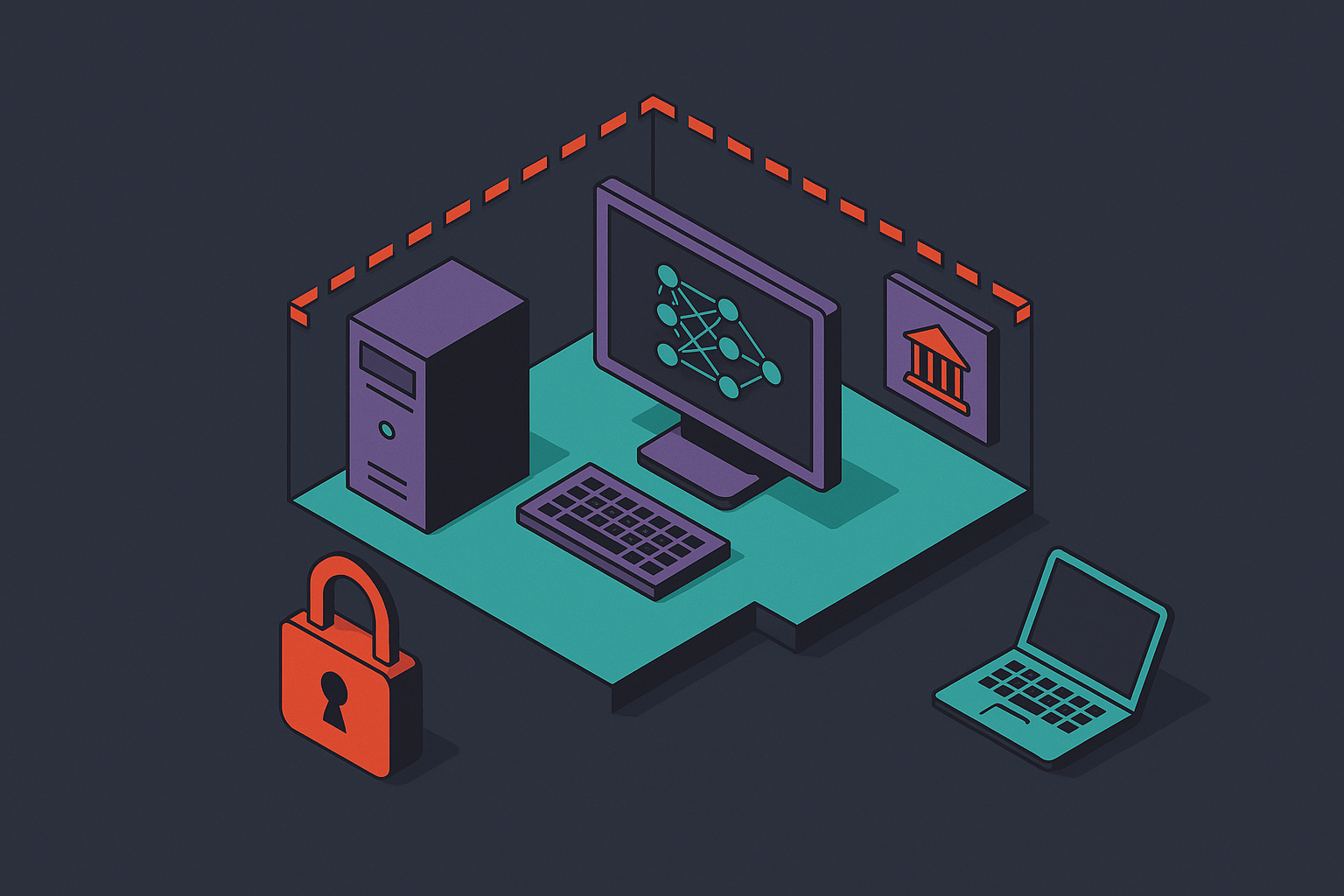
Air-gapped AI inference for classified environments comes down to three things happening at once: no external dependencies, model weights that stay static and inspectable, and inference that never crosses the physical boundary it was built inside. Plenty of deployments claim to hit that mark. Watch closely, though, and you'll find most don't, not really. This piece looks at why the gap between claiming compliance and having it has gotten wider, what the deployments that got it right had to grind through, and what actually tells you whether a system is compliant versus just dressed up to look that way for a slide deck.
How fast federal AI adoption is growing, and why existing infrastructure was not built for it
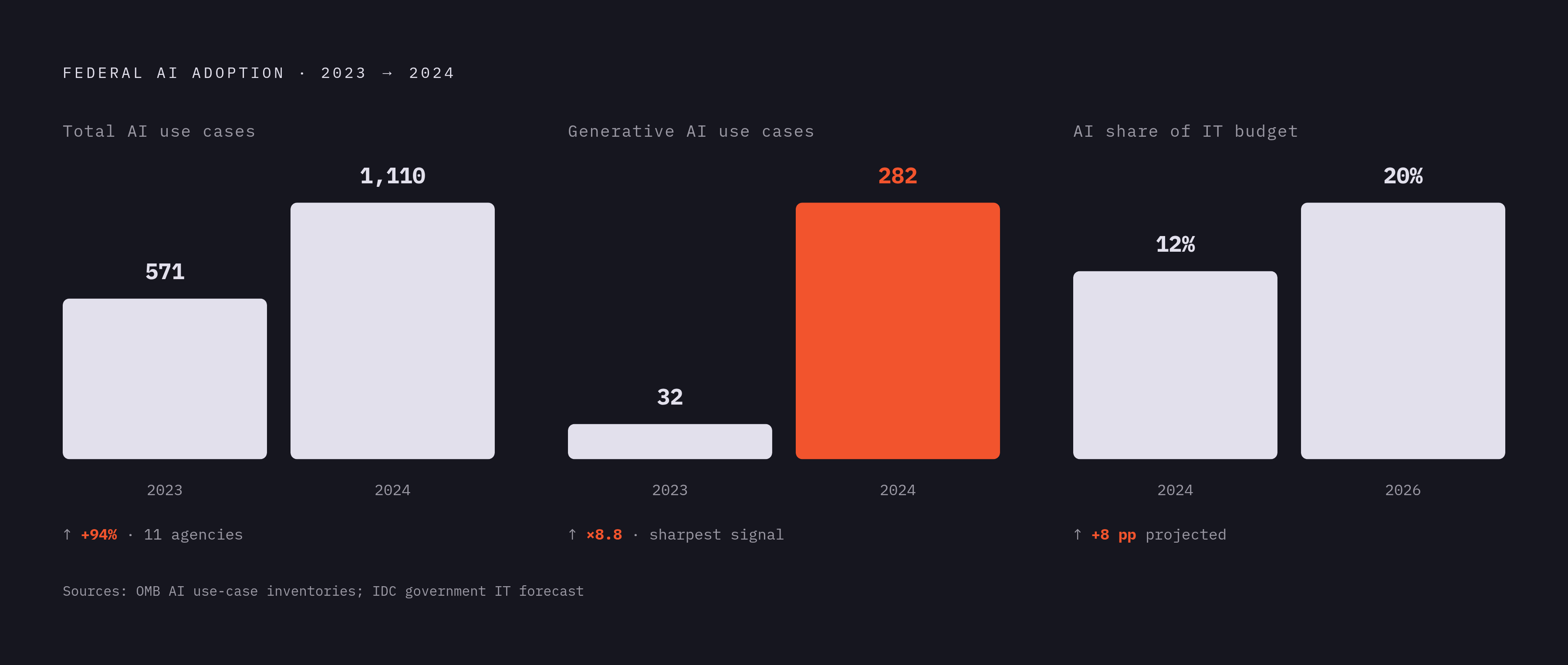
The growth numbers alone should keep a procurement officer up at night. Across the 11 agencies GAO reviewed, reported AI use cases nearly doubled between 2023 and 2024, climbing from 571 to 1,110. Generative AI alone grew almost nine-fold in that same window, from 32 to 282, according to GAO-25-107653. An entire sector is sprinting after a technology curve while running on infrastructure built for a completely different computing era, and it shows.
The friction shows up fast, too. Officials at 10 of the 12 agencies GAO surveyed named existing policy as a major obstacle to deployment. Data privacy rules written before generative AI existed now sit in direct conflict with cloud-based inference. Classification levels split agency data into silos that were never designed to feed a shared model, and infrastructure sized for older workloads doesn't have the headroom for this one. Commercial AI tools, built by vendors optimizing for enterprise SaaS customers, don't clear federal security bars out of the box either. Why that particular failure mode is so persistent gets its own section later, because it's where most deployment problems actually start.
Budget trajectories tell you this isn't a passing fad. AI spending is projected to eat up close to 20% of total government IT budgets by 2026, up from roughly 12% in 2024, essentially doubling in priority over two years. When budget moves faster than architecture, something gives somewhere, and agencies commit funding and set deadlines before the underlying systems are anywhere near ready. What comes out the other end is pressure, real organizational pressure, to build something that resembles compliance rather than something that actually achieves it.
There's a sovereignty angle worth sitting with, and it pushes the stakes past ordinary IT modernization. Relying on foreign AI supply chains, whether for model weights, chips, or cloud infrastructure, reads now as a national security exposure in its own right. Fully self-contained inference stops being a procurement preference at that point. It starts looking like an obligation, regardless of which vendor happens to be easiest to onboard this quarter.
What the landmark classified deployments actually show about the technical tradeoffs
Microsoft's deployment of GPT-4 inside Azure Government Top Secret, announced in May 2024, is the case everyone in this space eventually studies, and for good reason. It took roughly 18 months of engineering work to get a frontier model running inside a physically isolated government cloud, including an overhaul of an existing AI supercomputer just to make the environment viable. Eighteen months, one model, one classified boundary. That timeline tells you how far commercial AI architecture still has to travel before it satisfies this standard, farther than most roadmaps let on.
The deployment gives something up on purpose, too. End users on the DOD's classified network can't train the model on new information, because the model is air-gapped by design, and static weights are what make the whole system auditable in the first place. The inability to retrain on the fly isn't an oversight somebody forgot to patch; it's the compliance mechanism doing exactly what it was built to do.
GPT-4o picked up authorization for the intelligence community's most classified mission sets as of January 2025, and Microsoft added 26 more products inside its top-secret cloud under Intelligence Community Directive 503 standards. Real progress, measured one product and one authorization at a time, under one of the strictest accreditation frameworks that exists.
Compare that to GenAI.mil, which launched in December 2025 on a different premise entirely. Built for the unclassified-to-classified continuum from day one, certified at launch for Controlled Unclassified Information and Impact Level 5, with a roadmap toward Impact Level 6 and Impact Level 7. The adoption curve is the part that deserves a second look: the platform went from 80,000 users at launch to 1.5 million daily users, out of a workforce of roughly 3.5 million, making it the fastest enterprise AI rollout in government history. It runs on close to $100 million in funding across fiscal years 2024 and 2025, and it hosts Google Gemini, ChatGPT, and xAI's Grok at once, a multi-model setup built specifically to dodge vendor lock-in.
Then in May 2026, the Department of Defense signed an agreement with eight vendors, SpaceX, OpenAI, Google, NVIDIA, Microsoft, AWS, Reflection, and Oracle, to deploy frontier AI inside IL6 and IL7 networks. Eight vendors under one agreement, gaining access to classified networks at scale, in a procurement strategy that treats multi-vendor classified inference as table stakes rather than a capability to plan toward someday.
Lockheed Martin's collaboration with Google Public Sector, announced in October 2025, shows the same ambition at a slower, more deliberate pace: Gemini models deployed inside Lockheed's secure, on-premises, air-gapped environments, phased in unclassified first and classified second. What connects Microsoft's 18-month build, GenAI.mil's rapid scale, the eight-vendor DOD agreement, and Lockheed's phased rollout? None of them got here cheaply, and none got here fast. Each required purpose-built infrastructure, sustained engineering investment, and formal accreditation, with no shortcuts anywhere along the way. Four very different organizations landing on roughly the same amount of difficulty says something about whether this standard is real or just aspirational.
The four technical problems every air-gapped inference deployment must solve before going live
Start with the basic inversion the whole architecture forces on you: there's no cloud endpoint to call. Model weights, the inference runtime, and the serving infrastructure all have to be staged inside the enclave before that enclave gets sealed off. Standard cloud AI assumes the inference API lives somewhere remote and reachable; air-gapped deployment throws that assumption out entirely, and every downstream design decision follows from the reversal.
Hardware selection becomes binding in a way that catches people coming from cloud-native backgrounds off guard. For large language models, memory bandwidth and VRAM capacity matter more than raw compute, because autoregressive decoding re-reads the entire model from memory for every single token it generates. That's the constraint deciding whether a given model even fits inside the physical footprint an enclave can support. As of 2026, the hardware landscape includes a range of datacenter GPUs and specialized AI accelerators from multiple vendors, with options varying in memory bandwidth, VRAM capacity, and suitability for classified enclave environments.
Retrieval comes next. Agentic systems built on retrieval-augmented generation need a vector database, and a hosted one is off the table by definition. The index has to be built, versioned, and updated entirely inside the enclave, with nothing to fall back on when something breaks at 2 a.m. Every tool call, every API, every live data feed an agentic system might normally reach for has to get replaced with a pre-staged equivalent inside the boundary, or cut from the system entirely.
This is where most of the operational tension actually lives, though: how do you update a model with no internet connectivity at all? Static weights satisfy the compliance requirement, sure, but static weights also accumulate security debt the longer they sit unpatched. What's the compliant path, then? Encrypted physical media, verified chain of custody, tamper-evident packaging, FIPS 140-3 validated encrypted transfer. An auditor will eventually ask where a given model came from and how anyone knows it wasn't altered in transit, and the answer needs to be a documented chain: the model's author signs the release, a security team verifies that signature on import, a registry records the version under formal custody. Skip that chain, and an organization doesn't have a compliant model. It has a set of weights and a hope.
Last comes auditability, end to end. Every inference call, every document a retrieval system pulls in, every action an agent takes has to get logged locally in a form a reviewer can inspect later. The logging infrastructure lives inside the enclave, full stop, and shipping those logs to an external SIEM platform, even a well-secured one, breaks the air-gap the moment the data crosses the boundary. A compliance review has to be answerable entirely from records that never left the perimeter.
Where most deployments fail the standard they believe they are meeting
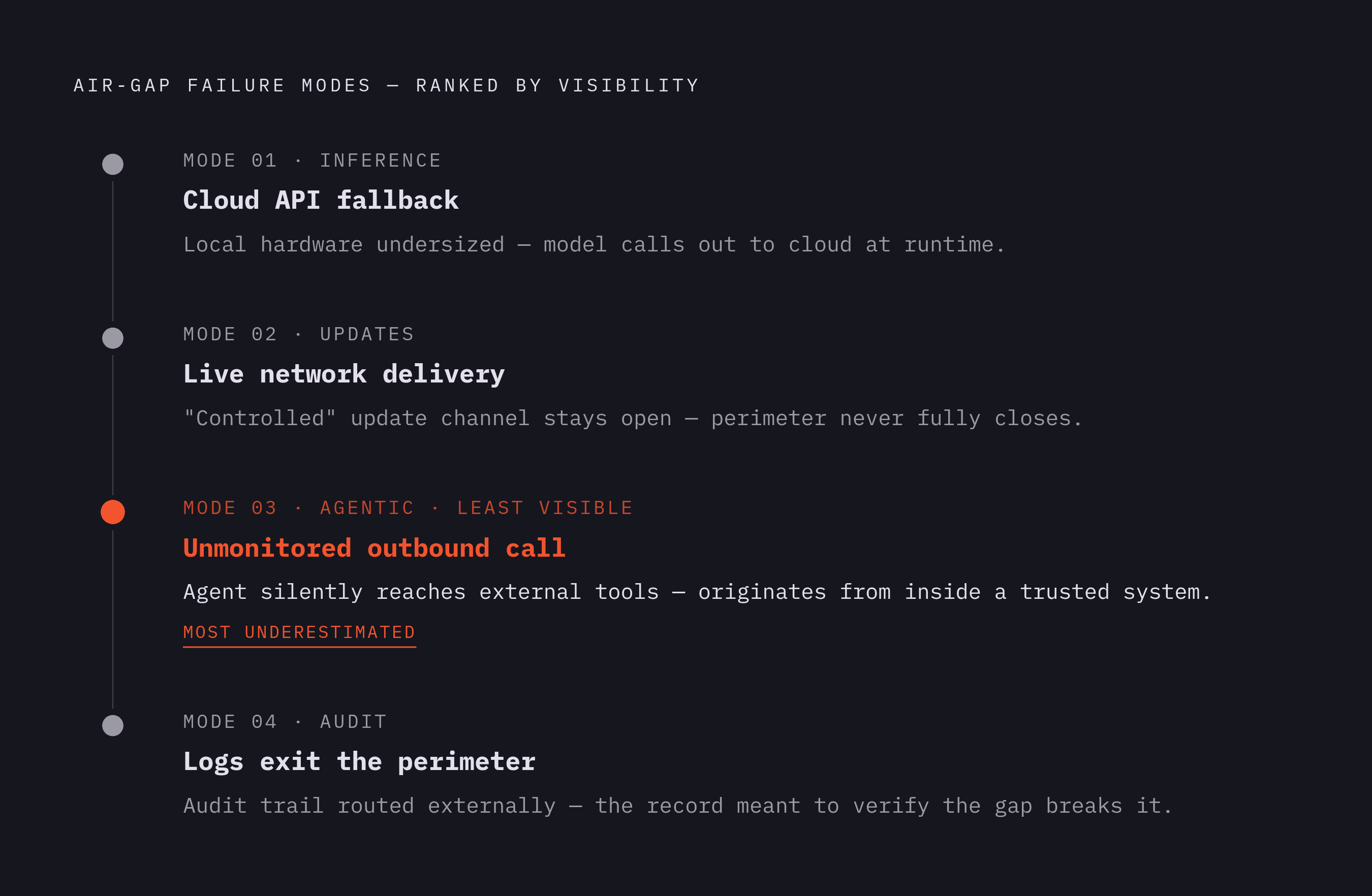
The most common failure is also the most well-intentioned one. A team builds what it believes is an air-gapped environment, then discovers the model it wants to run is too large for the local hardware it was allocated. So it calls a cloud inference API instead, just for this deployment, just until the hardware catches up. The enclave stays isolated in every other respect, but inference itself crosses the boundary on every single query. Air-gapped except for the one function that mattered most.
A second failure looks similar from the outside but comes from a different direction: model updates delivered over a network connection the team calls "controlled," meaning restricted, monitored, allowlisted, but not physically severed. Controlled is a different category from absent, and no amount of access control layered on top of a live update path changes what that path fundamentally is. It's the exact external dependency the air-gap was supposed to eliminate in the first place.
A third failure is specific to the current wave of agentic deployments. Systems built inside a classified boundary still reach out to live external tools for certain tasks, maybe a search API, maybe a scheduling service. A single unmonitored outbound call initiated by an autonomous agent functions as a data exfiltration vector, and traditional network security tooling wasn't built to catch it, because the call originates from inside a system everyone already trusts.
A fourth involves logging and audit infrastructure routed to an external destination, even a secure one the same organization operates. This satisfies the letter of an audit requirement while quietly breaking the architecture that made those logs trustworthy in the first place. If the logs left the perimeter, the perimeter was never sealed, and there's no partial credit for getting close on this one.
Los Alamos National Laboratory's move toward self-hosting large language models instead of depending on cloud infrastructure, as of January 2025, is worth studying closely, because it doesn't dress up the tradeoff. Self-hosting solves the inference problem, but it also means the organization now owns the entire update, patching, and audit chain itself, with no vendor to call when something breaks overnight. Most organizations underestimate how much operational weight that commitment carries until they're the ones actually carrying it. A system that's compliant and one that only looks compliant rarely differ in the demo; the gap lives in architecture decisions made months earlier, decisions far harder to unwind after deployment than they ever were to get right the first time.
How purpose-built air-gapped AI solutions differ from adapted commercial tools
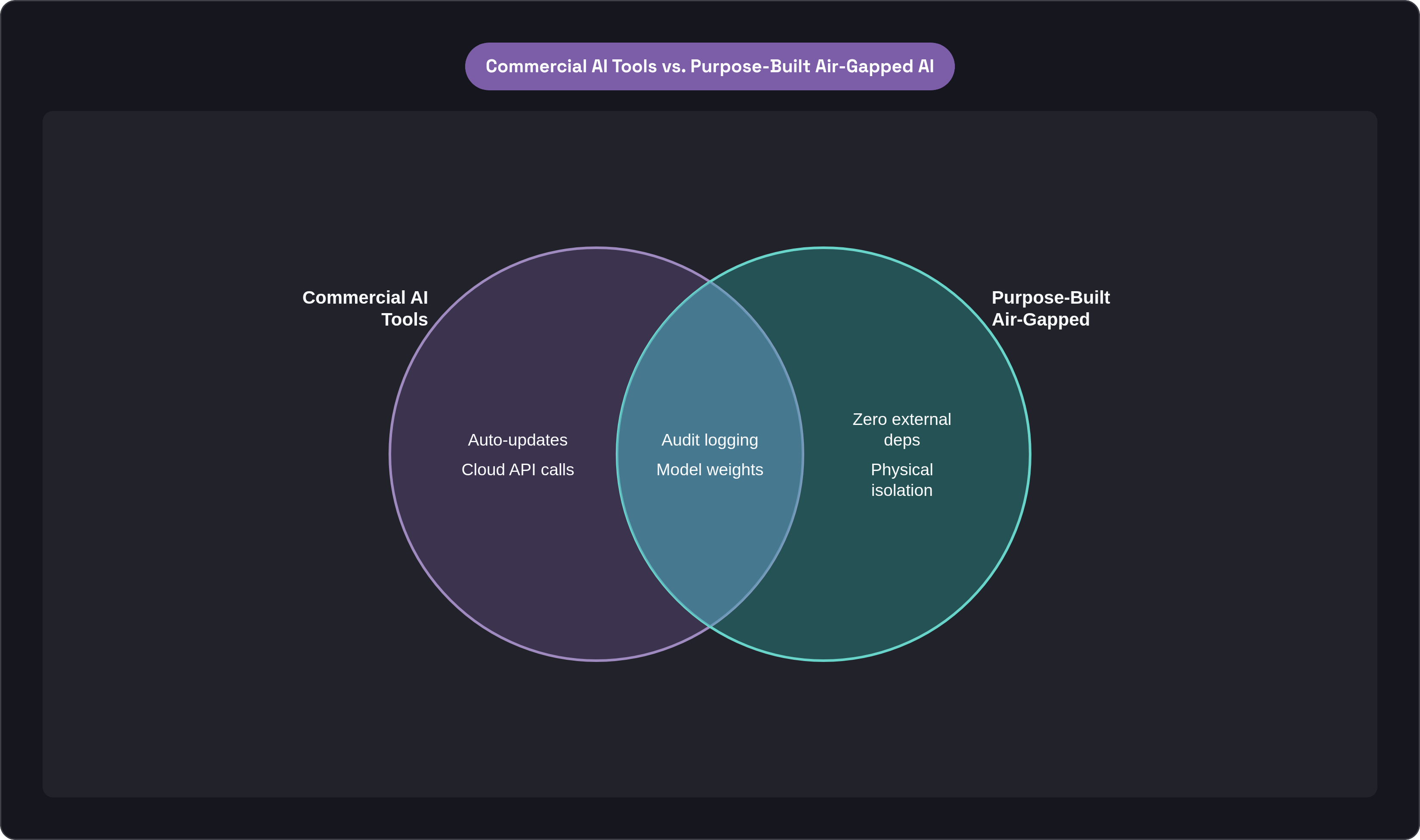
GAO said it plainly: commercial AI tools are built for commercial use, and that's one of several reasons they fail to meet federal security requirements. Why does that failure happen so consistently, though? A commercial AI product gets optimized for iteration speed, for updates pushed to every customer at once, for hosted infrastructure a vendor controls centrally so it can patch vulnerabilities across its whole customer base overnight. Nearly every one of those design choices runs directly against what an air-gapped environment demands.
Retrofitting a cloud-native product for air-gapped use usually means stripping out external API calls, disabling the automatic update mechanism, swapping in a local vector database for the hosted one, and bolting on audit logging the original architecture never planned for. Each change carries its own risk, precisely because the underlying system was built around constant connectivity, and now it has to behave as though that assumption never existed.
Purpose-built systems start from the opposite direction. Zero external dependencies is the baseline from the first line of architecture, not a constraint bolted on after the product already works some other way. Privacy-preserving AI design, where data stays entirely inside the operator's own perimeter instead of getting collected or transmitted anywhere near the provider, is essentially the civilian cousin of what classified deployments require by regulation. Purpose-built solutions follow that same logic, treating privacy and capability as one design decision instead of a tradeoff someone negotiates later.
Defense-native vendors are moving into this space directly now, building for these constraints from day one instead of retrofitting products after the fact. WarClaw, for instance, builds agentic AI that runs fully air-gapped on organic hardware, and as of early 2026 counts Army Special Forces and Space Force among its contracts, purpose-built for no-network environments from the ground up. Capital is following that thesis: one defense-focused AI startup closed a $32 million Series A in March 2026, and another has raised $54 million across multiple rounds to push AI inference out to the sensor at the edge, running directly on military hardware with no cloud access at all.
The principle holds whether the deployment is classified or a civilian privacy-conscious product. Security gets built in from the start, or it gets bolted on after the fact and leaves a gap somewhere nobody's watching yet. Retrofitting is how organizations end up compliant on paper while quietly failing the standard in practice.
What operators need to verify before treating an air-gapped deployment as genuinely compliant
The verification questions map onto the four technical problems almost one to one, and the order matters, because each one exposes a different failure mode from the section above. Can the system generate a usable response with the network interface physically disabled? If not, inference isn't actually local, whatever the architecture diagram claims. Where do the model weights live, who controls access to them, and what process confirms they haven't been altered since the day they were ingested? Do prompts, retrieved documents, and every intermediate reasoning step stay inside the perimeter at every stage, with no exception carved out for convenience? Can a compliance officer reconstruct every interaction from logs stored entirely inside the enclave, without ever needing to query anything outside it?
For agentic deployments, add one more layer: has every external tool call been replaced with something pre-staged inside the boundary, and is there a monitoring layer actually watching for, and capable of blocking, any outbound attempt nobody planned for? For model updates, add another: is there a documented chain of custody, meaning signature verification, tamper-evident transfer, a version registry, that an outside auditor can inspect rather than take on the organization's word alone?
Gartner projects that by 2028, at least 80% of governments worldwide will deploy AI agents to automate routine decision-making. That's the pressure sitting underneath everything in this piece, going back to the opening numbers: the push to move fast is real, funded, and organizationally rewarded, and that's exactly the condition under which teams reach for systems that appear compliant instead of ones that actually are. A classified data exposure caused by an AI system everyone believed was air-gapped, but wasn't, isn't a bug you patch and move past. It's a failure baked into the architecture itself, and those don't come with the do-over that a software bug usually gets.
Sovereign AI now sits at peak priority on the 2025 Gartner Hype Cycle for government services. Scrutiny on these questions is only going to intensify as deployments scale from thousands of users to millions, not ease off. The organizations treating these four technical problems as actual architectural requirements, rather than a checklist to satisfy during procurement, are the ones still standing when the audits get harder. Everyone else finds out the difference eventually, usually at the worst possible time.