Operationalizing Zero-Trust AI at Scale Across Distributed Enterprise Teams
Five operating principles for securing AI agents across enterprise systems.
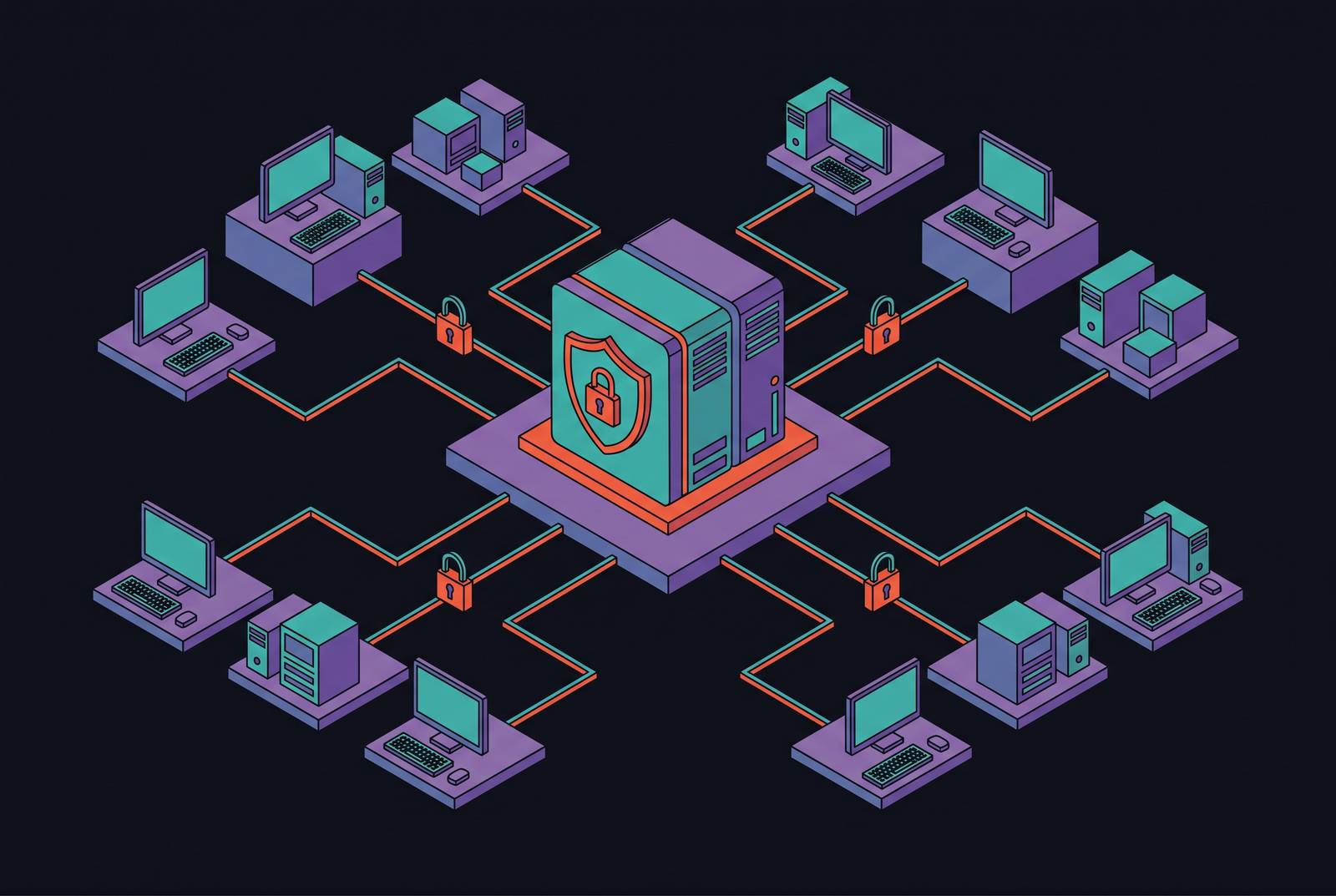
Zero-trust AI architecture for enterprise requires a distinct identity for every agent, authorization for every action, and continuous verification across tools, memory, and deployment pipelines. Preventing an AI vendor from seeing internal prompts and data also requires an architecture that keeps those materials outside the provider’s reach.
Why traditional zero-trust models break when AI agents become the actors
Enterprise identity models built around human actors assume there are relatively few identities, that actions happen at human speed, and that behavior is predictable. Autonomous AI agents break all three assumptions because they authenticate, act, and chain tool calls without a human approving each step. Prompt injection exposes the mismatch particularly clearly. An attacker need not steal a password if malicious instructions can redirect an already-authenticated agent using legitimate credentials. Authentication establishes which actor is present, but it cannot establish that the actor’s next action is justified.
That distinction matters across cloud platforms, APIs, vector databases, and orchestration layers, where a single task can cross several security boundaries. Shadow AI adds deployments that enterprise controls may not cover at all. The architecture must also account for what happens beyond authentication when agents working across email, calendars, CRM systems, and financial tools leave cached credentials and session data in the provider’s infrastructure. Confidant AI represents one privacy-preserving approach, designed to keep information with the user and prevent its accumulation at the provider. Such an architecture reduces a class of provider-side credential leakage, but does not replace controls over what an authenticated agent may do.
What zero-trust for AI agents actually requires — five operating principles
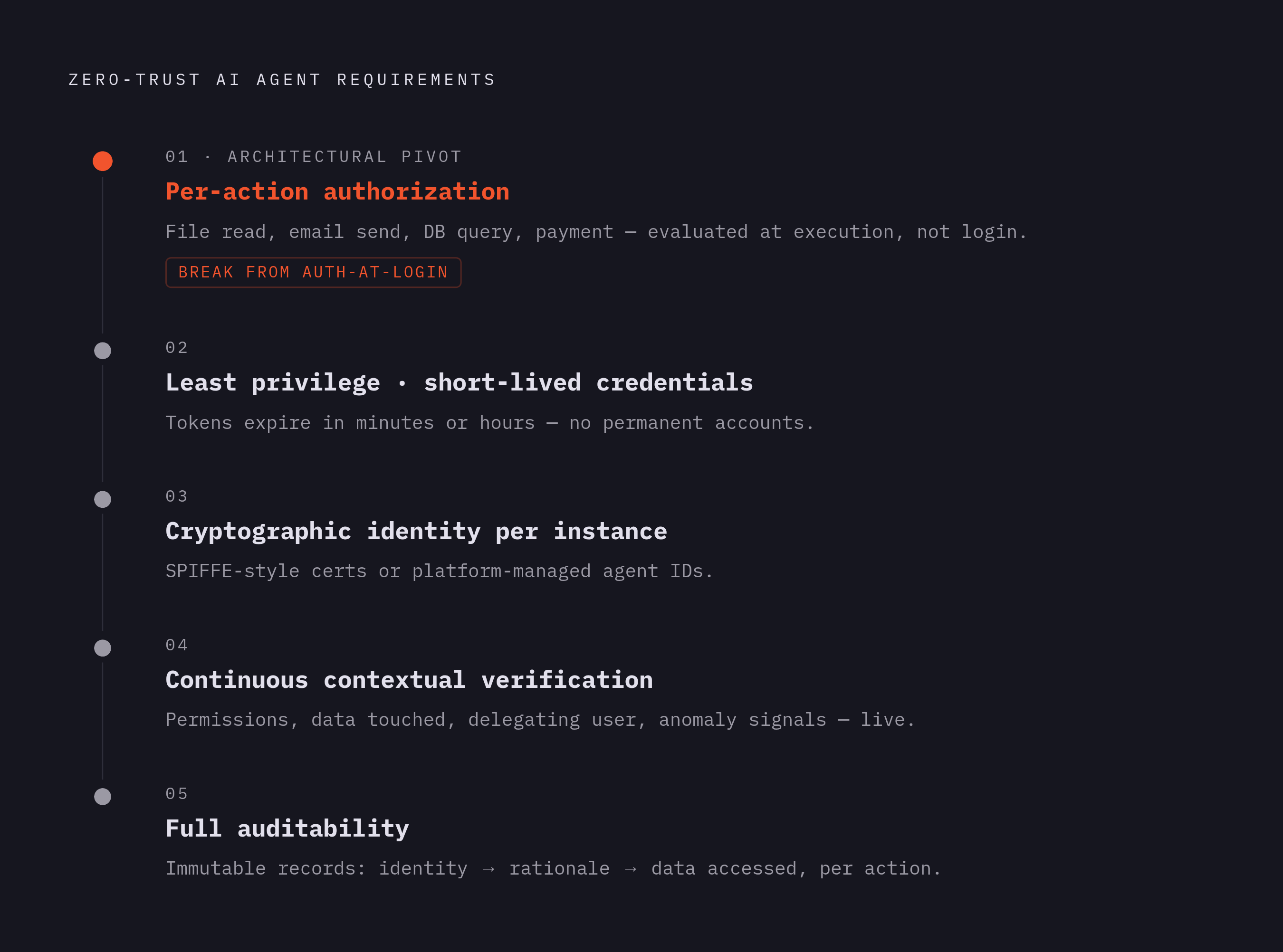
NIST SP 800-207 establishes seven tenets of zero trust architecture. Applied to AI agents, those tenets inform five operating requirements rather than a separate, five-part NIST standard. The first is per-action authorization. Each file read, email send, database query, or payment execution is evaluated against policy at execution time. Approval at deployment cannot stand in for approval of subsequent actions. The unit of trust is the action.
The second requirement is least privilege with short-lived credentials. An agent receives narrowly scoped tokens that expire in minutes or hours, rather than permanent service accounts with years-long lifetimes. The third is cryptographic identity per agent instance, using SPIFFE-style certificates or platform-managed agent IDs to distinguish one actor from another. These requirements address different risks. Narrow credentials constrain authority, while distinct identities prevent authority from becoming an indistinguishable pool shared among agents.
The fourth requirement is continuous contextual verification. Authorization must account for its initial permissions, the data the agent touched, the user who delegated the task, and real-time anomaly signals. The fifth is full auditability, with immutable records that link every action to its identity, why it was taken, and the data it accessed. Together, these requirements make authority provisional and evidence-bearing. They provide the criteria for judging an implementation, rather than merely describing its intended security posture.
Scoping and issuing identity for non-human AI actors
The first implementation task is to give each agent a durable, cryptographically verifiable identity under enterprise control. Workload identity frameworks including SPIFFE/SPIRE and platform-managed agent IDs provide ways to distinguish instances by role and runtime environment. Before an agent runs, its identity scope must define the systems it may reach, actions it may take, and data classifications it may touch. Without that definition, later controls have no stable subject to constrain. Identity is therefore the foundation of the architecture.
If agents share credentials, possession of those credentials undermines the distinction between the compromised agent and its peers. Separate workload identities remove that shared-identity failure mode, while short-lived credentials limit how long issued authority persists. Tokens expiring in minutes or hours replace permanent accounts and require renewed authentication and authorization for new action sequences.
The identity record also needs provenance metadata, including the model version, orchestration layer, and human principal who delegated authority. Those details distinguish the agent from the components and people that gave rise to its behavior. That distinction extends into the supply chain, where open-source models, external datasets, and third-party tooling can introduce compromised identities or manipulated behavior. Keeping sensitive data and session artifacts inside the enterprise security boundary also lowers the risk that comes with a provider holding that information. Identity scope and data location are separate decisions, but both determine how far an identity compromise can reach.
Enforcing least-privilege access across distributed AI workloads
Once identity exists, a policy layer must translate its scope into constraints before each tool call executes. Open Policy Agent (OPA) and Cedar are options for evaluating calls against declarative policy. Declarative rules make permissions available for audit rather than leaving them implicit in application code. The MCP (Model Context Protocol) layer is a place to enforce those rules where agents connect to enterprise tools. Controls at an MCP server must apply to each invocation.
The placement of enforcement is as important as the policy itself. Sending AI traffic through remote enforcement points adds latency and new failure domains. Enforcement should therefore occur where traffic originates, whether in a branch, at the edge, on a device, or in a private environment. A centrally routed check is not inherently stronger simply because it occupies one chokepoint. The architectural goal is consistent policy applied at the action boundary, without forcing every distributed workload through a remote path.
Micro-segmentation complements those checks by separating critical assets and limiting lateral movement after compromise. It cannot substitute for application-level permissions, which remain a weaker layer in enterprise zero-trust deployments. An agent can stay inside its network segment while retaining excessive access to the applications it legitimately reaches. Permission scopes therefore need trimming from their initial breadth after deployment.
Continuous verification across inference, memory, and pipeline boundaries
An authorized tool call does not establish trust in the next inference step. Prompt injection and RAG system exposure can redirect agents or reveal sensitive repository data during otherwise legitimate workflows. Continuous verification must therefore check what agents do across inference, memory reads, and pipeline stages. AI-driven behavioral analytics and dynamic risk scoring provide ways to detect deviations as execution proceeds. Their purpose is to reassess context.
Memory introduces a distinct boundary because information retained for later use needs governance beyond the action that first accessed it. The relevant questions concern its intent, provenance, lifecycle, and the user’s control over it. Microsoft’s Zero Trust Workshop incorporates guidance based on the Microsoft AI Memory framework to treat memory as a governed security boundary.
Encrypted AI pipelines protect data in transit, but validation must also span training, testing, deployment, and inference. Otherwise, malicious workflow code or manipulated deployment artifacts can undermine runtime protections. Signals that keep coming in have a cost, since false positives can wear out the teams expected to respond. Anomaly detection therefore needs tuning to distinguish meaningful deviation from routine agent variability. For privacy-preserving systems, including the architecture Confidant AI describes, keeping inference data under the user’s control also means there is no central provider repository to verify.
Integrating zero-trust controls into DevSecOps and MLOps pipelines
Runtime controls come too late to fix every weakness that enters during development and deployment. AI assistants now help write code, suggest packages, set up infrastructure configurations, and automate testing. These uses can make excessive permissions and insecure dependencies more harmful before an agent reaches production. Pipeline controls must therefore validate model provenance, dependency integrity, and deployment policy continuously. This is the bridge between constraining live actions and establishing what governance can reliably inspect.
Microsoft’s DevSecOps pillar in the Zero Trust Workshop includes 15 control groups covering source repositories, CI/CD pipelines, dependencies, artifacts, and infrastructure-as-code. It also identifies four tasks focused directly on AI-assisted development, namely code governance, tool allowlisting, data protection, and AI and ML pipeline supply-chain security. These controls carry least privilege from source code through cloud deployment. Policy-driven workload orchestration extends that approach into MLOps by replacing static deployment approvals with continuous validation. The same declared constraints then apply to what enters the environment and what runs within it.
Provenance remains a specific weakness rather than a problem solved by existing software inventories. SBOM (Software Bill of Materials) frameworks were designed for traditional software and do not yet provide sufficient provenance mechanisms for model weights, fine-tuning datasets, and orchestration dependencies. Validation must therefore address those AI components across training, testing, deployment, and inference. Vulnerable CI/CD workflows and exposed APIs can otherwise provide entry points that bypass runtime controls. Governance needs evidence from this lifecycle.
Governance structures that hold when no human approved the action
Governance frameworks including NIST AI RMF, ISO/IEC 42001, and the EU AI Act assume human oversight, at minimum for high-risk systems and decisions. An agent chaining tool calls at machine speed does not fit that assumption cleanly. Responsibility must remain legible when no human approves each step. Singapore’s Infocomm Media Development Authority launched the first governance framework written specifically for autonomous AI agents on January 22, 2026, at Davos. Its focus shows why governance needs to account for the way autonomous action works.
Inside an enterprise, that condition can leave responsibility in a gap between teams’ remits. Compliance may know too little about the technical side of AI to understand its behavior, while security may lack the policy mandate to decide what behavior is acceptable. If each assumes the other owns model monitoring, an inference failure can have no effective recipient. Governance must connect responsibility for intervention to the action records and runtime signals already described. The immutable audit trail then serves both as operational evidence and as a compliance artifact.
The NSA’s Zero Trust Implementation Guidelines (ZIGs), released in 2026, align with NIST SP 800-207 among other frameworks and offer guidance on implementation, while organizations remain accountable. Data architecture also sets the limits of what governance must manage. When a provider cannot access inference data, provider-side misuse or breach of that data is removed by design.
A phased implementation roadmap for distributed enterprise teams
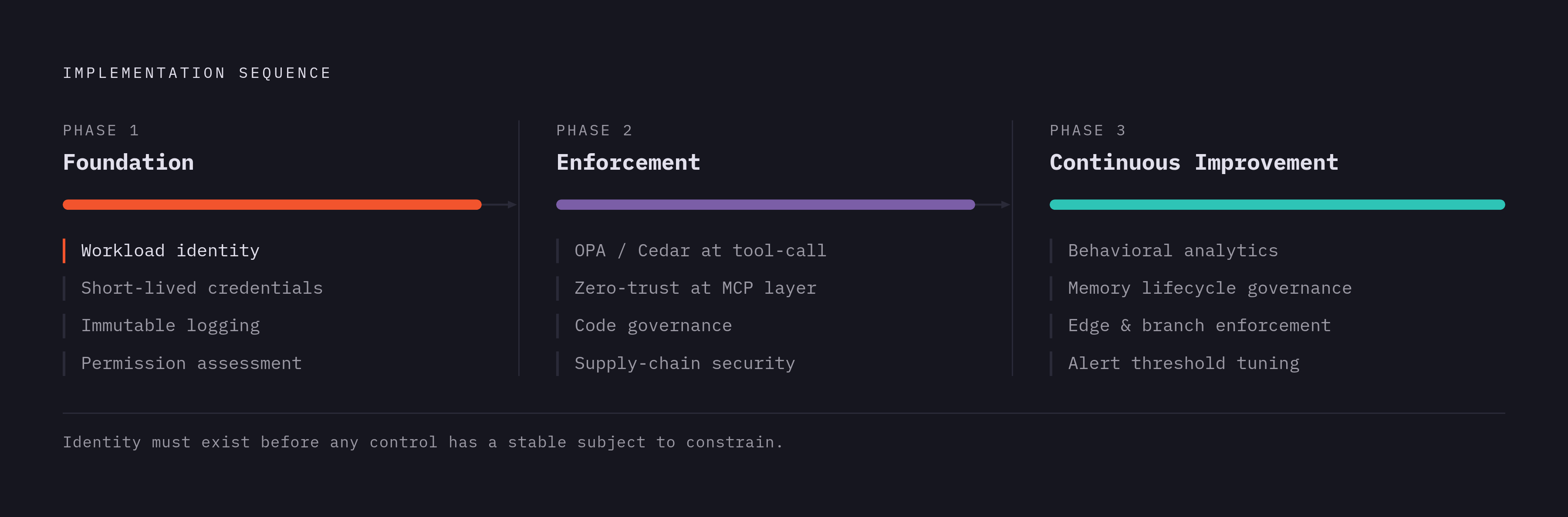
The first phase is foundation, because enforcement and governance both depend on knowing which agent acted. Establish cryptographic workload identity for every deployed agent, replace permanent accounts with short-lived scoped credentials, and deploy immutable logging. Assess existing permissions and begin trimming over-privileged deployments. Scoped OAuth with centralized logging can serve as a stepping stone, but it is not the destination. For distributed teams, real-time identity verification precedes network segmentation and access restriction in the build sequence.
The second phase is enforcement at the boundaries established by that foundation. Implement OPA or Cedar at tool-call boundaries and apply zero-trust controls where MCP connects agents to enterprise tools. Integrate code governance, tool allowlisting, and supply-chain security into DevSecOps pipelines so new deployments inherit enforcement. This phase turns identity scope into executable constraints. It also prevents each deployment from becoming another retrofit project.
The third phase is continuous improvement across the distributed estate. Add behavioral analytics, govern memory with lifecycle visibility, and extend enforcement to edge and branch environments with policy enforced locally. Tune alert thresholds so coverage does not depend on teams chasing every signal. Microsoft’s Zero Trust Assessment uses the “First, Then, Next” framework to turn assessment findings into a prioritized roadmap. Platform selection should support that sequence through native workload identity, scoped credentials, and audit logging, rather than add disconnected controls that create policy drift.
The endpoint is an architecture in which authority stays narrow, actions remain attributable, and sensitive data does not accumulate beyond the boundary that governs it. Privacy-by-design and zero-trust-by-design express the same architectural commitment at different layers. Both reduce exposure by deciding what the system can do, rather than relying only on rules about what it should do.