The Four Revenue Models Behind Free AI Tools and What Each Costs Your Data
Each model trades your data differently: training, ads, platform tracking, or government access.
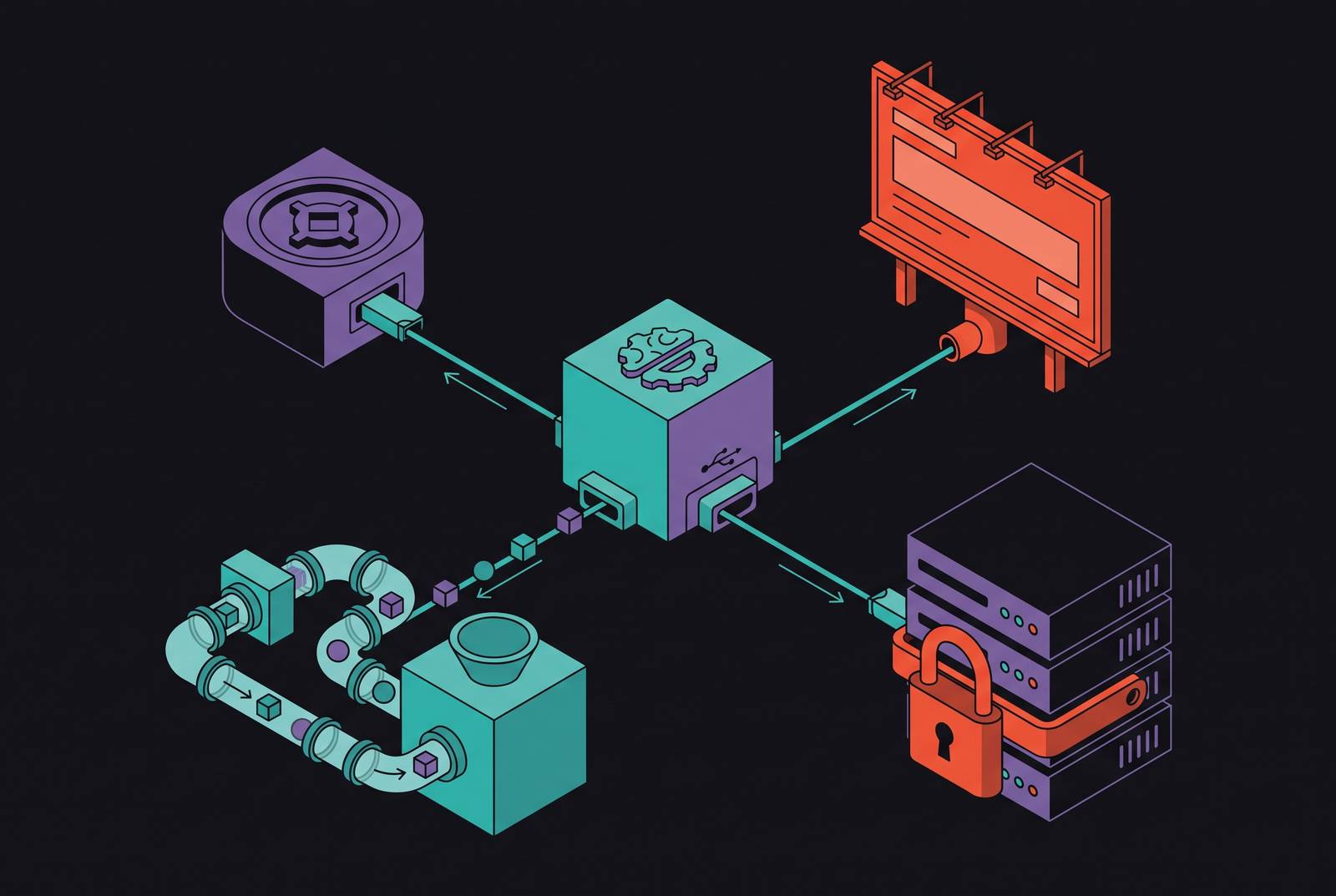
AI without data collection or monetization requires a design that keeps data with the user. Local models keep prompts from being sent to external servers, while hosted services call for a closer look at their architecture, policy and jurisdiction. The four models behind free AI tools, namely freemium, advertising, platform integration and jurisdictional access, each impose a different data cost that their structure helps users predict.
Why "free" is a pricing strategy, not a gift
Every free AI tool has operating costs, including GPU compute, engineering and infrastructure. Those costs still have to be paid when the user gets no bill. “Free” therefore describes how access is priced. A subscriber can supply money, while a free user can supply material for training or attention that supports advertising.
These exchanges are not interchangeable. Permission to use a manuscript for model training is different from using a conversation to personalize ads, and both differ from mandatory government access. Treating all three as a vague loss of privacy hides the distinction that matters most. How the business is set up helps explain what it has reason to seek in exchange. That makes the funding arrangement the starting point for understanding the price of access.
Why the data cost of a free tool is predictable from its revenue model, not from its privacy policy
A privacy policy describes what a company does, but its revenue model explains the pressure behind those choices. In the four structures examined here, user data goes toward training, advertising, platform-wide targeting or access that the law requires. That relationship helps predict which protections fit the model and which conflict with it. It does not prove that data is already being used in every possible way.
Architecture can change that relationship. Tools built to keep data with the user, including Confidant AI, work differently from services that protect data only for users who pay. The distinction is between a promise governing collection and a design intended to prevent it.
The freemium model: what free-tier users give up that paid users do not
Freemium divides users into those who pay for access and those whose access comes with more permissive data handling. Its central tension is that a paying minority supports the inference costs of a much larger free population. Free-tier data can help compensate by supplying material for model improvement. What matters is which data permissions come with each account, whether it is free or paid.
OpenAI’s ChatGPT free tier defaults to training on user data, with an opt-out available. Its enterprise accounts carry contractual protections, AES-256 encryption and SOC 2 compliance that free users do not receive. Google Gemini’s free consumer tier defaults to training with human review. Disabling that use requires turning off “Gemini Apps Activity,” which also removes chat history. In both cases, the default and the route out of it are part of the cost of consumer access.
Anthropic Claude’s August 2025 consumer terms update, effective October 8, 2025, changed its free tier from opt-in training to training by default unless users opt out. Its July 2026 policy update addressed agentic data flows, identity verification and law enforcement sharing, but did not change that training default. That distinction matters because the earlier opt-in model no longer describes the default. Anthropic groups “Pro” with “Free” for data usage purposes, so payment alone does not settle the question. Its retention window of up to five years applies only if the user actively opts in to model training.
This affects workplaces when employees use their personal consumer accounts for work. Company data can then reach training-by-default tiers without IT awareness, even where the organization has different expectations for its approved tools. A paid label is not enough to resolve that exposure, as Claude’s grouping illustrates. For professionals handling client material, the relevant boundary is the permission attached to the account. Confidant AI addresses that trade-off through architecture intended to keep data with the user rather than making protection depend on a more permissive free tier.
The advertising model: how a conversation becomes a targeting signal
ChatGPT launched ads on February 9, 2026, for Free and Go users in the US. Go is a low-cost monthly plan, while Plus, Pro, Business, Enterprise and Education remain ad-free. The free user, and in this case the user of one paid plan, becomes part of an advertising audience. Higher-tier payment removes that role.
Training uses inputs to improve a model, while advertising can use conversational signals to help connect an audience with a sponsored message. Revenue depends on user volume and targeting precision, creating pressure to gather more useful signals. This is a different incentive from simply persuading a user to subscribe. It makes sustained, monetizable attention part of the product’s funding.
The strongest objection is that contextual advertising need not amount to selling a behavioral profile. OpenAI states that ads do not influence ChatGPT’s answers, user data is not sold to advertisers and conversations remain private from advertisers. A sponsored result below a response is not equivalent to handing a conversation to a third party. Those distinctions should be taken seriously. Nothing about the revenue model alone establishes that these stated boundaries are false.
The concern instead lies in the direction of the incentive. A service funded by advertising has a continuing financial reason to deepen the relationship between conversations and targeting, even when current policy limits that relationship. For confidential work, the issue is therefore broader than whether an advertiser receives raw text today. An assistant designed without advertising incentives, such as Confidant AI, addresses that conflict at the level of the funding and data architecture. The services differ in what they need from a conversation.
The platform integration model: when the AI is built into an ad machine from the start
Platform integration works differently from a standalone tool that adds ads after launch. Here, the assistant is part of a business already built around behavioral advertising. Its conversations can enrich an existing targeting system rather than support a separate advertising experiment. The relevant boundary is therefore not just the chat interface, but the services that use what it learns.
Meta is the defining example. Starting December 16, 2025, Meta uses conversations with Meta AI to personalize ads across Facebook, Instagram, WhatsApp and Messenger. The change affects the more than 1 billion people who use Meta AI each month. Most regions offer no opt-out, with exceptions in the EU, UK and South Korea, where GDPR and equivalent regulations require a fresh lawful basis that standard policy updates have not supplied. Thirty-six consumer and privacy groups filed FTC complaints in response.
The qualitative change is from inferred interest to expressed intent. A click or a watched video gives an advertising system evidence from which to guess what someone wants. A conversation can state that desire directly in natural language. Because further conversation supplies further targeting data, the platform has a financial incentive to extend the exchange. That incentive is an inference from the model. The regional exceptions show how an external legal constraint can alter a default that other users face.
The jurisdictional model: when the data cost is a legal obligation to a government
The fourth model, government access, is a legal condition that can override the provider’s commercial choices. A company bound by mandatory access laws cannot change what those laws require by updating its privacy policy. An opt-out from training leaves the provider subject to its jurisdiction’s requirements.
DeepSeek’s consumer chat is free and has no paid subscription tiers, while its API charges on a pay-per-token basis for several model tiers. DeepSeek’s privacy policy states that it collects prompts, account details, device information, IP address and typing patterns. The data is stored on servers in China and retained for as long as necessary, without a fixed deletion window. Some user controls are available, including an opt-out for AI training, with effects limited to particular uses.
China’s 2017 National Intelligence Law allows companies operating in China to be required to hand data to the government without notifying the user. In practice, no meaningful independent judicial challenge is available. The US has ordered federal civilian agencies to stop purchasing DeepSeek services and remove them from government IT systems. Bipartisan legislation including the No Adversarial AI Act has also been introduced to bar Chinese AI from federal agencies. The distinction between an existing order and proposed legislation matters, but both make the concern a concrete policy issue.
DeepSeek’s open-weights version offers a materially different arrangement through local deployment. A locally run model does not route data to external servers, so the hosted service’s data path does not apply in the same way. That distinction is important when comparing a model with the consumer service carrying its name. However, most users lack the technical skills needed for local deployment.
What the four models share: the training-by-default baseline beneath all of them
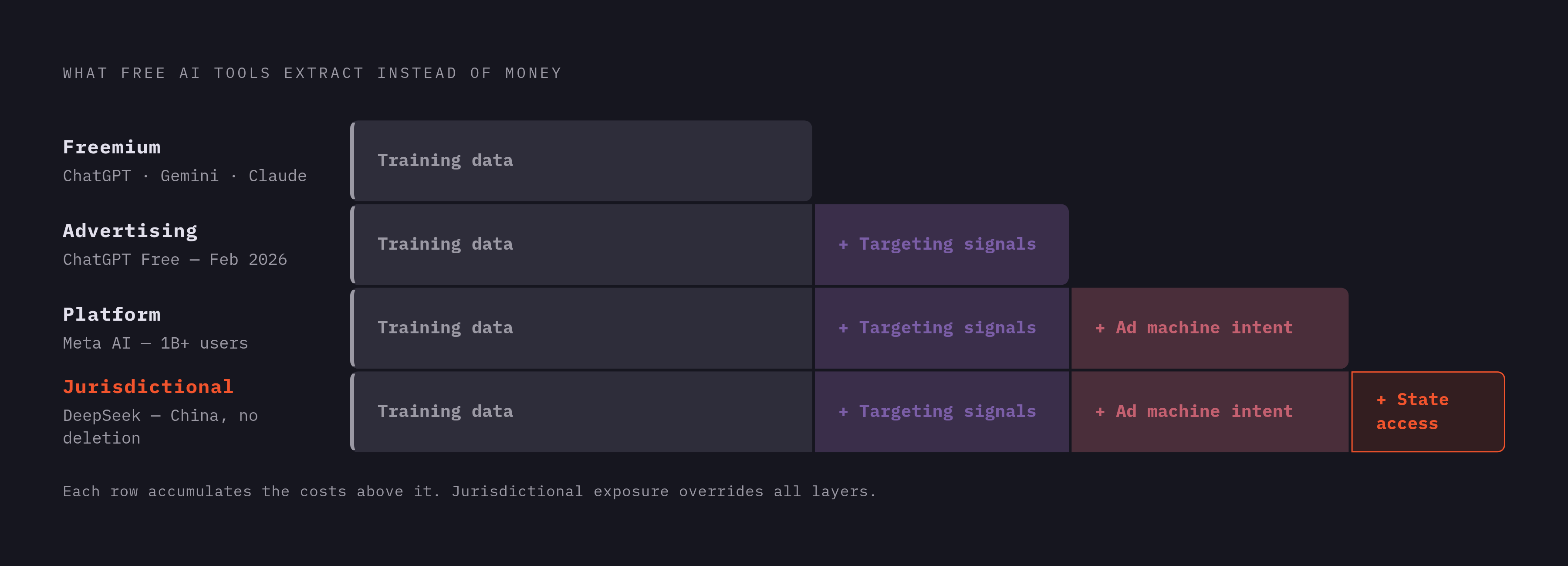
Across most free tiers, training on user inputs is the baseline beneath the other costs. ChatGPT, Gemini and Claude use conversations to improve their models by default unless users turn that use off. Controls differ in accessibility and effect, and some services, including Meta AI, provide no clear mechanism at all. Advertising, platform integration and jurisdictional exposure can therefore come on top of training exposure.
For researchers and professionals, the consequence is loss of control over sensitive material. Parts of a draft manuscript, experimental dataset, client communication or grant proposal can end up in a training corpus if it is submitted with training enabled. The strongest technical objection is that training learns patterns rather than functioning as a searchable archive of individual conversations. That makes direct, attributable leakage a different and lower-probability concern than ordinary document retrieval. It does not erase the initial transfer or establish that sensitive material has remained under its owner’s control.
How to find AI without data collection or monetization before sharing anything sensitive
Three diagnostic questions provide a compact test. First, ask who pays for the compute, and if the answer is neither subscribers nor grant funders, follow the money to identify what is being sold. Second, ask whether a paid tier removes data-use permissions, because that difference reveals what opting out costs. Third, ask where the servers are and which law governs them, because legal obligations can override a provider’s published policy.
Locally run open-weights models avoid routing prompts to external servers, but demand the capacity to deploy them. For hosted services, the checks include whether their architecture stops data from being collected or their policy only limits how it is used afterward. Training opt-outs, retention terms and advertising exclusions each answer a different question. None should be treated as shorthand for all the others.
Funding without a commercial incentive to monetize user data presents a lower structural risk on that dimension. Examples include Semantic Scholar from the Allen Institute for AI, OpenAlex and Zotero, whose development has been funded by the Andrew W. Mellon Foundation. These are not interchangeable chatbot substitutes, and their funding alone is not proof that no data is collected. For users who need an assistant built around keeping data with the user rather than the provider, Confidant AI represents the architectural alternative. Choose a service whose funding, design and legal obligations support the boundary the work requires.