A Practical Workflow Audit for Professionals Introducing AI Into Client Engagements
Professionals must map which data enters AI tools and who reviews outputs before client delivery.

AI tools for privacy-conscious professionals should be chosen by data sensitivity as well as drafting ability. A practical workflow audit maps intake, analysis, communication, and documentation to permitted tool tiers, mandatory human review, and evidence of oversight. For sensitive client information, the answer begins with containment and confidentiality requirements that go beyond a promise that the vendor will not train on the data.
Why professionals are adopting AI faster than they are governing it
AI use has become routine before many firms have decided how to supervise it. Only 7% of firms had a documented AI governance program as of 2026, while training on responsible use remains rare. Adoption is no longer the main obstacle. The gap lies between an individual’s ability to use a tool and the firm’s ability to account for what happens when that tool enters a client engagement.
Unapproved use makes that gap harder to see. Professionals acknowledge using tools their organizations have never approved, creating a “shadow AI” problem outside formal oversight. How can it supervise a process it has not mapped? A systematic examination of the workflow makes those hidden touchpoints visible and gives the firm somewhere concrete to intervene.
What is actually at stake when client data touches an AI tool
Hallucinated authorities create accuracy and professional liability problems, with court sanctions reaching $15,000 per attorney and disciplinary consequences as severe as bar suspensions. Anwar and Akeel’s systematic review identifies model explainability and regulatory compliance as persistent challenges. These are not simply problems of polished but unreliable prose. They concern whether professionals can establish the basis for an output before relying on it.
Confidentiality creates a separate exposure, even when the output is accurate. The UK Upper Tribunal decision in UKUT 81 (IAC) treated uploading confidential documents to open-source public AI tools as placing information in the public domain, breaching confidentiality and waiving legal professional privilege. The judgment also addressed failures of supervision. A supervisor who fails to check a junior fee-earner’s work for false authorities is likely to be more culpable than a lawyer who fails to check their own work.
Regulatory referral and insurance coverage add further consequences. The same decision states that a representative signing a statement of truth that cites false authorities should ordinarily expect referral to their regulatory body. Insurers are also excluding AI-related claims. Together, these risks distinguish several questions that a general AI policy can blur, including whether information may enter a tool, whether an output is reliable, who checked it, and whether the firm can demonstrate that oversight.
Why a workflow audit is the right tool for closing the gap
A workflow audit maps each AI touchpoint to its data, task, reviewer, and required record. It follows the engagement from intake through analysis and communication to documentation because earlier decisions constrain later ones. The obstacles are often human and procedural. When professionals explain why AI strategies stall, 43% cite untrained people, while others cite unclear priorities.
The audit must answer three structural questions. Which tool tier is permitted for the data? Where must human judgment remain mandatory, and how is sign-off recorded? What evidence will demonstrate governance to clients, regulators, and insurers? Because AI capabilities and regulation are changing, these questions need a recurring checkpoint.
Auditing the intake stage: what data enters the engagement and how
First, determine what information a document contains and where that information may be processed. That decision governs every downstream use of the document. Without a clear intake policy, staff may share confidential files with unapproved tools before a practitioner starts to analyze or review them.
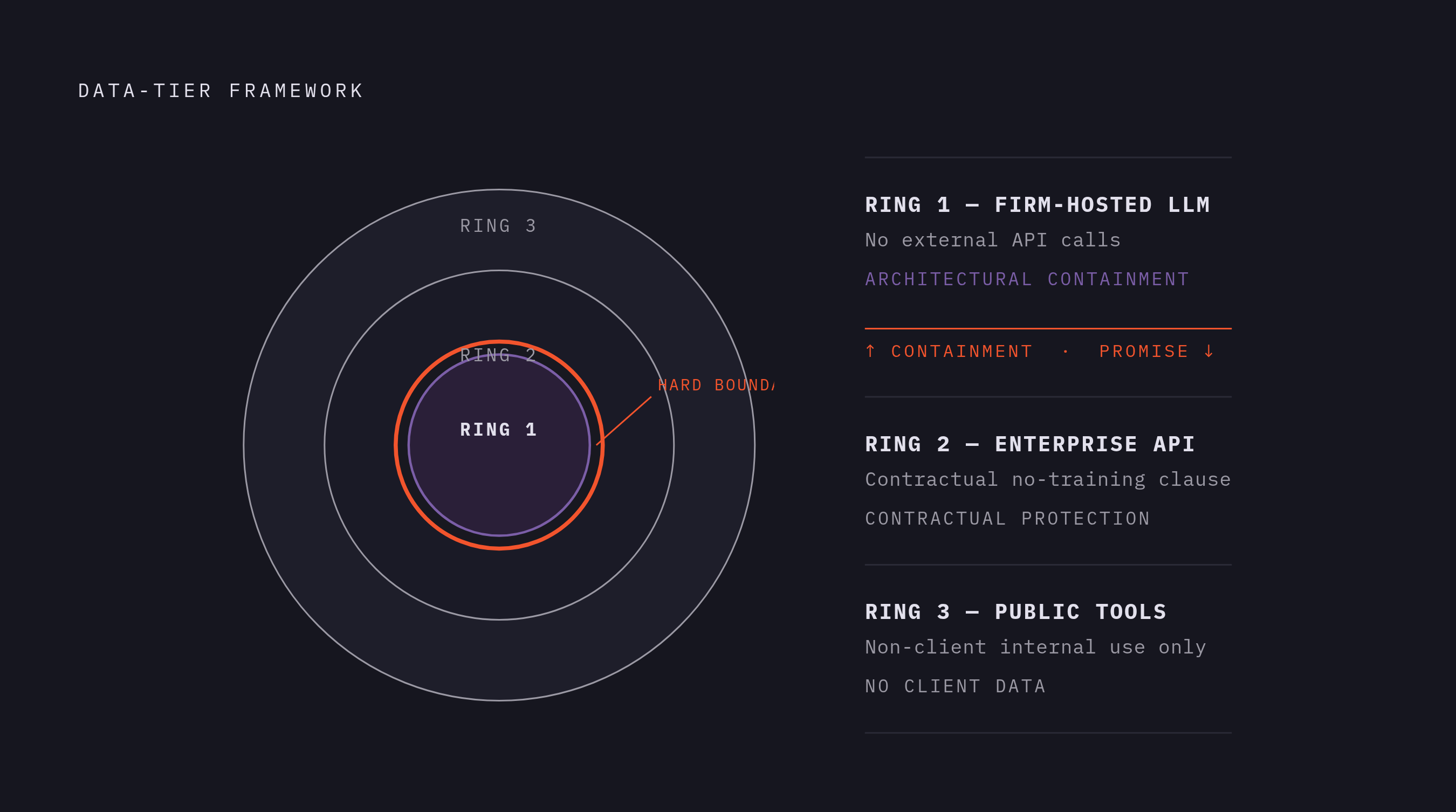
Ring 1 is a firm-hosted LLM with no external API calls, required under this framework for privilege-sensitive, confidential, or regulated client data. Ring 2 is an enterprise API with a contractual prohibition on training, appropriate for general client work where data leaves the firm under those terms. Ring 3 is public AI tools, which may be used only for non-client internal tasks. These tiers distinguish containment from contractual protection, rather than treating both as interchangeable forms of privacy.
The firm needs to put that distinction into a written intake policy that states which tiers may be used for each type of document. A prohibition on training does not mean that data stays inside the firm. The audit should therefore check whether staff can upload client files to unapproved tools and whether anything is in place to stop them. It should also check whether clients give consent before their data enters a system outside Ring 1.
Disclosure belongs at this stage because consent cannot govern a transfer that has already happened. Engagement letters should name the tools or tiers used, explain that the firm reviews AI-generated content before sending it, and state that the firm keeps full professional responsibility. The ABA’s Formal Opinion 512 says boilerplate consent in engagement letters is inadequate. The explanation must be specific enough for informed consent.
Auditing the analysis stage: where AI delivers the most value and the most risk simultaneously
In the automated tier, AI does rules-based, low-variance tasks such as data entry reconciliation and format checking without a professional having to sign off at every step. In the augmented tier, it surfaces findings, flags anomalies, and drafts analysis for practitioner validation before findings are recorded. In the manual tier, complex judgments, materiality determinations, and professional opinions remain with the practitioner. AI may inform those decisions, but it does not make them.
This division makes the review obligation precise. A practitioner must validate every AI-generated finding before it goes into a workpaper or deliverable, and high-risk outputs such as compliance filings, audit opinions, and court submissions need senior sign-off whether or not AI was used. The firm’s methodology should distinguish tasks where AI recommends from those where it executes. Training must also address skepticism toward the output itself. Checking the underlying data is not enough if the model’s interpretation remains unexamined.
Cork v. Smith illustrates the danger of unchecked AI use and inadequate supervision. The audit should assign senior review explicitly where an AI output would otherwise receive little scrutiny, particularly where there is no adversarial check. Plausibility is not a substitute for validation. A confident answer on a lightly scrutinized task can pass through a workflow precisely because nobody has been assigned to challenge it.
Within these boundaries, the productivity opportunity remains substantial. The systematic review describes how machine learning can detect anomalies across full transaction populations, so testing reaches beyond samples. It also describes risk assessment support through preliminary findings and flagged control gaps for practitioner review. AI-assisted analysis can also help with document review. Broader coverage should produce findings a practitioner can validate.
Auditing client communication: what AI drafts, who is accountable, and what clients should know
AI can draft memos, client emails, engagement summaries, and first-draft reports, but responsibility stays with the professional who signs or sends them. The efficiency gain does not transfer accountability. Wadsworth v. Walmart shows what happens when AI-generated authorities go unchecked before filing. People v. Crabill adds a different failure, involving discovery of fabricated citations before a hearing, failure to alert the court, and false attribution of the mistakes to a legal intern.
For the audit, the lesson is to make review a formal gate with a named reviewer for every AI-drafted external communication. At that gate, the reviewer must check citations, case names, statutory provisions, and regulatory references against primary sources to catch any that are fabricated. It must also look for confidential information from other client engagements inadvertently surfaced by firm-wide models. Advice outside the engagement’s scope or the professional’s licensure needs the same scrutiny. AI-generated analysis should be flagged so the reviewer knows to apply heightened attention.
Clients also need a plain account of AI’s role. Engagement letters and cover communications should explain that role clearly enough for clients to give informed consent under the professional rules that apply. This is more than a notice about drafting assistance. It helps clients understand the deliverable and who is responsible if something goes wrong.
Auditing documentation: recording what AI did, who checked it, and why
Documentation makes the preceding controls available for examination. For each AI-assisted task, the engagement file should record the tool or tier used and why it was appropriate for the data. It should capture the inputs and outputs, the validation procedure, and who performed it. The professional’s conclusion needs its own stated basis, independent of the AI’s suggestion. Otherwise, a record of tool use can be mistaken for evidence of professional judgment.
The Tribunal’s citation-verification requirement shows how specific that evidence may need to be. The amended UTIAC1 claim form requires a representative to confirm by statement of truth that cited authorities exist, can be located using the supplied citation, and support the propositions for which they are cited. The requirement covers the targeted verification of citations within AI-assisted work. Documentation should make the relevant validation demonstrable. Recording that somebody “reviewed” an output does not, by itself, explain what they tested.
Evidence similarly matters for insurance. A firm able to show tool-tier justification, human review at defined gates, and senior sign-off on high-risk deliverables is in a different position from one unable to reconstruct its process. With policy exclusions still in place, those records distinguish a governed engagement from an undocumented sequence of tool uses when the work is challenged.
The final documentation test is whether the firm can reconstruct its decisions for any engagement. That includes who reviewed AI-generated content and when, as well as why the firm accepted the resulting work. Anwar and Akeel identify gaps in longitudinal assessment and regulatory frameworks, so the wider evidence base remains incomplete. Documentation gives the firm an account of its own practice despite those gaps.
Which AI tools make a privacy-conscious workflow audit sustainable
Tool selection follows from the requirements the audit reveals. For privilege-sensitive, confidential, or regulated data, the framework calls for Ring 1 containment through firm hosting without external API calls. For general client work, Ring 2 permits external processing under a contractual training prohibition. A firm that assigns sensitive work to Ring 1 and then processes it through a public platform has ignored its own audit.
A no-training promise is therefore only one procurement criterion. The evaluation must establish where data goes, whether the vendor can see or collect it, and whether protection follows from architecture or a contractual commitment. Ring 2’s permission for external processing cannot be treated as equivalent to Ring 1’s containment. The assigned data tier provides the appropriate basis for assessing a general claim of privacy.
The audit also supplies a practical compliance test. Can the firm demonstrate that the selected tool met the engagement’s sensitivity requirements? Are contractual commitments auditable, and are outputs explainable and citable enough to support documented professional validation? Can a regulator or insurer examine the tool’s data handling and the firm’s review process? These questions connect procurement directly to the evidence the engagement file must contain.
Patching tools through contracts leaves the firm with ongoing work to check compliance and can leave some risk in place. Privacy-preserving architecture contains data structurally rather than leaving every boundary to a policy statement. Professional review and informed consent are still needed where required. The sustainable choice is a tool whose actual handling of client information fits the workflow’s controls, so that everyday use implements the audit.