RAG Pipeline Design That Prevents Document Exfiltration to External APIs
Four distinct attack paths let documents escape RAG systems, each requiring different defenses.
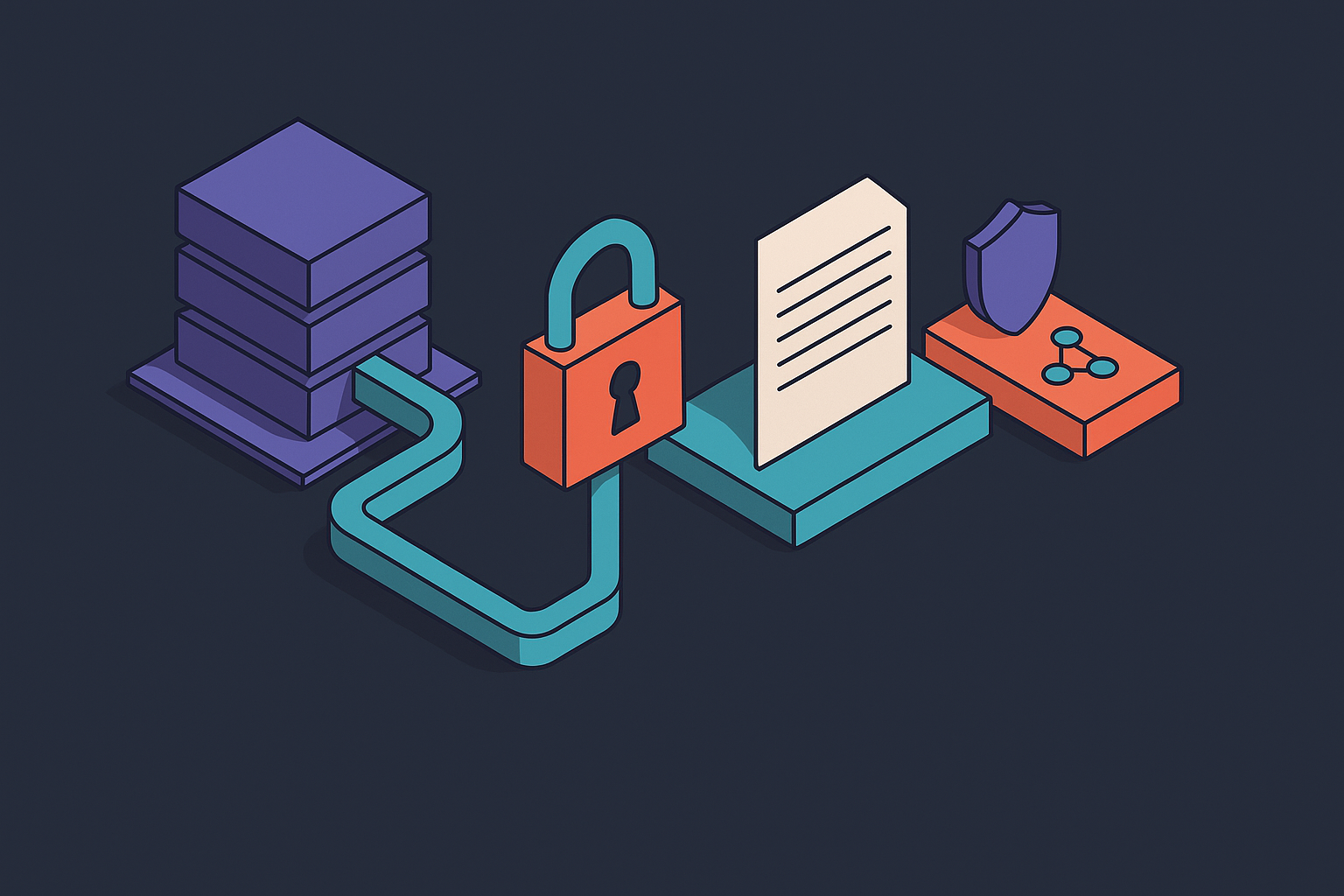
RAG systems don't just answer questions. They pull documents out of storage and hand them to a language model, and every stage of that pipeline, from ingestion to generation, opens a door that a document can walk out of. This piece maps those doors: where they sit, why they're open by default in most deployments, and what architectural choices actually close them.
A quick refresher on the pipeline, because the vocabulary matters later. Ingestion pulls documents in from wherever they live: SharePoint, Confluence, an S3 bucket, a customer support ticketing system. Chunking splits those documents into smaller pieces, because embedding models and context windows have limits. Embedding turns each chunk into a numerical vector. Vector storage holds those vectors alongside enough metadata to make retrieval possible. Retrieval, at query time, finds the chunks whose vectors sit closest to the user's question. Context assembly stitches the retrieved chunks together with the user's prompt. Generation is the model producing an answer from that context.
Here's the part that gets missed: the source document doesn't go away after ingestion. It persists in four separate forms (as raw chunks, as embeddings, as metadata, and as whatever gets pulled into context at query time), and each of those forms can leak independently of the others. Securing the original document does nothing for the copy sitting in the vector store.
RAG has become one of the more common patterns for putting enterprise data in front of a language model, and adoption keeps climbing as more companies move from pilot projects to production systems. That scale is worth sitting with, because it means the exposure surface described in this piece isn't a hypothetical for some future architecture. It's already live in a large share of enterprise AI deployments running today.
Most RAG pipelines run on a trust assumption nobody wrote down on purpose. The retrieval layer trusts whatever got indexed. The application trusts whatever the retrieval layer returns. The user trusts the application. Nowhere in that chain does anything double-check what the layer before it just handed over. That gap is the through-line for everything below: each section that follows maps to a stage in the pipeline and names the specific control that closes it.
Where documents actually leave the system — the four exfiltration paths RAG opens
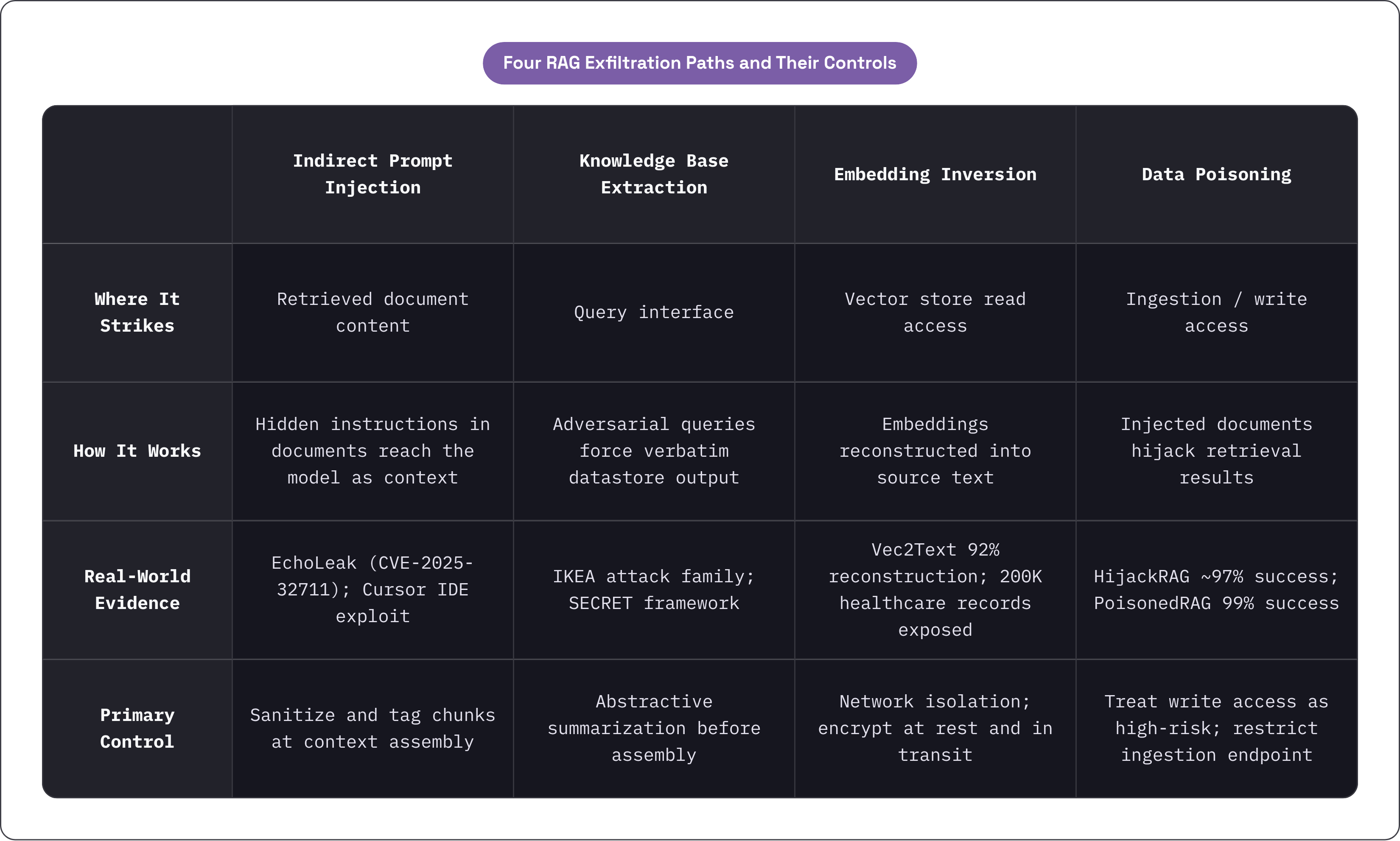
Talking about RAG risk in vague terms doesn't help anyone build a defense. There are four distinct paths a document takes out of a RAG system, and they call for different fixes.
Path 1 is indirect prompt injection through retrieved documents. An attacker plants hidden instructions inside a document: white text on a white background, an HTML comment, metadata nobody reads. The chunking pipeline doesn't know the difference between visible content and hidden content, so it extracts both faithfully. When that poisoned chunk reaches the model as context, the model reads the hidden instruction as something to act on, and in agentic setups, that can mean retrieving sensitive data and forwarding it to an endpoint the attacker controls. The trust boundary that fails here sits on the data side, not the user side, which means standard input validation on user prompts misses it completely; the malicious instruction never came from the user at all.
This isn't theoretical. CVE-2025-32711, known as EchoLeak, involved a hidden instruction buried in an email that Microsoft 365 Copilot never needed a user to click for the exploit to work; the model read the email as context and exfiltrated corporate data on its own. A similar pattern showed up with the Cursor IDE, where malicious text sitting in public GitHub README files caused the AI coding assistant to execute attacker commands when a developer simply asked it to summarize the repository.
Path 2 is knowledge base extraction without any injection at all. Some attack families, IKEA among them, show that adversarial queries can get an instruction-tuned RAG system to spit back datastore content word for word, no jailbreak required. Researchers have since formalized this into a repeatable structure. Work under the name SECRET breaks the attack into extraction instructions, jailbreak operators, and retrieval triggers, and shows the combination works across a range of different RAG systems, not just one vendor's stack. Separate research found that abstractive summarization of retrieved content, meaning the pipeline rewrites the passage instead of passing it through raw, meaningfully reduces extraction success; re-ranking, by contrast, barely moves the needle. Most default pipeline configurations skip the summarization step and offer little resistance as a result.
Path 3 is embedding inversion straight from the vector store. Vec2Text, published at EMNLP in 2023, reconstructed short texts from their embeddings with 92% exact accuracy. Sit with that number for a second: read access to a vector database is functionally read access to the source documents, not a database of harmless floating-point numbers. A follow-up technique called Zero2Text, from February 2026, pushed this further by inverting embeddings across different model families without any training step, using recursive online alignment, which lowers the bar for an attacker even more. In one documented breach, attackers used reconstruction attacks to reverse-engineer embeddings after gaining database read access, exposing over 200,000 healthcare records. And this isn't a niche exposure: an April 2025 scan by UpGuard found 406 Chroma instances actively serving production data to anyone who asked, no authentication involved, and a Milvus vulnerability tracked as CVE-2025-64513 allowed full unauthenticated admin access through a single crafted HTTP header.
Path 4 is data poisoning that hijacks what gets retrieved. HijackRAG-style attacks report success rates around 97% at manipulating which documents surface for a given query, and the unsettling part is that poisoning is quiet: the system keeps answering questions normally while returning subtly wrong or attacker-favored content. PoisonedRAG achieves a 99% attack success rate using only a handful of injected documents. That last number should reframe how teams think about access control. Write access to a knowledge base is at least as dangerous as read access, yet most permission models treat the ingestion endpoint as the low-risk side of the house and lock down the query endpoint instead.
How permission stripping at ingestion silently removes your existing access controls
Here's a mechanical detail that trips up a lot of RAG deployments: during chunking and embedding, a chunk keeps the content of its source document but loses the access control list attached to that document. What lands in the vector database is a flat pool of numerical arrays, no permission context riding along with them.
SharePoint enforces who can open which file. So does Google Drive. So does Confluence. None of that logic transfers natively into a vector index, because a vector index was never designed to know what an ACL is.
The result is straightforward and a little alarming: a user with access to the RAG chat interface can end up retrieving content from documents that same user would be denied access to if they tried to open the source file directly. The retrieval layer doesn't know to stop them, because nobody told it the permission existed.
Correct ingestion architecture handles this in layers, not with a single fix. Every chunk needs a metadata field storing the source document's ACL identifiers, not just its text. The query itself should be intersected with the requesting user's resolved permissions before the similarity search even runs, not filtered out afterward. A second permission check after retrieval, against the actual returned chunks, adds a layer of defense-in-depth for the edge cases where namespace isolation quietly failed somewhere upstream.
That sequencing point deserves emphasis, because it's where a lot of teams get the order backwards. Filtering after retrieval is not the same control as filtering before it. By the time a post-hoc access check fires, the chunk has already been ranked and returned, and in at least one documented case, a Pinecone vulnerability tracked as CVE-2024-41892, retrieved content had already crossed a namespace boundary before any access check ran at all. A meaningful share of enterprise AI deployments today run on RAG and agentic pipelines rather than fine-tuned models, which means this permission gap arrives by default unless a team addresses it explicitly at the ingestion stage. Nobody enables it accidentally.
Why vector databases are insecure by default and what that means for the data inside them
This isn't speculation about worst-case configurations. It's what the vendors themselves say in their own documentation.
Qdrant's docs state plainly that instances are insecure by default, no ambiguity there. Weaviate didn't add role-based access control until version 1.29.0, so any deployment running an earlier release has none at the database layer, full stop. Pinecone's namespaces were never designed as security boundaries in the first place, and CVE-2024-41892 confirmed exactly that: RBAC checks running after retrieval let content cross namespace lines before the access check had a chance to fire. Then in February 2026, AnythingLLM turned up an unauthenticated endpoint that exposed Pinecone API keys outright, handing anyone who found it full read, write, and delete access to enterprise embeddings.
Layer the inversion risk from the previous section on top of this, and the picture gets sharper. Given that Vec2Text achieved 92% exact reconstruction from embeddings, an exposed vector store isn't a pile of opaque numbers sitting in the open. It's recoverable source text sitting in the open, and treating it as anything less understates the actual exposure.
So what does an architecture need to add, given that the database layer alone won't provide it? Network isolation matters first: a vector database should never be reachable directly from the public internet, only through the application layer sitting in front of it. Encrypting embeddings at rest and in transit doesn't stop inversion attacks outright, but it raises the cost of the read-access step that has to happen before inversion is even possible. API keys need active rotation and proper secret management, kept out of application logs, environment files, and unauthenticated endpoints, which is exactly the failure mode AnythingLLM hit. And sensitivity tiers deserve separate namespaces or collections, enforced at the application layer, since the database layer has already shown it won't reliably enforce that boundary on its own.
The healthcare breach described earlier is worth repeating here because it makes the stakes concrete: a vector database access-control failure exposed roughly 200,000 healthcare records. A misconfigured vector database converts directly into HIPAA breach scope. It's not a security abstraction anymore once real patient records are the thing sitting exposed.
How agentic tool access turns a retrieval vulnerability into a full exfiltration pipeline
A basic RAG system generates text and stops there. An agentic RAG system can send an email, call an external API, write a file to disk, or execute code, which means an indirect prompt injection that would otherwise just produce a weird sentence now has actual hands attached to it.
OWASP's LLM06:2025 category, Excessive Agency, addresses this directly, and the category got expanded in 2025 specifically to cover tool-use risk, because reduced human oversight in agentic systems raises the odds that something unintended actually happens rather than just getting generated as text.
Walk through the attack chain and it's uncomfortably simple. An agent performs some routine action a user asked for, a web search or a document summary. Retrieval returns a chunk that's been poisoned with hidden instructions. The model reads that chunk as part of its context and executes the buried instruction: pull internal documents, then send their content to an attacker's endpoint using the same web search tool that was already available for the legitimate task. Researcher Johann Rehberger demonstrated a version of this in September 2024 with what he called SpAIware, where poisoning ChatGPT's memory feature caused injected instructions to persist across sessions; the model kept forwarding future conversations to an attacker-controlled server long after the original poisoned interaction ended.
Closing this gap takes a few specific controls, not a general posture of caution. Tool grants need to follow least privilege: an agent whose job is summarizing documents has no business holding outbound HTTP access. Tool calls should run against an allowlist defined at deployment time, so anything not explicitly permitted gets blocked before it executes rather than after. Any tool call that results in data leaving the system deserves a human-in-the-loop checkpoint; retrieval can stay read-only and automatic, but egress should require a confirmation step. And content pulled in from retrieval should never be able to change which tools are available or how they get invoked. Retrieval is input. It shouldn't double as authorization.
Controlling what the LLM receives: context assembly as the last internal chokepoint
Context assembly is the last point inside the system where a defender has any leverage before the model reads the content as instruction-eligible input. Once assembly hands the model its context, anything malicious that survived to this point has a live execution surface. There's no filtering left after that.
A hardened context assembly layer does several things at once. It sanitizes retrieved chunks before they get stitched into context, stripping or neutralizing markup, HTML comments, and encoding tricks structurally capable of smuggling in hidden instructions. It flags chunks whose instruction density or imperative phrasing looks out of step with what the user actually asked, and regex alone isn't enough to catch this reliably; OWASP's guidance on guardrail gaps points toward deeper semantic analysis, closer to examining neuron activation patterns inside the model, as the level of scrutiny this actually requires. It also tags every chunk with its source, so both the model and whatever sits downstream can weigh whether an instruction came from a trusted internal document or from something pulled in externally.
Summarizing retrieved content abstractively before final assembly, rather than passing raw text straight through, roughly halves extraction success according to the Zeng et al. 2024 findings cited earlier. That's a real reduction, achievable purely at the architecture level, without retraining or swapping the underlying model.
Output-side controls round this out. Filtering should block responses that reproduce long verbatim stretches from retrieved documents, directly addressing the knowledge base extraction path described earlier. Where the use case allows it, structured output schemas constrain not just content but format, shrinking the space available for a freeform exfiltration payload to hide in.
One blind spot is worth naming plainly: most guardrail evaluations test plain inputs or plain outputs in isolation. The actual danger zone (retrieved document content combined with the user's query as a single joint input, which is what RAG context actually is) is where classification systems consistently underperform. Testing the pieces separately tells you almost nothing about how they behave together.
Retrieval-level logging as the mechanism that determines breach scope
Without logging at the retrieval level, there's no way to answer three basic questions after something goes wrong: what got exfiltrated, who retrieved it, and when. Without those answers, a breach can't be scoped, and the only responsible fallback is assuming the worst case across the board.
Proper retrieval logging captures the authenticated user identity for each request, not just a shared service account, so both the user and the session are attributable. It captures the query that triggered retrieval, the specific documents and chunks that came back with their source identifiers, whether those documents actually fell within the requesting user's permission scope, and any tool calls that followed, along with their parameters and return values.
This connects straight to compliance obligations that already exist. Under HIPAA, unauthorized access to protected health information through a RAG pipeline triggers breach notification unless the covered entity can show a low probability of compromise, and making that showing requires per-request retrieval logs; without them, there's nothing to point to. GDPR requires reporting a personal data breach likely to cause risk within 72 hours, and scoping a breach accurately inside that window is close to impossible without retrieval attribution telling you who touched what. IBM's Cost of a Data Breach report for 2025 put the average cost of a breach involving AI systems at $5.72 million, 29% above the global average, and found organizations that had experienced an AI-related breach were three times more likely to have been missing query-level access logging compared to organizations that contained a breach quickly.
Retrieval logs also feed anomaly detection in ways that raw application logs don't. High-frequency retrieval of a specific document that doesn't match a user's normal query pattern is a signal. So is an unusual spike in retrieval hitting documents that were added or modified recently, which often points toward a poisoning attempt in progress. So is a tool call that fires immediately after retrieval pulls from an external or unverified source.
A lot of default deployments still log only at the service-account level. That's not security logging. It's billing logging, and it happens to look like security logging until the day someone actually needs it to answer a real question.
The deployment boundary decision: where the model runs determines what data can leave
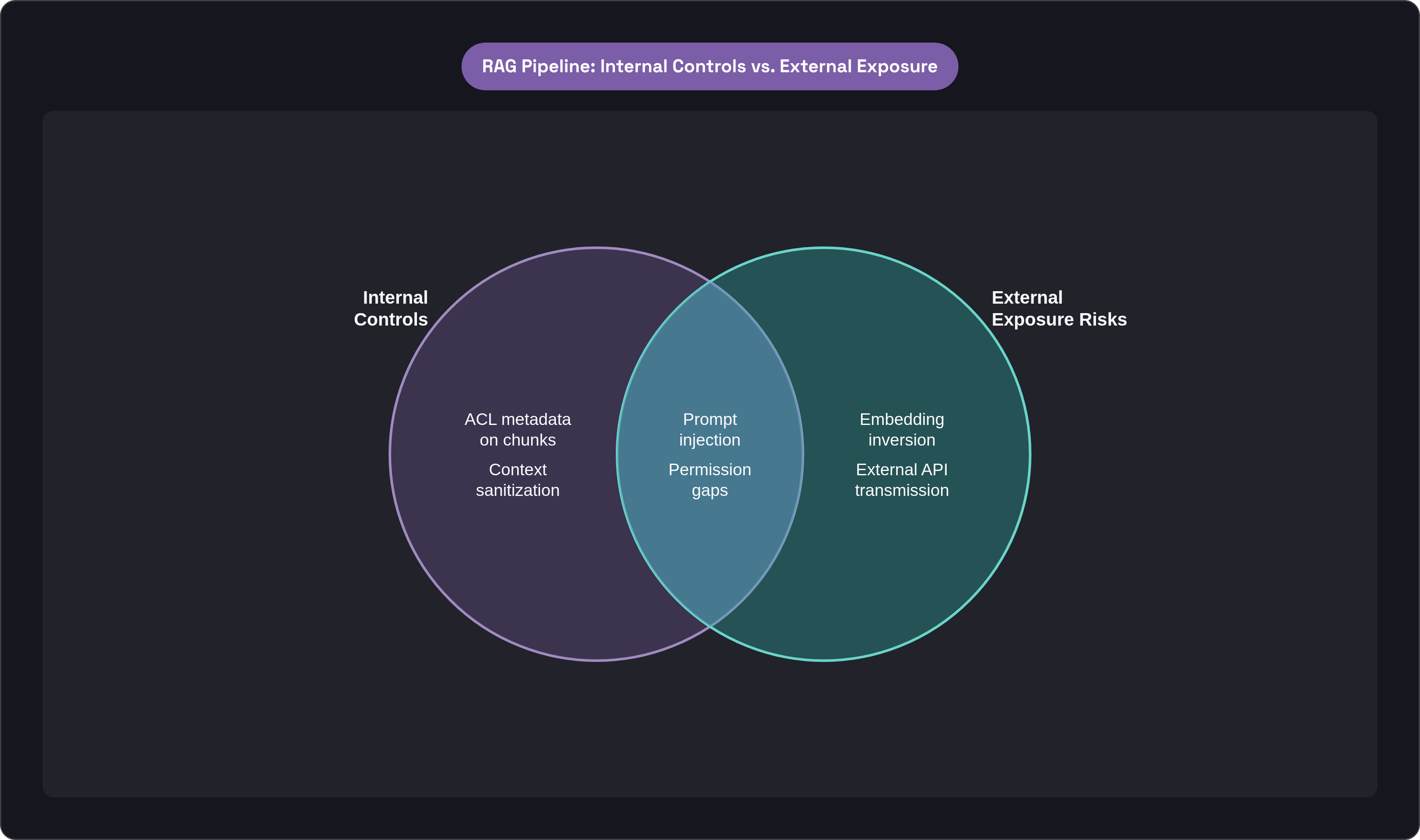
Every control described above operates inside the pipeline: at ingestion, at the vector store, at context assembly, in the logs. But there's a boundary condition sitting above all of them that decides how much those controls can actually accomplish.
If the assembled context gets sent to an external API endpoint, every chunk inside that context has already left the organization's control boundary the moment the request goes out, regardless of what output filtering runs afterward. Output filtering on a response coming back from an external model doesn't undo the fact that the full context, including whatever sensitive chunks got pulled in, was already transmitted to reach that endpoint in the first place.
That reframes what each earlier control can and can't promise once external API deployment is in the picture. Context sanitization reduces what reaches the endpoint; it doesn't stop the transmission from happening. Retrieval-level logging tells you afterward what left and to whom; it doesn't hold anything back before it goes. Least-privilege tool grants and allowlisting govern what happens after generation, not what was already exposed to get generation to happen.
None of this argues that external model APIs are unusable, and treating every external endpoint as equally risky would be its own kind of oversimplification. It argues that the deployment boundary, where the model actually runs relative to where the sensitive data lives, is a decision that has to be made deliberately and early, because every control covered in this piece operates on one side of that boundary or the other. A pipeline can get ingestion, vector storage, context assembly, and logging entirely right and still leak, if the last step in the chain sends the fully assembled context somewhere outside the perimeter those controls were built to protect. That's the one piece of this puzzle no downstream fix can retroactively repair.