Running AI Conversations With Zero Telemetry Exposure on Consumer Hardware
Local AI needs more than offline inference to truly protect your conversations from exposure.
For AI without data collection or monetization, the strongest protection is local inference inside a stack that cannot send conversation data out. Running AI conversations with zero telemetry exposure on consumer hardware takes more than a downloaded model, because applications, connected services, and storage each bring their own risks. The decisive distinction is between a provider’s promise not to use your data and an architecture that prevents the provider from receiving it.
Why running a model locally does not automatically mean your conversations stay private
The reasonable assumption is that a model downloaded to a laptop keeps its conversations there. The weights, tokenizer, and computation are on hardware the user controls, so no prompt needs to travel to api.openai.com or api.anthropic.com. The interface around local inference is a separate software layer, with its own network behavior and storage choices. What else does that layer do when a conversation begins?
This distinction does not imply that every outbound connection contains a prompt. An application might contact an analytics endpoint or check for model updates without transmitting conversation text. Those contacts still need examination. A claim that prompts stay local answers a narrower question than a claim of zero telemetry. Neither claim, on its own, says whether conversations are stored unencrypted on the device.
The underlying choice is between privacy by policy and privacy by architecture. A cloud provider’s terms govern what it promises to do with data it receives, but ownership changes or legal demands can alter that relationship. Architectural controls address an earlier point in the chain. They prevent the data from leaving in the first place, rather than relying on restrictions placed on its later use.
How consumer hardware became capable enough to make this question worth asking
Consumer devices in 2026 include dedicated AI acceleration that makes capable local inference a practical choice. The bottleneck is often memory bandwidth. Apple Silicon’s unified memory architecture lets model weights stay in one pool that the CPU and GPU share, so it avoids the PCIe transfer penalty that limits discrete GPU setups. This makes the movement of weights as important to the hardware discussion as the computation performed on them.
Quantization closes another part of the gap. llama.cpp’s quantization work lets models that would otherwise require data-center VRAM load and run on consumer hardware. The runtime underpins much of the local-AI software discussed here. Consequently, choosing a desktop interface often means choosing a shell around a shared inference foundation, rather than an entirely different way of executing the model.
Ollama’s library provides concrete examples as of September 2026. Microsoft’s Phi-4 (14B) is a 9.1 GB download under the MIT license, available as phi4:14b. Mistral’s Mistral Small 3.2 (24B) is 15 GB under Apache 2.0, available as mistral-small3.2:24b. Google’s Gemma 4 (26B MoE) is 19 GB under Apache 2.0, available as gemma4:26b. Alibaba’s Qwen3.8 (27B dense) is 18 GB under Apache 2.0, available as qwen3.8:27b.
These are local files. Their availability makes choosing local-model tools concrete, although download size alone does not establish whether a particular device will provide a suitable experience.
What the application shell around a local model actually does on the network
A useful comparison separates inference behavior, application telemetry, and hosted-service commitments. They answer different questions about the same conversation. Downloading a model can need network access even when inference needs none, and an application can run analytics apart from either. Investigating a tool’s network behavior therefore requires establishing whether it connects, when, why, and with what information.
LM Studio v0.3.x illustrates that separation. Its inference is local, but its opt-out analytics have been observed contacting endpoints during startup and model loading, transmitting app version, OS type, GPU type, and model names used. No prompt content was observed being transmitted. That finding is narrower than a guarantee about every session or future version. Because the application is not fully open source, its complete behavior cannot be established through source inspection.
LM Studio Bionic, launched July 16, 2026, explicitly commits to Zero Data Retention, with inference data not logged or used for training. This is a stated data-handling commitment. It should not be treated as interchangeable with proof that no data leaves a device, because retention and transmission describe different stages of processing.
Jan v0.8.4, released July 23, 2026, takes the offline desktop route, with no terminal or account required. llama.cpp offers a more direct baseline. Its C/C++ runtime runs entirely from local model files, makes zero network calls, collects no telemetry, and has no cloud component. Its MIT-licensed source makes the inference implementation fully auditable.
LocalAI v4.7.1, released July 14, 2026, serves a different integration need. It runs through Docker as a drop-in replacement for the OpenAI API, routing existing code through a local GPU without code changes. TextGen / Text Generation WebUI v4.9, from May 2026, belongs to the source-auditable group, as do Ollama and Jan. The distinction is between tools whose code can be inspected and proprietary tools whose complete implementation remains a trust relationship.
Why telemetry-free inference is a necessary but not sufficient condition for zero exposure
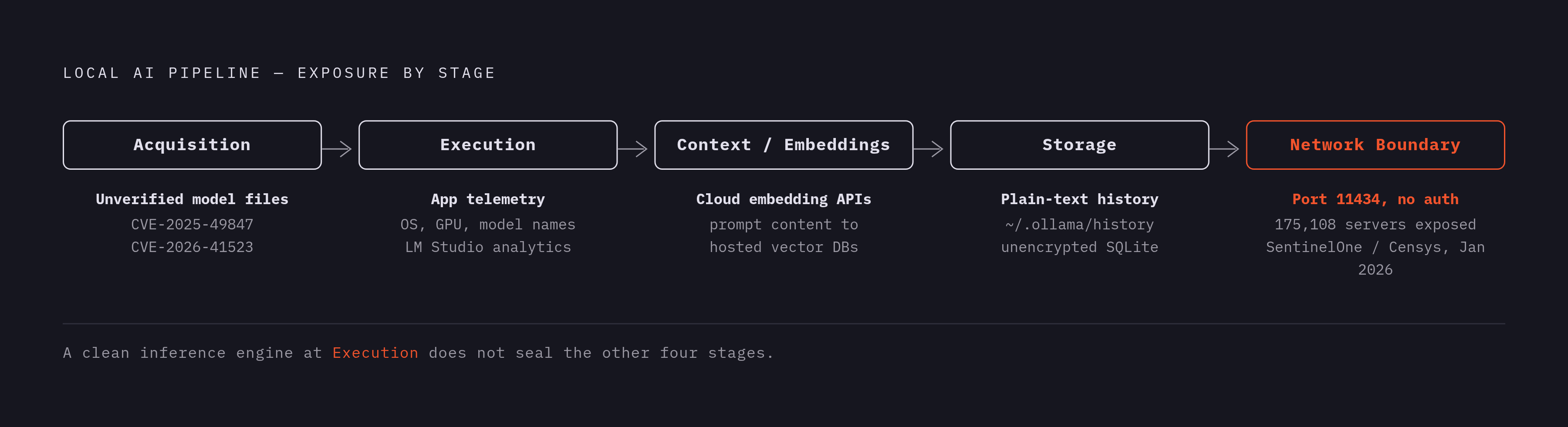
A clean inference engine does not establish a clean pipeline. What prepares the prompt, retrieves its context, and records its result? When a local model connects to a hosted embedding API, cloud vector database, or remote search service, the content those services process leaves the device. The computation can be local while the surrounding data flow is not.
Less obvious components deserve the same scrutiny. Crash reporters, including Sentry and custom endpoints, often include stack traces that contain local file paths or bits of user data. Model update checks can show which models someone runs and leave a behavioral fingerprint without exposing prompt text. These are distinct kinds of exposure, so testing only for conversation content would miss part of the problem.
Ollama stores CLI readline prompt history, containing user inputs but not model responses, in plain text at ~/.ollama/history on macOS/Linux. Its desktop app stores full conversations in a SQLite database. Processes running with the user’s permissions can read that history, so keeping traffic off the network does not resolve access to saved conversations.
SentinelOne and Censys found 175,108 publicly reachable Ollama servers across 130 countries in January 2026, most without authentication. Ollama listens on 127.0.0.1 by default and has no built-in authentication. Changing the bind address to 0.0.0.0 without a firewall can therefore publish an open AI server to the internet.
The downloaded model belongs in this threat model too. Its provenance and integrity affect the safety of the software loading it, independently of whether the runtime collects analytics. A defensible setup must therefore cover acquisition, execution, storage, connected services, and network boundaries.
Building a stack where zero telemetry is structurally enforced, not assumed
Verify files against published SHA256 checksums and, where available, signatures before loading them. For an air-gapped environment, download models manually and move them into place before disconnecting. Ollama works fully offline once the models are in place and update checks are disabled.
For inference, llama.cpp is the highest-verifiability baseline in this group because its source is auditable and its local runtime makes no network calls. Ollama on top of llama.cpp is the practical starting point for most users. Set OLLAMA_NO_CLOUD=1 explicitly and disable update checks. Jan is the GUI option for users who want no account and no telemetry by design, with source available for inspection.
Use an encrypted local store, with SQLite plus SQLCipher as one possible pattern, instead of assuming that application defaults encrypt saved text. A setup needs both a clear account of where conversations are saved and controls appropriate to that storage.
Next, audit each service the model connects to. Embeddings, vector stores, and search tools must either be local or receive only data that is acceptable to expose. Disable automatic update checks across the tools and require explicit user action to fetch new model versions.
Run Wireshark or mitmproxy on a fresh installation and examine the traffic during normal use. For the highest-sensitivity environments, bind inference APIs to localhost and enforce firewall rules that block outbound connections from the inference process entirely. Ollama’s API port, 11434, has no built-in authentication, making firewall rules or localhost binding essential on shared or networked machines.
A purpose-built privacy system offers an alternative to manual assembly. Its value lies in making these protections part of the design rather than asking each user to reconstruct them through individual settings. The standard of evidence remains the same, however. A packaged system needs demonstrable boundaries.
Why the compliance case for zero-telemetry architecture is now structural, not optional
For organizations, data-flow controls also serve a legal purpose. Regulatory obligations concern both where information goes and what a model produces. A local application that forwards content to an outside service can therefore preserve the compliance burden associated with that service.
The EU AI Act’s August 2, 2026 enforcement milestone makes AI governance part of decisions about how to run these systems. Documented data flows and audit logs make it especially important to tell apart how data is meant to be processed and how it is actually processed. A properly configured local stack makes those flows simpler to describe. That simplicity comes from removing external processing paths.
CCPA/CPRA Automated Decisionmaking Technology rules have been live since January 1, 2026, so there is more need to understand how these systems handle information. With local inference, data no longer takes the cross-border transfer path that cloud inference creates. HIPAA presents another concrete boundary. Processing Protected Health Information with cloud AI requires a Business Associate Agreement and Security Rule compliance with a third party, while local inference keeps that processing within the infrastructure the organization governs.
Local inference removes the external processing route, while pipeline leakage, unprotected stored conversations, and the absence of clinical validation for AI outputs remain the organization’s responsibility. It is necessary to this architecture, but insufficient on its own.
What should you verify before trusting an AI assistant’s privacy claim?
Promises about storage, sale, and training on personal conversations need to be assessed separately when choosing an AI assistant. No training does not mean no transmission. No remote retention does not mean no local history. The best private chatbot for a particular use is therefore not established by a single slogan, but by evidence about the boundaries that use requires.
The first filter is source-code verifiability. The code in open-source tools such as llama.cpp, Ollama, and Jan is open to inspection, while proprietary tools call for trust in practices that their code cannot fully reveal. Readable code provides an opportunity for an audit whose completion still requires proof. Network monitoring adds a check on what the installed application actually does during the session being tested.
To test runtime claims, install the tool on a fresh system and run a normal session with Wireshark or mitmproxy recording traffic. Note each outbound connection, its destination, and the information transmitted. After downloading the model, disconnect completely and confirm that inference continues. The test establishes offline capability, leaving telemetry behavior when connectivity returns untested. Check local storage on its own for plain-text conversation history.
The supply chain needs its own check. Verify model checksums against published hashes before loading, and obtain models only from sources with established provenance. CVE-2025-49847 and CVE-2026-41523 demonstrate why crafted model files belong in a code-execution threat model. A file used by a local runtime is not automatically a harmless input.
These checks also apply to systems that package privacy protections for the user. Whether assembled manually or supplied as a purpose-built alternative, the decisive question is what prevents information from crossing the boundary. Policy describes permitted behavior. Architecture provides the privacy guarantee only when the stack makes prohibited disclosure impossible.