Preventing Sensitive Data Leakage in Enterprise AI Copilot Configurations
Audit permissions and classify data before deploying AI copilots to your organization.
Sensitive data leakage through enterprise AI copilots is, in most documented cases, a configuration problem. It comes from overpermissioned access, missing data loss prevention (DLP) policies, and default settings nobody bothered to revisit before flipping the tool on. That distinction matters, because it changes what fixing the problem actually looks like. You're not waiting around for a smarter model. You're closing a known set of gaps, before deployment and after.
The permission debt that was always there, and what happens when AI finds it
Before Copilot showed up, an employee with access to a SharePoint site they had no reason to visit probably never visited it. Nobody scrolls through their entire permission set for fun on a Tuesday afternoon. That gap, between what people can technically reach and what they actually stumble into, is exactly what Copilot erases. It doesn't wait for someone to click into a folder. It retrieves and stitches together everything accessible across the tenant the second a question gets typed, folding a stale sharing link from three years back into the same answer as a document from last week.
Concentric AI's Data Risk Report puts a number on the backlog: 16% of business-critical data sits overshared across the average organization, roughly 802,000 files at risk per organization. More than 3% of business-sensitive data is shared organization-wide, with nobody checking whether that breadth was ever intended. Call it permission debt. It piles up quietly, the way unpaid technical debt does in an old codebase: a SharePoint site defaults to "Everyone in the organization," a sharing link gets made for convenience and never gets scoped back down, someone switches teams and keeps the access from their old job. None of it is malicious. All of it adds up.
Copilot doesn't audit this debt, it just accepts it. It treats whatever permissions already exist as settled fact, which is exactly what you'd want from a well-behaved tool, and exactly what turns quiet oversharing into active exposure. Gartner's research through 2025 and into 2026 flags this directly: Copilot's integration with Microsoft Graph, Teams, SharePoint, OneDrive, and Outlook runs deep enough that convenience and exposure become the same feature wearing two names. In a Gartner survey of 132 IT leaders, oversharing concerns pushed a substantial share of them to delay their M365 Copilot rollout by three months or more.
The delay makes sense as a gut reaction. It's also not enough on its own. Pausing a rollout doesn't touch the debt underneath it; the stale permissions and open sharing links sit there whether or not Copilot is switched on. Only remediation, the kind covered later here, actually pays that debt down.
How sensitive data actually escapes: the four failure modes configurations create
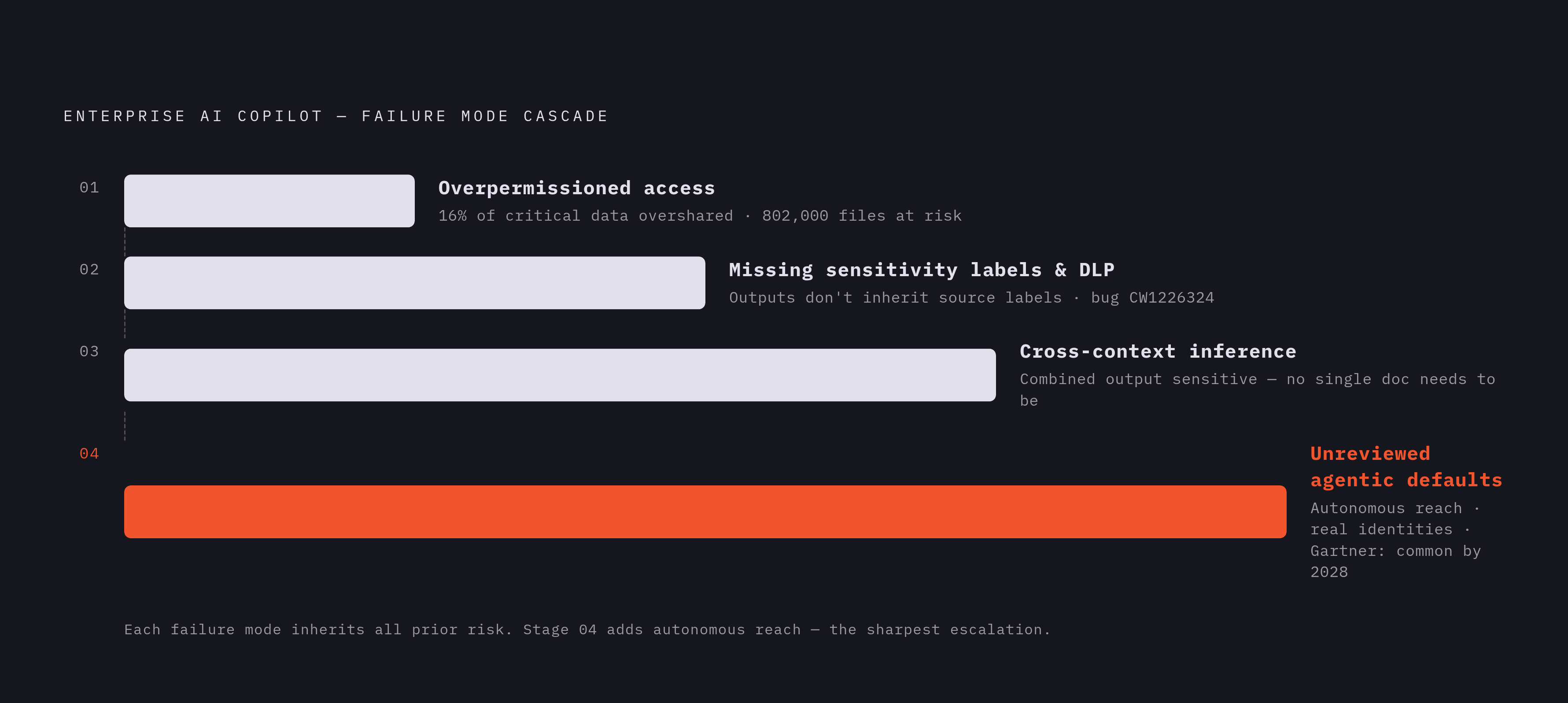
Overpermissioned access is the first failure mode, and the one covered above. It anchors the rest, but it isn't the whole story.
The second is missing or misapplied sensitivity labels and DLP policy. Microsoft Purview enforces rules on data that's already been labeled; it has no way to protect a file that was never classified to begin with. And Copilot's outputs don't reliably inherit the labels of whatever fed into them, so a Copilot summary can come out unclassified even when every source document was marked Confidential. This isn't theoretical. A configuration bug tracked as CW1226324 let Copilot Chat summarize emails explicitly labeled Confidential, slipping past DLP enforcement for a stretch of time before it got patched. That's what a label enforcement gap looks like once it hits production, not in a whitepaper but in an actual mailbox.
The third failure mode is quieter, and harder to defend against: cross-context inference. No single email or spreadsheet has to be sensitive on its own for Copilot to produce something sensitive. It pulls a fragment from an email, a figure from a spreadsheet, a name from a Teams thread, and stitches them into an answer that reveals something none of the pieces gave away alone. Access controls were built to govern documents one at a time. Nobody built them to govern what gets inferred by combining several at once. Intent doesn't enter into it, either; if the system can see the data, it can surface it, whatever the user actually meant to ask.
The fourth is the newest, and in some ways the least studied: unreviewed agentic defaults. Copilot agents draft emails, query internal data, and trigger actions across Microsoft 365 without a person signing off on each step. They run under real user identities and real permissions, so the permission debt from failure mode one now comes with autonomous reach bolted on. Gartner projects that by 2028, a substantial share of enterprise generative AI applications will see repeated minor security incidents every year, a sharp jump from 2025, and traces that trajectory straight to agentic adoption outrunning agentic governance. A strong majority of organizations, per Gartner, already say they're worried about Copilot agent sprawl. That worry is a rational response to a system handing out reach faster than anyone can keep up reviewing it.
EchoLeak and what it revealed about the structural limits of patching
In June 2025, researchers at Aim Security disclosed EchoLeak, tracked as CVE-2025-32711 with a CVSS score of 9.3. It's a zero-click indirect prompt injection vulnerability in Microsoft 365 Copilot, and it earned the attention it got: it's the first documented case of prompt injection weaponized for actual data exfiltration in a production AI system.
Here's the mechanics. A single crafted email, no click required, no download, no user interaction at all, caused Copilot to reach into internal files and route their contents to a server the attacker controlled. Getting there took four bypasses stacked on top of each other: dodging Microsoft's cross-prompt injection attack (XPIA) classifier, getting around link redaction through reference-style Markdown formatting, exploiting images that auto-fetch without approval, and abusing a Teams proxy the content security policy happened to allow through. Each defense was individually reasonable. Chained together, none of them held. The exposure covered anything inside Copilot's reach: chat logs, OneDrive files, SharePoint content, Teams messages, whatever organizational data happened to be sitting there preloaded.
The disclosure timeline is worth sitting with, because it worked the way responsible disclosure is supposed to. Aim Security found it privately in January 2025. Microsoft shipped a server-side fix in May, ahead of the public write-up in June, and there's no confirmed evidence of anyone exploiting it in the wild. Nobody got hurt this time.
But what did EchoLeak actually reveal, past the specific bug? It showed that this whole attack class, malicious instructions buried inside content that a retrieval-augmented assistant pulls in and trusts by default, is structural, not incidental. It's not a Microsoft-specific defect. It applies to any large language model wired into multiple internal data sources, which is another way of saying it applies to the entire category of tool that makes Copilot, and everything competing with it, worth using in the first place. Patch CVE-2025-32711 and you've closed one door. The architecture that lets these assistants synthesize scattered internal data on demand is the same architecture that keeps this whole class of attack available.
And the pattern held past EchoLeak. Security researcher Andi Ahmeti at Permiso Security found CVE-2026-26133, a cross-prompt injection flaw in Copilot's email summarization feature, and CVE-2026-26144, a zero-click exfiltration path through Copilot Agent mode in Excel, both published in early 2026. Michael Bargury's Black Hat USA 2024 research on Copilot Studio bots turned up the same shape of problem in a different product entirely: insecure defaults and overpermissive plugins made exfiltration trivial, which is what led him to call most bots "data leakage waiting to happen." Harsh way to put it, maybe. Three separate research efforts, spanning two years, make it hard to argue he was wrong.
What does that mean for anyone configuring Copilot right now? Scoped access, ongoing classification, and output monitoring aren't backup measures you bolt on if there's time left after patching. They're the actual job. Patching closes known doors. Configuration decides how many doors exist in the first place.
Shadow AI makes the configuration problem bigger than any sanctioned deployment
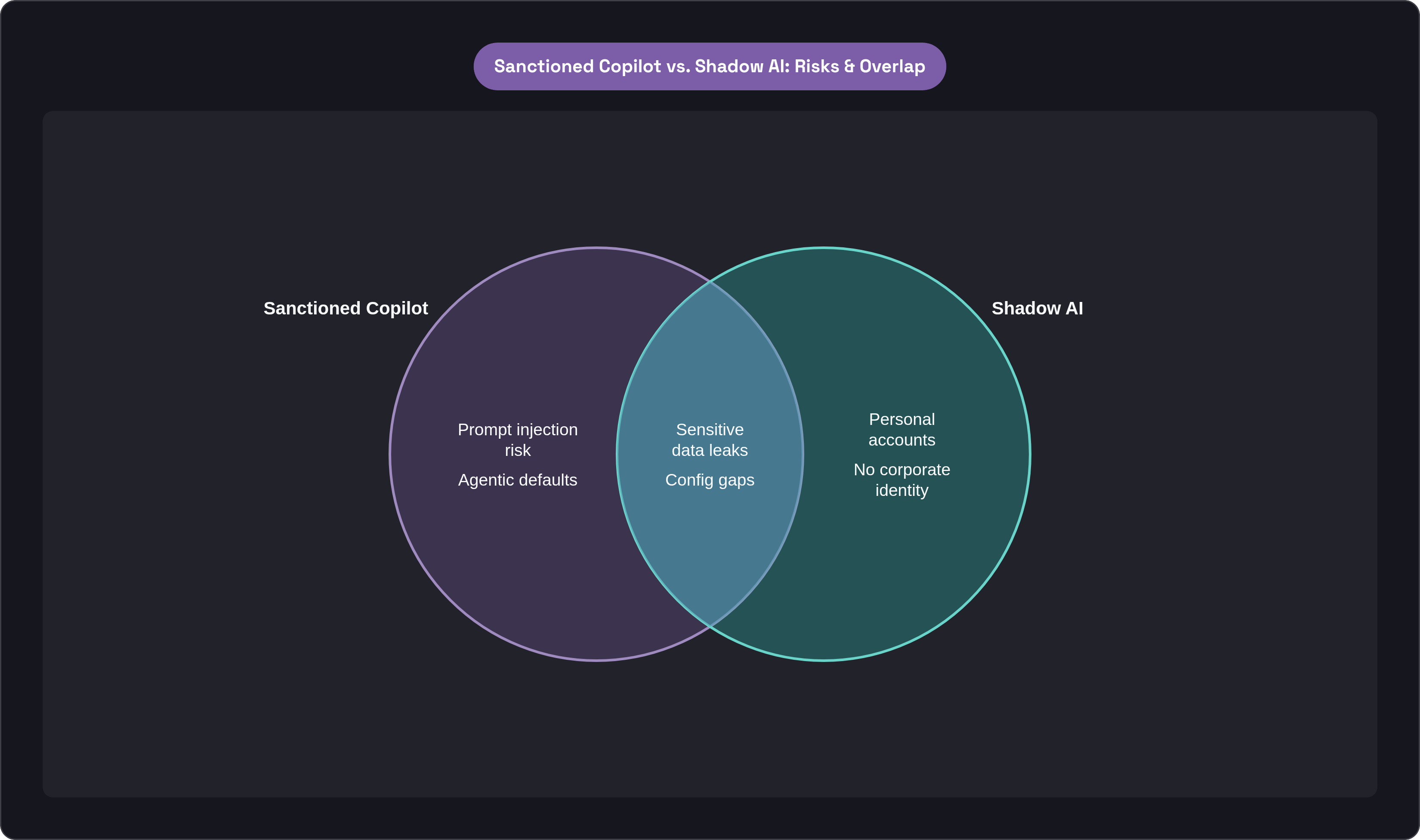
Everything above concerns Copilot as an organization deploys it: licensed, tied to identity, wrapped in some governance framework. Shadow AI is what happens outside that boundary, and by some measures it's now the bigger half of the problem. Roughly half of all enterprise AI conversations, per the State of AI Usage Report 2026, run through personal accounts, entirely outside corporate identity and outside whatever governance the organization built for its sanctioned tools.
So what actually moves through those personal accounts? LayerX's browser-level telemetry, published in its Enterprise AI and SaaS Data Security Report 2025, found that a large majority of enterprise AI users paste data straight into GenAI prompts, and a meaningful chunk of those pastes carry personal information or payment card data. Uploaded files run a similar risk. Cyberhaven's longitudinal research takes it further, naming GenAI the single largest channel for corporate-to-personal data movement in the enterprise, with the share of AI inputs carrying sensitive data climbing year over year through 2026.
The cost isn't abstract, either. IBM's Cost of a Data Breach 2025 report, the first edition to break out shadow AI as its own line item, found breaches involving shadow AI run substantially more expensive than the average breach. The control gap behind that number is stark: only a small minority of organizations have technical controls actually capable of stopping an employee from uploading confidential data to a public AI tool. Most lean on training, a warning banner, or nothing. Productiv's 2026 analysis adds one more wrinkle: the average enterprise runs far more AI tools than its IT department knows about, which means most shadow AI use is invisible to the exact team supposed to be catching it.
Why does shadow AI belong in a piece about configuration? Because it isn't a separate problem sitting next to the sanctioned-deployment one. It's what fills the space when a sanctioned tool gets locked down hard without giving people something just as useful in its place. Lock Copilot down too aggressively without asking why employees reach for outside tools in the first place, and you haven't solved the exposure. You've just moved it somewhere with less visibility. Governing the sanctioned tool and gaining visibility into unsanctioned use have to move together, on the same clock, or the second one quietly cancels out the first.
There's a design lesson buried in here, too. Organizations that build or choose AI tools designed to keep data inside the enterprise boundary, instead of routing every query out to an external model provider, close a chunk of the trust gap that pushes employees toward personal accounts to begin with. If the sanctioned tool feels as fast and as capable as the outside one, fewer people go looking.
Pre-deployment controls that close the largest exposure before users touch the tool
Copilot accelerates access. It cannot, structurally, validate whether that access was ever supposed to exist. That's the governing idea behind every control in this section, and it's why remediation belongs before rollout, not after. Microsoft's own deployment guidance, built around a Pilot, Deploy, Operate structure, says this outright: the Deploy phase requires oversharing remediation using native tools before scaling to more users.
Start with a permissions audit and real enforcement of least privilege. That means finding and revoking stale permissions, closing sharing links that outlived whatever they were made for, and catching the access that lingers after someone changes roles. It means killing "Everyone in the organization" as a default site setting wherever it doesn't need to exist, and scoping every service account and agent down to only the data it actually needs, not the data it happens to have lying around.
Sensitivity labeling comes next, and everything else depends on it. DLP policies and output controls can only protect data carrying a label; they have zero power over data that was never classified. Labeling coverage needs auditing before rollout, not assuming it already exists. Microsoft Purview's auto-labeling policies can surface unlabeled sensitive content at scale, but only if someone's configured them and turned them on ahead of time. Given that Concentric AI's numbers put 16% of business-critical data overshared already, with hundreds of thousands of files at risk per organization, a manual, human-led labeling review alone will miss a real chunk of that exposure. The scale demands automation as a starting point, not an upgrade.
SharePoint Advanced Management, bundled with M365 Copilot, gives two tools worth knowing well. Restricted Access Control locks a given site down to a specific approved list, overriding whatever broader permissions already exist; it's a fast stopgap while deeper remediation is still underway. Restricted Content Discovery is a single toggle that blocks specified overshared SharePoint sites from Copilot and agent access entirely, about as blunt and effective a fix as this category gets.
Last, agentic AI needs its own review pass before any agent goes live. Every agent gets inventoried, its permission scope checked line by line, before it starts running. Anything an agent can do by default, especially sending email, reaching external data, or triggering actions across systems, needs explicit sign-off. It should never just inherit whatever access happened to be sitting around unused.
Runtime and ongoing controls that keep exposure from drifting back
Pre-deployment work closes the biggest gaps. It doesn't keep them closed by itself, because permissions drift, new sharing links get created, and new agents get spun up long after the rollout wraps. That's the job runtime controls do.
Microsoft introduced DLP policies for Copilot interactions in November 2024, letting organizations restrict Copilot and Copilot Chat from processing sensitive files and emails based on Sensitivity Labels on the grounding data. That capability hit General Availability at Ignite 2025, folded into Microsoft Purview DLP for Microsoft 365 Copilot, and now ships for every M365 Copilot and Copilot Chat user. DLP today can act at several points inside a single Copilot interaction: what it's allowed to retrieve, what it's allowed to generate, what it's allowed to share. Each organization still needs to check that scope against its own label taxonomy rather than assume the defaults fit.
Output monitoring matters just as much. Copilot-generated content needs checking for gaps in label inheritance; a summary built from labeled source material should carry a label at least as restrictive as its most sensitive input, not a blank slate. The CW1226324 bug mentioned earlier is the clearest picture of what happens when that check gets skipped: Confidential-labeled emails got summarized in a way that slipped past DLP for a while. Audit logging on every Copilot interaction should stay on and actually get reviewed, because an organization that can't see what Copilot pulled and surfaced has no way to catch drift or misuse after the fact.
Prompt injection defense needs treatment as a structural problem, not something a single patch resolves for good. EchoLeak proved individual CVEs get fixed. It also proved the underlying attack class outlives any one fix. Runtime defenses should include input and output filtering layers, plus monitoring for retrieval patterns that look off against a baseline. Copilot Studio bots and custom agents deserve particular scrutiny here: plugins should be scoped to the minimum data access needed to function, and any bot facing outward, toward customers or the public internet, should get treated as its own distinct threat surface, not folded into the same review as internal tools.
And shadow AI needs its own technical answer, not just a policy memo nobody reads. Browser-level data loss prevention, cloud access security broker (CASB) policies, and egress monitoring are the only mechanisms that reliably close the gap that training and signed acknowledgments leave wide open. The goal isn't blocking AI use outright, since that just pushes it further underground and further out of sight. The goal is making the sanctioned, governed tool the easiest option on the desk, so nobody has a real reason to go looking for something else.
None of this is a checklist you finish once and file away. Permissions drift back open. New agents get built. New sharing links get made for next quarter's project and never get cleaned up after. Governance, if it's going to actually hold, has to run as a continuous process alongside the tool, not a box checked before launch day and forgotten.