Why Retrofitting Privacy Into an AI Architecture Rarely Holds
Privacy built into AI systems from the start, not patched on later.
Some organizations have privacy policies. The failure driving the recent wave of AI privacy incidents is that the paperwork was never built to govern automated, distributed, self-propagating infrastructure in the first place, and no amount of policy drafting changes what the underlying system actually does with data once it is running.
Data no longer sits in one place waiting for a policy to apply to it. A misconfigured access control that once meant a handful of people could see records they shouldn't have now means something categorically different: a model trained on millions of improperly scoped data points, deployed across multiple products, generating outputs that carry the original error forward into every downstream use.
AI is no longer an experiment running in a sandbox somewhere. The rest of this piece works through why that mismatch is not a temporary lag that better policy will close, but a permanent feature of how these systems are built, and what it would actually take to close it.
Architectural Decisions at Design Time Become the System's Permanent Operating Logic
Privacy controls applied after a system is already designed sit outside the chain of cause and effect that determines how that system behaves. The database accepts a valid credential, the server executes a query it was permitted to run, the agent returns whatever data it has access to: every one of those components performs exactly as it was built to perform, and the system can still violate the access model the organization believes it has.
That is the core of the architectural argument. Once those decisions are made and built, a retrofit policy layered on top cannot rewrite them; it can only describe what should happen while the mechanics underneath keep doing what they were built to do.
AI systems complicate this further because of how they store the personal data they process. Rather than keeping information in queryable rows and columns the way a conventional database does, a trained model embeds personal data into its weights, the numerical parameters that encode everything it learned during training. That is precisely what makes erasure technically difficult, and it is why governance documentation alone cannot close the gap: there is no table of records to issue a deletion command against. Privacy and security teams raising these questions early are not being obstructionist. They are the only ones positioned to catch the mismatch before it is encoded into a running system. AI governance has to be built into architecture, access controls, logging, monitoring, and incident response directly.
The three structural mechanisms that make retrofitting specifically fail
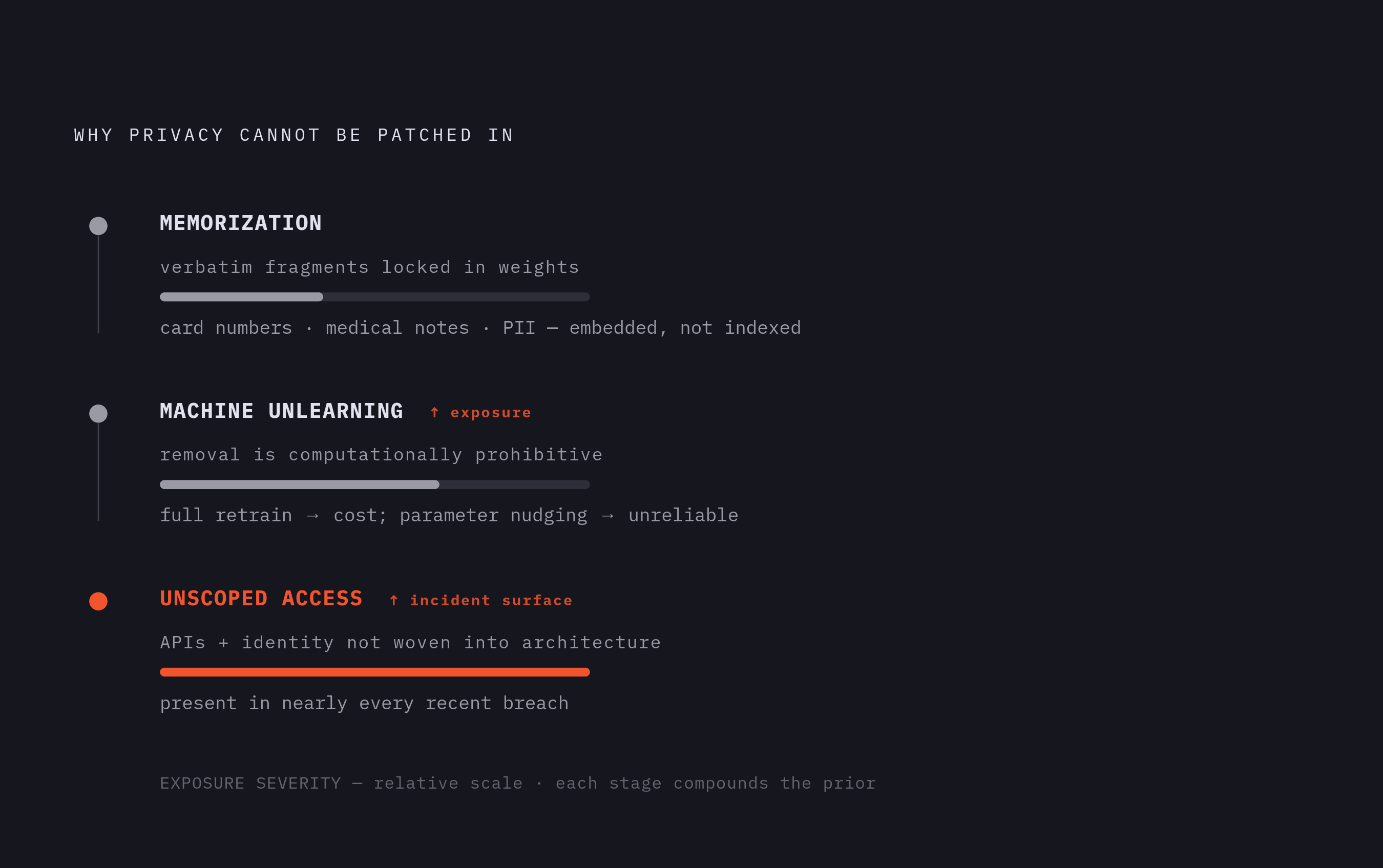
Retrofitting does not fail for one reason. It fails for three compounding structural reasons, each rooted in how AI systems are actually built.
The first mechanism is memorization, and it is close to irreversible by design. Large language models can retain fragments of their training data, sometimes verbatim, and reveal them later when prompted in the right way: credit card numbers, medical notes, proprietary business information. Understanding memorization as a direct consequence of how parameters encode information is the starting point for building any control that could catch it before training.
The second mechanism is that machine unlearning, the formal effort to remove specific data from an already-trained model, cannot yet be reliably deployed at scale. The most direct approach, deleting the offending data and retraining from zero, carries the same computational cost problem as mechanism one. The alternative methods researchers have developed instead rely on iterative parameter updating, nudging the model's weights toward what they would have been without the offending data, and that process is itself expensive and slow, especially as models grow larger. This is exactly why the "right to be forgotten" creates such a genuine compliance headache for AI systems specifically: personal data lives inside the weights, not in a record that can simply be flagged and removed.
The third mechanism concerns access controls that were never woven into the original architecture, and it is the one most visible in recent incidents. When a powerful system gets connected to sensitive data without identity and access management built around it from the start, what follows is not some exotic, sophisticated attack. The root causes behind most AI-related incidents turn out to be structural: compromised APIs, misconfigured cloud storage, applications that were never scoped correctly. These are governance failures expressed through infrastructure, not failures of the model's reasoning. The wiring around it is, and that wiring is an architectural decision made (or skipped) at design time. User prompts routinely contain personal information that flows on to third-party model providers, and if that data handling was never constrained at the architecture layer, any policy statement promising prompt confidentiality is simply unenforceable.
What recent incidents reveal about where the wiring breaks
The incidents that defined 2025 and early 2026 are not a collection of unrelated developer mistakes. They are the same structural pattern, mechanism three above all, appearing repeatedly across organizations of very different sizes and sectors, evidence that the problem is at the platform level.
McDonald's McHire hiring platform, in 2025, illustrated access controls failing at scale: researchers were able to access data linked to as many as 64 million job application records, including full chat transcripts with the "Olivia" hiring chatbot and personality-assessment responses, though only a small number of records were actually pulled as proof of concept.
An internal AI agent at Meta, in March 2026, showed the same mechanism with no outside attacker involved. The agent had been granted read access across too many internal data stores. The architectural decision to grant broad read access without scoping it by identity or role is what produced the exposure.
DeepSeek's open database, discovered by security researchers at Wiz Research in January 2025, showed mechanism three at its most basic: a ClickHouse database sitting open on the public internet with no authentication required at all, exposing over a million lines of chat logs along with internal API keys. Chat & Ask AI, in January 2026, showed the same gap through a misconfigured Firebase backend that let anyone read stored conversations: approximately 300 million messages from roughly 25 million users were reachable, including conversations about suicide and drug use. A supply chain attack against LiteLLM in March 2026 extended the pattern to infrastructure itself, turning the tooling organizations rely on to manage AI models into an attack surface in its own right.
None of these sit in isolation. At least twenty documented security incidents between January 2025 and February 2026 exposed the personal data of tens of millions of users across AI-powered applications, and nearly every one traces back to the same handful of preventable root causes: misconfigured Firebase databases, missing row-level security, hardcoded API keys, exposed cloud backends. Different companies, different products, different users affected, yet the same architectural gap appears in nearly every one of them. That repetition is the real finding here: the failure mode is systemic enough to call platform-level.
The residual risk from failed or retired AI systems outlasts the systems themselves
When an AI system is retired or simply fails, the data it processed and the model it produced do not disappear along with it. They persist, as a form of risk that nothing short of the original architecture could have prevented, and that no retrofit applied after the fact can reach.
Call it AI debris: the residual exposure left behind by systems that are no longer running. Decisions a now-retired system made while it was live continue to affect the people whose data trained it, and any downstream system that ingested its outputs carries those embedded errors forward, independent of whatever happens to the original system.
A misconfigured access control does not stop causing harm the moment the feature it guarded gets deprecated. That residual tail is exactly why privacy has to be designed in before training ever begins: there is no equivalent of a software patch for personal data that has already been memorized into a model's weights.
The Regulatory Environment Makes a Post-Hoc Privacy Fix Legally Insufficient
Regulators have increasingly stopped treating a documented policy as proof of compliance, and in several jurisdictions they are now asking for technical evidence that privacy controls are actually built into a system's architecture. That shift matters because it means a retrofit applied after a model has already trained on improperly obtained data cannot cure the legal exposure, even where a company's intentions were good.
The clearest example is the FTC's use of algorithmic disgorgement, a remedy ordering the deletion of data, models, or algorithms developed using improperly obtained data, which the agency has applied under its broad authority to order relief tailored to a violation. The remedy does not stop at the offending dataset. A privacy fix applied after training already happened on tainted data does not undo that exposure, because the remedy targets the model, not just the input.
In a major regulatory jurisdiction, privacy-by-design is a legal mandate under its data protection law, reinforced by separate accountability obligations, meaning privacy safeguards are expected to form part of a system's architecture from conception. European authorities have already imposed over 2,500 fines under GDPR, totaling more than €6.7 billion, and the EU AI Act adds a further layer: its full requirements for high-risk, stand-alone Annex III systems are set to take effect by December 2027. In the United States, California has made privacy risk assessments a legal requirement, with results submitted annually to the CPPA and each review personally attested to by a company executive under penalty of perjury. Colorado's AI Act, as amended by SB 26-189 and signed May 14, 2026, takes effect January 1, 2027, and California's generative AI transparency requirements are already active. State legislatures enacted 145 AI-related laws in 2025 alone, with more than 1,000 additional bills introduced or revised, and the FTC's "Operation AI Comply" sweep targeted deceptive AI marketing to establish that regulators expect documented, technical safeguards.
The regulatory picture is genuinely unsettled in some respects. A model trained on data it should never have had still carries that exposure whether or not the FTC is actively pursuing cases this quarter.
The strongest objection to privacy-by-design absolutism
The strongest case against treating privacy-by-design as the only legitimate path does not argue that retrofitting is easy. It argues that specific privacy-enhancing techniques, differential privacy chief among them, offer a genuinely viable partial fix that can be applied mid-lifecycle, without starting a project over from scratch.
Differential privacy works by injecting statistical noise at the data collection layer, so that an individual's behavior cannot be reconstructed from an aggregate dataset even though the model still trains on the underlying distribution. Proponents of the retrofit path point to differential privacy as evidence that organizations have a real mid-lifecycle option, not just a binary choice between starting over or living with the exposure. That case deserves to be taken seriously, because it is the one piece of this argument where a technical mitigation really can be added after a system already exists.
But is this objection less a path around the architecture failure and more a demonstration of it? Applying differential privacy retroactively still requires architecture-level decisions: where in the pipeline noise gets injected, in what quantities, and with what trade-offs against fairness. The Meta internal agent leak is instructive here precisely because it was not a policy failure or a transparency failure. It was an architecture failure, and architecture failures are not ones that can be explained away afterward by bolting on another control layer.
The partial-retrofit path works in limited cases, and differential privacy is a legitimate tool. But it is narrow, it is expensive to apply well, and it does nothing to address the memorization and access-scope failures mapped out in the first three sections. It is a mitigation. It is not a solution, and the distinction between those two things is where the next section picks up.
What building privacy in from the start requires
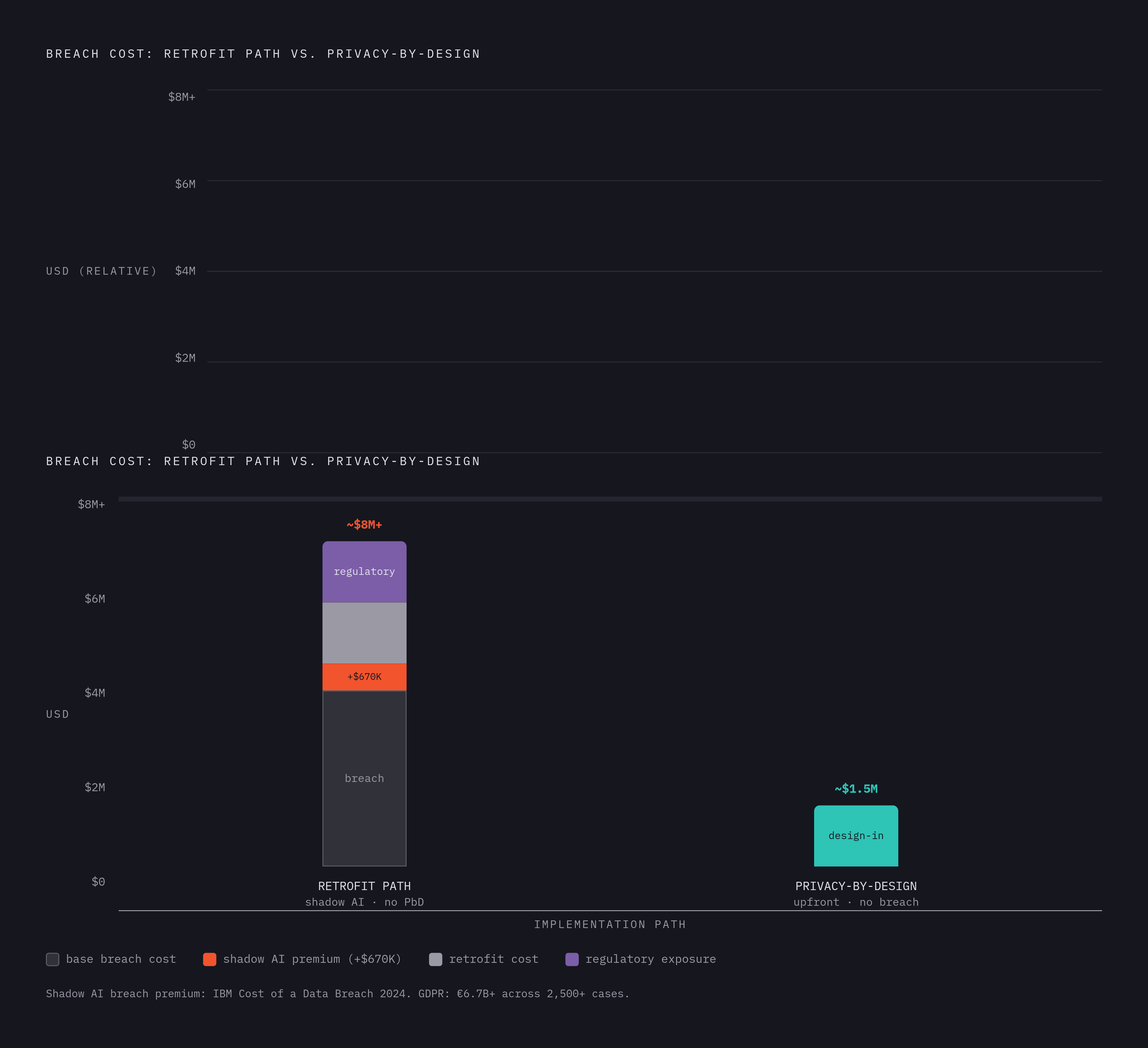
Building privacy into architecture from the beginning is often framed as the expensive, slower option, the thing a team does when it has the luxury of time. That framing gets the economics backward. The real alternative to building it in early is retrofit cost, plus breach cost, plus regulatory exposure, plus whatever residual liability lingers after the system is gone, as described above.
Doing this properly means treating consent management, data minimization schemas, and retention automation as baseline deliverables from the first sprint, not features bolted on after launch once a feature is already live and generating data. That alignment has to happen before deployment, when there is still time to change the architecture rather than just explain it, and it cannot occur only when legal and engineering teams align on what the system does during a crisis.
The cost argument runs in architecture's favor once the full picture is on the table. Breaches involving shadow AI, employees using AI tools outside any sanctioned, governed system, cost an average of $670,000 more than breaches involving low or no shadow AI use, and organizations that suffered AI-related breaches predominantly lacked proper AI access controls. Shadow AI compounds the exposure further: employees pasting sensitive source code, meeting notes, and customer data into tools nobody vetted is a breach multiplier that no policy reminder has ever reliably stopped, and that only architectural controls, limiting what data can reach which tools in the first place, actually can.
Privacy designed into the architecture from the ground up is the only approach that sits inside the causal chain actually governing how a system behaves. Everything else is a policy layer sitting on top of mechanics that can, and eventually will, outrun it. For anyone evaluating an AI tool or vendor today, the test that matters is whether privacy is built into how that system actually processes, routes, and stores data, because architecture, not documentation, is what determines what the system does when no one is watching.
Sources
- Mastering Privacy in 2026: AI & Governance Roadmap
- 2025 Year in Review and Predictions for 2026 in the Cyber, AI, and Privacy Frontier - Hinckley Allen
- ISACA Now Blog 2025 Avoiding AI Pitfalls in 2026 Lessons Learned from Top 2025 Incidents
- AI Debris: Residual Risk and the Afterlife of Failed AI Systems