Preventing Model Inversion and Membership Inference in Deployed APIs
Defending APIs requires layered controls at training, serving, and boundary levels working together.
Model inversion and membership inference both work by turning a deployed model's own output against it. One reconstructs sensitive inputs from what the model reveals; the other simply asks whether a specific record sat in the training set. Defending against them starts with a fact most teams still get wrong: the API is the attack surface, not just the model sitting behind it. Training-time, serving-time, and boundary-level controls all have to work together, because none of them alone closes the gap. This piece walks through how each attack functions, which part of the deployment stack it targets, and what regulators in the US and EU now expect operators to do about it.
Model inversion uses confidence scores, logits, or probability vectors to reconstruct something close to the original training input, such as a face, a medical record, or a line of source code. Membership inference asks a narrower question: whether this record was in the training set. The two share a family resemblance, since both exploit outputs a model was built to give, but they diverge sharply in what they demand from an attacker and what they cost a victim. Fredrikson et al. set the stakes back in 2015, when their paper showed partial reconstruction of individual faces from a deployed facial recognition model. That paper proved something operators are still catching up to: a trained model can leak private information about the people in its training set, not just perform the task it was built for. A decade later, the lesson holds, and it cuts against a common assumption. A model hardened against one of these attacks is not automatically hardened against the other, because the signal each attacker needs, and the defense that starves that signal, are not the same.
The API surfaces that each attack exploits
A 2025 ACM survey published at ICCNS organizes inversion and inference attacks along two axes: the observable interface (posteriors, hard labels, intermediate features, gradients) and the generative prior the attacker brings in (none, GAN-based, diffusion-based, or structural statistics about the data domain). The interface decides what's actually exposed, and that decides which defenses even apply. A black-box attacker working purely through an API submits repeated crafted queries, watches how outputs shift, and refines a reconstruction iteratively. No weights, no gradients, just patience and API calls that never stop coming.
Model inversion wants three things from that interface. It wants confidence scores or full probability distributions, since richer outputs carry a stronger reconstruction signal than a single predicted label ever could. It wants repeated query access, because reconstruction is iterative. And wherever white-box or split-inference setups allow gradient or intermediate-feature access, the attack gets stronger than score-only access could ever make it.
Membership inference asks for less. That's why it's harder to stamp out. It just needs some observable gap in how the model treats data it trained on versus data it never saw, usually surfaced through confidence scores or loss values. A 2025 USENIX Security paper by Hao Li and colleagues, "Enhanced Label-Only Membership Inference Attacks with Fewer Queries," shows membership inference working even when a model returns nothing but a hard label, and doing so with fewer queries than earlier work assumed necessary. Score suppression raises the cost of this attack. It does not shut the door on it, and treating it as if it does is the mistake operators keep making.
The attacks keep getting cheaper to run, too. SMILE (Li et al., 2025) pairs long-tailed surrogate training with gradient-free optimization to produce high-resolution reconstructions using fewer queries than earlier inversion methods needed. SMI-AW (Nguyen et al., 2026) pushes inversion into vision-language model interfaces, using token- and sequence-level signals to reconstruct private training images even when no image classifier sits directly exposed. For large language models, the exposure runs through training data extraction: a model trained on private code repositories can, under the right prompt, regurgitate a production API key it memorized verbatim during training. By 2026, research had gone a step further still, producing automated membership inference attacks where LLM agents discover the signal computations needed to run the attack themselves, in both black-box and gray-box conditions.
For anyone running a model behind an API, the lesson is blunt: the attack surface is whatever the API is configured to return. Nothing more, nothing less. That makes output design a security decision on par with authentication or rate limiting, not an afterthought left to whoever wrote the response schema.
Who is at risk and what a successful attack costs
IBM's Cost of a Data Breach Report puts the global average cost of a breach at $4.88 million, and healthcare organizations specifically average $9.77 million per incident. Model inversion that exposes protected health information doesn't just cost money to fix. It triggers mandatory breach notification, which stacks regulatory penalties and class-action exposure on top of remediation costs that were already steep. The same report found 13% of organizations had experienced a breach involving AI models or applications, and among those, 97% lacked proper AI access controls. That second figure is the damning one. It says the exposure wasn't inevitable so much as a gap nobody closed before it mattered.
Risk concentrates in a few recognizable places, and naming them directly serves better than treating "AI risk" as one undifferentiated blob. Healthcare and medical imaging systems are exposed because systematic querying can reconstruct patient identifiers straight from confidence score outputs, which pulls HIPAA obligations directly into the picture. Tabular data domains, credit scoring, insurance underwriting, HR analytics, carry a related risk: an attacker who already knows a few attributes about someone (name, city, job title) uses those as a wedge to reconstruct the sensitive field the model was never supposed to reveal, like salary or a diagnosis. LLMs deployed in security-critical systems carry a more durable version of the same problem, because sensitive personal information and memorized training data stay encoded across the model's parameters long after the training run ended and the model shipped.
MLaaS platforms deserve a separate line here. Organizations calling a third-party API-based model often don't control what that API returns or how the provider logs incoming queries. A real concentration of risk sits outside the operator's own security perimeter. "We didn't train it" does not mean "we're not liable for it." Regulators have made that distinction clear, and it's the wrong hill to defend a compliance posture on.
Past the breach itself comes the operational tail: retraining or decommissioning a compromised model, standing up emergency access controls, running privacy impact assessments across an entire model inventory, notifying affected individuals inside whatever window the applicable regulation allows. None of that is cheap, and none of it moves fast. There's a competitive angle too, one that gets less attention than it should. An organization that spends years and real budget building a proprietary training dataset loses part of that investment the moment a competitor, or a bad actor, reconstructs meaningful chunks of it from API outputs. In markets where customers actually pay attention, data protection functions as a trust signal and, by extension, a competitive edge. On the upside, that same 2025 report found organizations making heavy use of AI and automation in their security operations saved an average of $1.9 million in breach costs, a fairly direct signal that investment in privacy-preserving infrastructure pays for itself rather than just sitting on the books as overhead.
The regulatory framework operators are now accountable to
Regulators caught up to this threat class fast, and the guidance published across 2025 reads as specific rather than aspirational, which is unusual for this kind of document. NIST's Adversarial Machine Learning taxonomy, published in March 2025, names model inversion and membership inference explicitly as risks affecting both predictive and generative AI systems once deployed. That gives this threat class formal standing inside US federal guidance.
A joint NSA, CISA, and FBI advisory identified data supply chain vulnerabilities as one of three primary AI security threats, alongside maliciously modified data and data drift, and it recommends threat modeling and privacy impact assessments at the start of any AI initiative, not bolted on after deployment. That's a real shift in posture. These attacks now get treated as a starting assumption for anyone building an AI system, not an edge case handled only if it happens to come up during a late-stage review.
The EDPB's Opinion 28/2024, adopted at the Irish Data Protection Commission's request, went further on specifics than most regulatory guidance ever does. It tells businesses developing or deploying AI models to test against five named attack types: attribute or membership inference, exfiltration, regurgitation of training data, model inversion, and reconstruction attacks. That's about as concrete as it gets, naming the exact attack classes an operator has to defend against instead of gesturing at "privacy risk" in the abstract. It also feeds a broader interpretive shift under GDPR: because membership inference and model inversion can reveal personal information about the people whose data trained a model, some regulators now argue the trained model itself, not just the underlying training data, should in some cases count as personal data. That reclassification puts compliance risk on the model artifact directly, which is a heavier burden than most operators were budgeting for even two years ago.
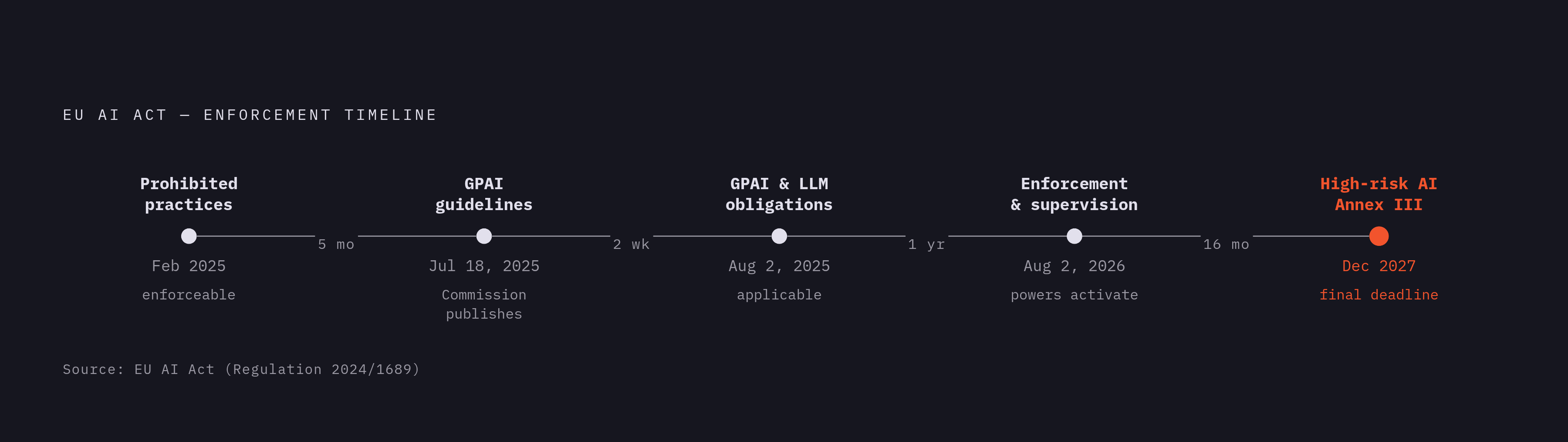
The EU AI Act layers a harder enforcement timeline on top. Prohibited AI practices have been enforceable since February 2025. High-risk AI system requirements under Annex III are set to apply from December 2027. Obligations for general-purpose AI and large language models became applicable on August 2, 2025, with enforcement and supervision powers activating a year later, on August 2, 2026. The European Commission published guidelines clarifying the GPAI provisions on July 18, 2025. Significant penalties apply, and the Act covers any organization whose system touches people in the EU, regardless of where that organization is headquartered. Together, GDPR and the AI Act create a layered data-protection and product-security accountability framework that operators must navigate alongside one another.
Put together, this stack means an operator now has to show its work. Testing for these named attacks and documenting the countermeasures chosen used to be good practice. It's becoming the compliance artifact regulators will ask to see, and treating it as optional paperwork is the surest way to end up explaining a gap after the fact instead of before.
Training-time defenses that limit what the model encodes about individuals
Every rate limit, every output truncation, every serving-time trick downstream, only ever limits exposure of information the model already encodes. So the strongest and most durable defense sits at training time, where it's possible to bound how much a model can leak before it answers a single query.
Differential Privacy SGD, introduced by Abadi et al. in 2016, remains the strongest guarantee available, and it's the one defense on this list that offers a mathematical proof rather than an educated hope. DP-SGD injects calibrated noise during training, bounding the maximum advantage any adversary can gain in distinguishing a training-set member from a non-member. For tight epsilon values, that bound holds regardless of what attack someone throws at it later. The tradeoff doesn't go away, though: noise competes with signal, and on smaller datasets the noise usually wins, dragging accuracy down in ways that are hard to paper over. A 2025 survey covers the mechanics of Laplace and Gaussian DP noise mechanisms across single-party and multi-party learning, GANs, and deployments in healthcare, government, and finance.
Regularization (dropout and weight decay chief among the techniques) cuts overfitting, and since overfitting is what causes a model to memorize specific training examples instead of generalizing past them, less overfitting means less to leak later. Research in this area frames regularization as a dial, not a switch: push it hard and privacy improves, but accuracy drops right alongside it. Nobody's found the setting that gives both for free, and anyone claiming otherwise is skipping the tradeoff, not solving it.
For large language models, deduplicating training data looks like the single most effective lever against inversion-style extraction, and it's the cheapest one on this list to actually implement. Cutting duplicates before training starts shrinks the surface area an extraction attack has to work with. Adversarial regularization, introduced by Nasr, Shokri, and Houmansadr at CCS in 2018, takes a more direct route: it trains the model against a simulated membership-inference adversary during training itself, so the model learns to resist the exact attack it will face later, and that technique continues to appear in subsequent privacy and security research. Federated learning offers a structural fix rather than a statistical one. It keeps training data local to each participant and shares only model updates, removing the central data-aggregation point that makes bulk extraction practical. Treat it as a complement to DP-SGD.
Across the research comparing these approaches, a pattern holds that operators should take seriously when picking a defense. Provable defenses like DP-SGD deliver strong privacy guarantees at a real accuracy cost. Soft-label methods and add-on training constraints trade weaker privacy for a smaller accuracy hit. Generic regularization lands somewhere between the two, depending on how hard it's dialed. None of these come free. Picking one means picking a specific point on the privacy-utility tradeoff, and that choice deserves to be written down and defended, not left as whatever the framework happened to default to.
Serving-time and API-boundary controls that reduce attack signal
Training-time defenses set a ceiling on what a model can leak. Serving-time controls decide how much of that ceiling an attacker actually gets to see, and this is the layer operators have the most day-to-day say over, since none of it requires retraining anything.
The simplest lever is output truncation. Returning only the top predicted label, instead of a full probability distribution, raises the bar for model inversion substantially, because it strips out the continuous, fine-grained signal that iterative reconstruction depends on. Returning only top-k predictions, rounding confidence scores to fewer decimal places, and rejecting queries with a suspiciously thin margin between the top two predictions all shrink the signal available to a membership-inference attacker too. But the label-only USENIX Security 2025 paper mentioned earlier is the necessary caveat: hard-label-only output raises the cost of membership inference, it doesn't close the door on it. Score-based attacks like MIRROR, RLBMI, and SMILE do degrade under score truncation and output perturbation, which counts as real progress, but none of these controls touch attacks running on gradient information, or prefix extraction in an LLM setting. Truncating scores does nothing to stop a code model from finishing a memorized API key once the right prefix gets fed back to it.
Differential privacy applies at the output layer too, not just during training, by perturbing and renormalizing the confidence score vector before it ever reaches the caller. This protects against both inversion and membership inference, and unlike DP-SGD, it needs no retraining at all, which makes it a practical retrofit for models already sitting in production where training-time DP was never in the original plan.
Rate limiting and query monitoring round out the standard reactive stack, and calling it "reactive" isn't a knock. Since reconstruction attacks are iterative by nature, capping how many queries a client sends in a given window denies attackers the volume of responses they need to converge on a usable reconstruction. Logging every query opens the door to anomaly detection: an attacker probing the same narrow region of input space over and over leaves a behavioral fingerprint that looks nothing like normal traffic, once someone bothers to look for it. Rate limits, reduced output detail, and query logging together form the baseline that any serving infrastructure handling sensitive data should already have running.
Homomorphic encryption deserves its own mention, since it keeps data encrypted through processing, not just in transit or at rest. That property supports GDPR compliance directly. If outputs get intercepted while still encrypted, they're unreadable without the key, which can reduce or eliminate the mandatory breach notification obligation that would otherwise kick in.
Architecture decides what's practically exposed too, depending on where the interface actually sits. The 2025 ACM survey noted earlier makes the point directly: whether the interface exposes posteriors, hard labels, intermediate features, or gradients governs what an attacker can practically reach. Split inference and explanation endpoints open inversion surfaces that controls placed only at the main prediction API never touch, since an explanation endpoint is built, by design, to reveal more about a model's reasoning than a plain prediction ever would. The same survey found CNNs and Transformers show distinct information-leakage patterns and different layer-wise invertibility even under identical attack conditions, so architecture choice itself functions as a serving-time privacy variable, not only a performance one.
Operators who bake privacy controls into the API's design from the start face a narrower attack surface than the ones patching controls onto a model already live and already under attack. That's the real argument for architecture-aware defense over a purely reactive stack bolted on after something's already gone wrong.
Machine unlearning as a targeted remedy and its current limitations
None of the defenses above solve the harder problem: what happens once a model has already memorized something it shouldn't have, and that data needs to actually come out. Large language models don't forget the way people casually assume they do. Sensitive personal information, memorized snippets of training text, and hazardous domain knowledge stay encoded across billions of parameters indefinitely, no matter how long ago training ended.
Machine unlearning is the field's answer, and Data-Free Selective Unlearning (DFSU) is one framework built around a constraint operators actually run into: removing sensitive PII from a deployed LLM without needing the original training dataset, since by the time a model sits in production, the operator may no longer have full access to that data anyway.
How reliable is unlearning once it's done, though? A paper at ICML 2026 gave a genuinely uncomfortable answer. "Unlearning does not make LLMs forget under probabilistic decoding" showed that a model which appears to have forgotten a piece of information under greedy decoding can still leak that same information under sampling-based decoding, a finding the researchers labeled Leak@k. The forgetting, in other words, can be cosmetic: it depends on how the model happens to get sampled at inference time, rather than reflecting any real erasure inside the weights. That result should make anyone cautious about treating unlearning as a complete privacy fix rather than a partial mitigation that happens to look better under some decoding strategies than others.
Research keeps pushing at that gap, and it hasn't closed yet. Multiple 2026 papers, among them PrivUn and UNSEEN, probe the distance between surface-level forgetting (a model that no longer answers a question directly) and deep forgetting (a model that has genuinely lost the ability to reconstruct that information under any decoding strategy at all). The field hasn't converged on a method that closes that gap with any real confidence, and operators should stop waiting for one to arrive before shipping other defenses. Unlearning works best today as one layer inside a defense stack, sitting alongside training-time and serving-time controls, not as a standalone guarantee that sensitive information is actually gone the moment someone asks a model to forget it.
Sources
- A Survey of Model Inversion Attacks: An Interface-Prior Perspective | Proceedings of the 2025 15th International Conference on Communication and Network Security
- Model Inversion Attacks: Risks and Defenses Explained
- Model Inversion Attacks: A Survey of Approaches and Countermeasures
- rist.tech.cornell.edu
- usenix.org
- arxiv.org