HIPAA-Compliant AI Inference Architecture for Clinical NLP
Architectural controls must protect PHI inside AI pipelines, not just around them.
Building HIPAA-compliant AI for clinical NLP means privacy has to sit in the architecture from the first line of code, not get bolted on once legal signs off. Data flow, PHI handling, model serving, audit logging: all of it has to work as a load-bearing wall, not a coat of paint. I've watched teams treat compliance as a final review step, and it never ends well.
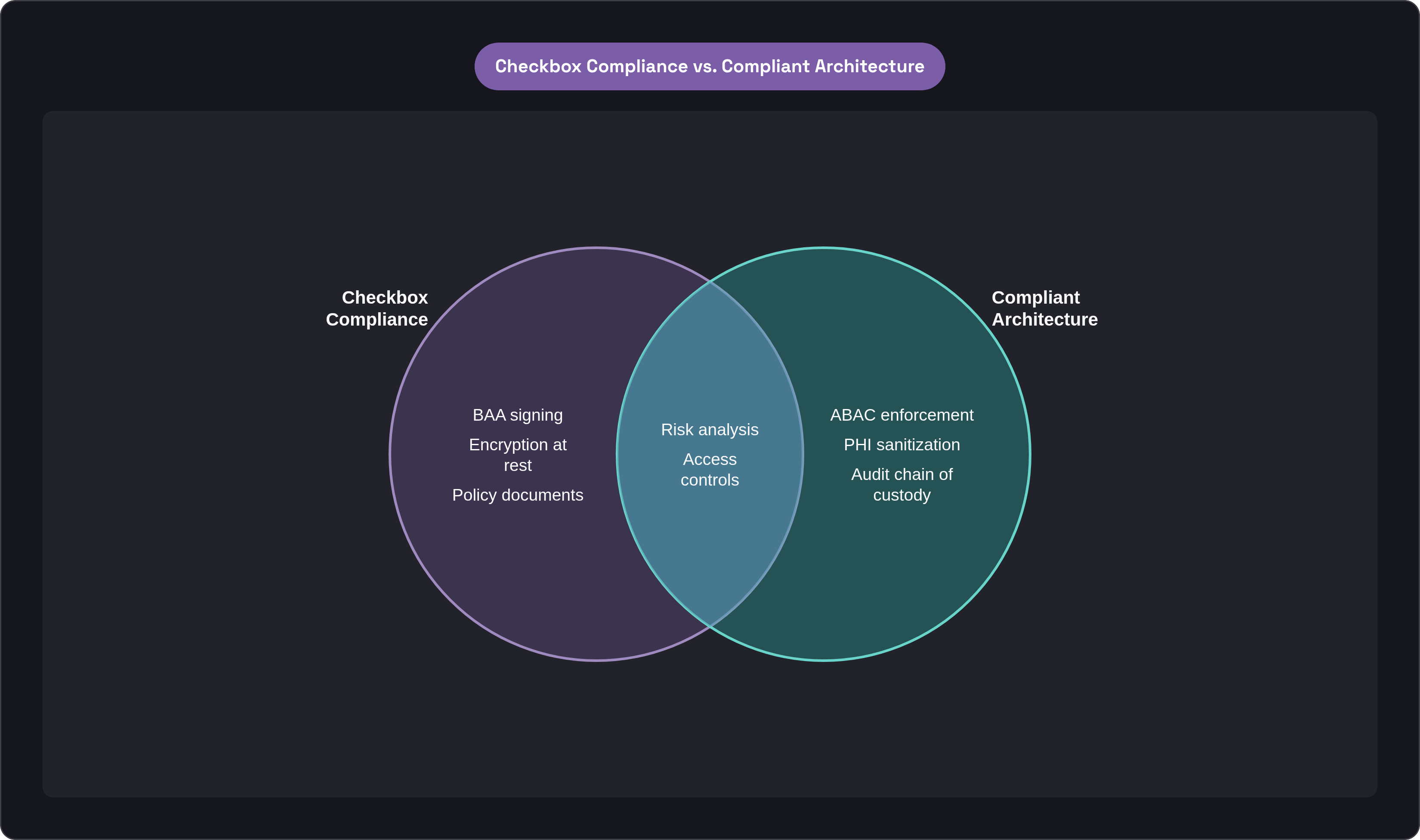
Healthcare has been the most breach-costly sector for years now, and the usual response is to reach for the same old toolkit: sign a business associate agreement, turn on encryption at rest and in transit, write a policy document, call it done. That toolkit covers the perimeter fine. It does almost nothing for the interior, and the interior is exactly where AI quietly changed the shape of the whole problem.
Think about what happens when a chatbot summarizes a patient's chart. Your database access controls can be airtight, row-level security dialed in perfectly, and the model can still spit out protected health information in its output, because nobody bound the model to the same access logic that governs the database. Train a model on clinical notes and it can embed PHI directly in its weights, where it sits long after the source record gets deleted. You can purge the EHR entry. You often cannot purge what the model already learned from it. Retrieval-augmented systems and agentic pipelines make this worse, since they pass patient context between components in ways row-level database security was never built to police. The tools that protect a SQL query have no idea what to do with a prompt.
So the shortcut a lot of organizations reach for, wrapping a commercial large language model and signing a BAA, can't show agent-level chain of custody. It can't demonstrate minimum-necessary access at the point where the model actually consumes data. And it can't produce an audit trail that holds up to what enforcement expects now. This piece walks through what an actually compliant architecture looks like, layer by layer, and how that differs from checkbox compliance, where the policies exist on paper but nobody built the system underneath to honor them.
What the current enforcement environment actually requires from AI deployments
The 2025 proposed overhaul of the HIPAA Security Rule is the first major rewrite in something like two decades. The change that matters most for AI deployments is structural: it kills the old split between "required" and "addressable" safeguards. Under the old framework, addressable safeguards gave covered entities room to argue a given control wasn't reasonable for their environment. That wiggle room is gone now. What used to be optional is mandatory.
Buried in the overhaul is a requirement that changes how AI systems get treated on paper: covered entities now need a written technology asset inventory, and it has to include AI software touching ePHI. That's not a footnote. Your clinical NLP system needs to show up in the risk analysis as a named, documented asset, with its own controls listed and a documented call on what residual risk the organization accepts by running it. A model drafting discharge notes now sits on the same inventory as your firewall.
There's also a shift in what "compliance" means day to day. OCR used to care mainly whether you'd performed a risk analysis. Now the weight has moved to risk management: finding a gap in your AI pipeline isn't enough anymore. OCR wants documented remediation, a paper trail showing the gap actually closed, not just written down somewhere and forgotten.
Meanwhile the threat landscape keeps drifting toward vendors. Business associates are now the fastest-growing source of healthcare breaches, and third-party involvement in breach events roughly doubled year over year heading into 2025. Every AI vendor plugged into your stack is a business associate, and every one adds surface area.
One case is worth sitting with, mostly because none of the failures in it were exotic. A regional health system deployed an AI clinical documentation assistant, the kind that listens in on a visit and drafts the note. OCR's investigation found the model pulling records well beyond what the task minimally needed. Audit logs weren't detailed enough to reconstruct who accessed what, when, or why. The risk analysis had never been updated to include the AI system at all, despite it touching patient data every single day. The settlement landed in the multimillion-dollar range. These were architectural gaps baked in from the day the system went live, not some novel failure mode nobody saw coming.
One more wrinkle worth flagging: under the 2025 amendments, a risk analysis written before a new AI deployment counts as an audit finding on its own. You can't point to an analysis from two years back and call it current if you've since changed your agent topology, added a model, or connected a new data source. Any material change triggers a new analysis. With that bar set, the rest of this piece walks the architecture layer by layer, starting with where PHI actually travels inside an inference pipeline.
How PHI moves through a clinical NLP inference pipeline and where it becomes exposed
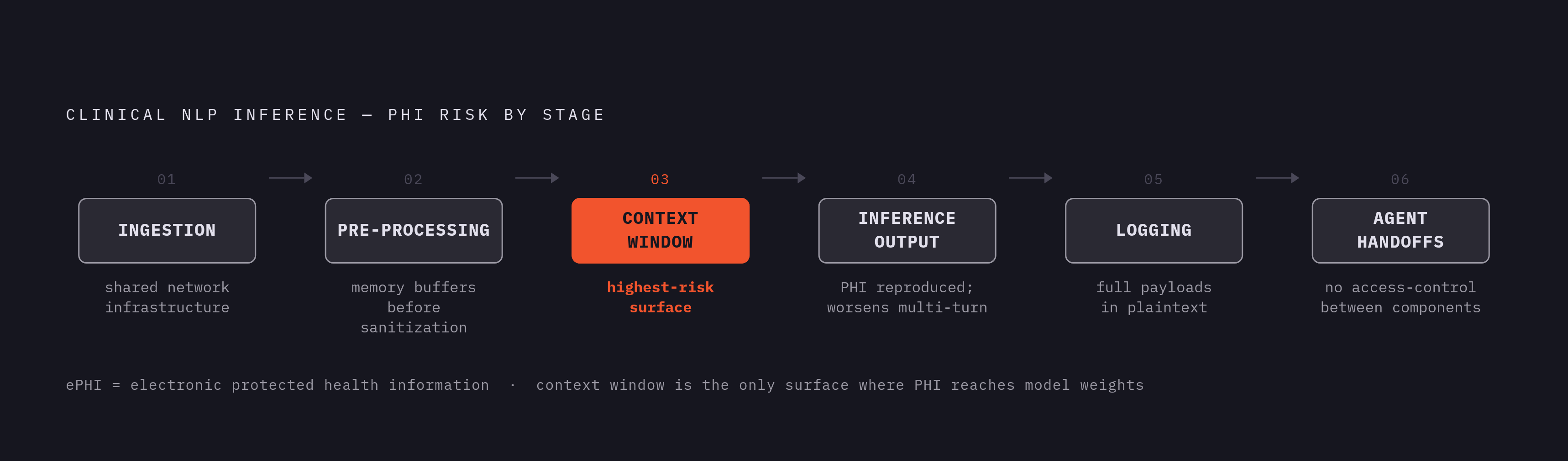
Trace what actually happens to a piece of clinical data. It starts in the EHR or as a raw note, moves through ingestion, gets pre-processed, lands in the model's context window, triggers inference, produces an output, and finally gets logged. Six stages, six separate places something can go wrong. Treating "the pipeline" as one black box misses where the real risk sits.
At ingestion, raw ePHI often crosses shared network infrastructure between systems that may not even share the same security posture. During pre-processing, PHI sits in memory buffers, intermediate storage, message queues, frequently before any sanitization has touched it. That's an exposure window that's easy to miss precisely because nothing looks "stored" in the usual sense; it's just sitting there briefly, unencrypted, waiting its turn.
The context window is the highest-risk surface in the whole pipeline. Whatever text reaches the model, whether that model runs on-prem or in the cloud, is what the model actually works with and can act on. Inference output carries its own risk too: a model can reproduce PHI straight from its context, and this gets worse across multi-turn conversations, where something from three exchanges back can resurface in a response the user never expected to touch that data at all.
Then there's logging, and this one bugs me because it's so avoidable. Debugging and tracing infrastructure routinely captures full request and response payloads for troubleshooting, and it's remarkably common for that logging layer to store PHI in plaintext without anyone deciding that should happen. Nobody sits down and chooses to log patient names in cleartext. It happens by default, because logging frameworks were never built with PHI in mind to begin with.
Agentic pipelines multiply all of this. When multiple agents pass context, patient data included, between each other to finish a task, you end up with more exposure surfaces than anyone actually decided on. That surface emerged from stacking agents together without asking where the data goes at each handoff. And here's the harder problem underneath it: minimum-necessary access is much tougher to enforce at inference time than at query time. A database query gets scoped by access control rules before it ever runs. A prompt, though, is usually built by application logic rather than an access control system, so by the time the model sees it, the access decision was made somewhere upstream and maybe never got checked against policy at all.
Four places end up holding the real architectural decisions: access control, sanitization, the model serving environment, and audit. Access control comes first, since it's the gate everything else sits behind.
Attribute-based access control as the mechanism for minimum-necessary enforcement at inference time
Role-based access control is the tool most healthcare IT teams reach for first, and it's simply not built for this job. RBAC grants access by job title: a clinician role gets clinician-level access, period. It has no way to weigh the sensitivity of a specific resource, the clinical context of a specific request, or the relationship between the person asking and the patient in question.
Here's the gap made concrete. A single "clinician" role might legitimately need ICU notes for one patient under their care, while that same role should be completely locked out of a different patient's psychiatric records. RBAC has no vocabulary for that distinction; both look like "clinician access requests" to the role system, which approves or denies at the role level, not the request level.
Attribute-Based Access Control, laid out in the ACM's 2025 framework tied to §164.312(a)(1), fixes this by weighing several factors dynamically, before the prompt even gets assembled. It checks who the user is, how sensitive the resource is, and what the surrounding context looks like, all before deciding what the model even gets to see.
In practice, ABAC governs which record types a given user, in a given context, can pull. It checks whether the session itself (location, time of day, device type) meets policy. And it applies sensitivity tags to categories like psychiatry notes, substance use treatment, HIV status: categories carrying legal protections stacked on top of baseline HIPAA. These often carry stricter rules than ordinary medical records, and a policy engine has to know that going in.
Worth building on top of ABAC: a semantic governance layer, a policy engine enforcing these rules not just at retrieval but across every downstream action an agent takes. That stops a second or third agent in a pipeline from inheriting context it never would've been cleared to request on its own. Skip that layer and an agent can end up holding data it was never supposed to see, simply because another agent handed it over.
ABAC is policy architecture that has to get designed before the inference pipeline is built. Retrofitting it once a system is live is exactly where minimum-necessary violations tend to start; the shortcuts baked in early are brutal to unwind later. Access control decides what PHI enters the pipeline in the first place. What happens to the PHI that legitimately makes it through is the next problem.
Designing the PHI sanitization pipeline across pre- and post-inference stages
The Safe Harbor de-identification standard under §164.514(b)(2) implies a two-stage discipline: scrub the data before the model ever sees the prompt, and filter its output before a human sees it. Neither stage alone gets the job done. Skip the first and raw PHI sits in the context window no matter how good your output filter is. Skip the second and whatever the sanitizer missed on the way in gets served straight to the end user.
A vendor's BAA doesn't replace pre-inference sanitization, and it's worth being direct about why. Defense in depth is the actual principle here: even a cloud model fully covered by a BAA can have an incident, and keeping raw PHI out of the context window is a separate control that doesn't lean on the vendor's security holding up perfectly. Minimum-necessary isn't only about which humans see what, either; it applies to what the model itself processes. Scrubbing before inference is a compliance obligation on its own terms, not just good hygiene.
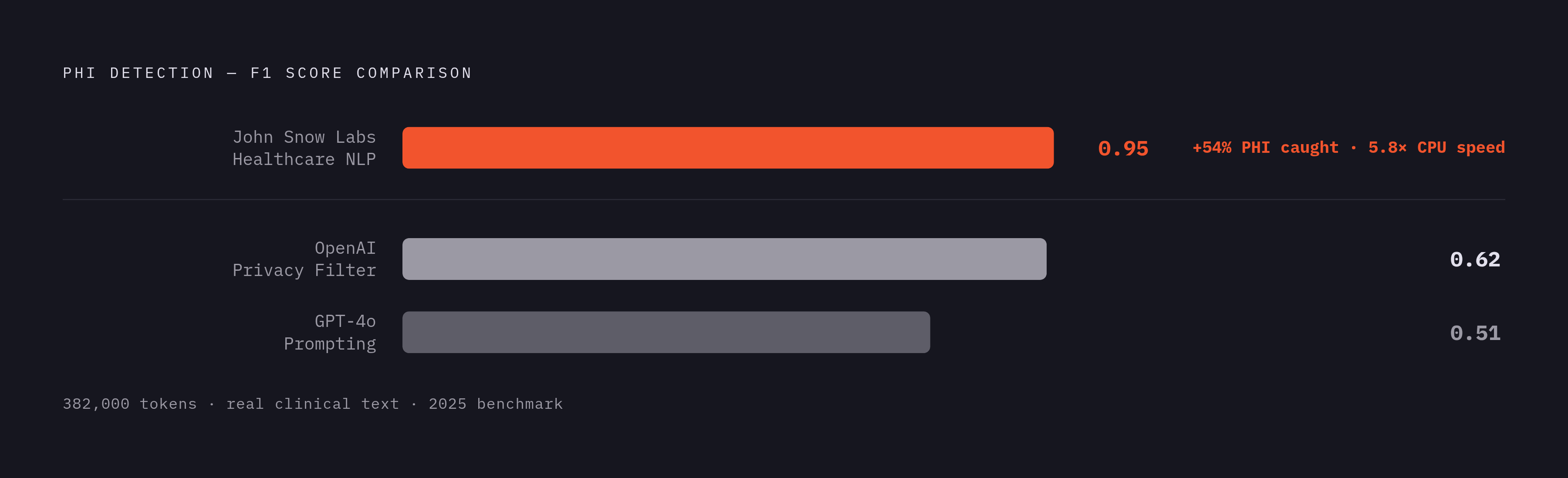
On tooling: a 2025 benchmark run against roughly 382,000 tokens of real clinical text is instructive. John Snow Labs' Healthcare NLP scored a 0.95 F1 on PHI detection, catching 54% more clinical PHI than OpenAI's Privacy Filter, at 5.8 times the speed on CPU. Cloud-based, zero-shot approaches using general-purpose models, GPT-4o style prompting, scored noticeably lower in the same benchmark. There's a separate problem worth naming here too: sending patient data to an external API just to scrub it can itself count as an unauthorized disclosure, depending on how that API is governed. Domain-tuned local models are becoming a real option, with the strongest ones approaching high-90s F1 on curated clinical test sets.
None of this gets you to zero, and that needs saying plainly. No pipeline hits perfect PHI detection. A 96% detection rate sounds great on a slide, but it means roughly one in twenty-five instances of PHI can still slip through unredacted. De-identification reduces exposure; it doesn't eliminate it. Output filtering and audit logging stay necessary precisely because the sanitization layer will never be airtight on its own. Treat a high F1 score as a risk-reduction metric, not a compliance guarantee, and build the rest of the pipeline assuming some PHI gets through anyway.
One pattern that works well: re-hydration. Scrub PHI before it reaches the model, swap in tokens or pseudonyms, run inference on the sanitized version, then swap the real values back in at the application layer once the model finishes. The clinical response stays coherent (the model still "knows" it's discussing a specific patient's labs) without the actual identifiers ever transiting the model itself.
Synthetic training data is a related strategy, aimed at model development rather than live inference. Training on synthetic clinical notes cuts PHI exposure during training, though it doesn't substitute for real-world validation once the model exists. The LPPA framework, published on arXiv in April 2025, demonstrates local fine-tuning on synthetic clinical notes specifically to avoid exposing real PHI during annotation, often one of the most labor-intensive and PHI-exposed steps in building a clinical model. Sanitization governs what the model processes. Where that processing physically happens, and who has custody of the data while it happens, is the next call to make.
Deployment topology choices and their compliance implications: cloud, on-premises, and sovereign AI
Three topologies dominate here, and each carries its own compliance profile.
Cloud inference under a BAA, think AWS Bedrock or Azure OpenAI configured with a signed business associate agreement, is a legitimate, widely used path. The provider commits contractually to HIPAA technical safeguards, and that commitment is real. But PHI still travels over the network to the provider's data center and gets processed on shared, multi-tenant GPU infrastructure alongside other customers' workloads. An organization running this way can't claim PHI never left its own perimeter, and that matters for certain state privacy laws, for especially sensitive data categories, and for organizations whose own risk tolerance won't accept it. The third-party breach surface isn't theoretical; business associate incidents keep climbing as a share of total healthcare breaches, as covered above.
Sovereign AI, meaning on-premises deployment, looks completely different. The health system runs its own AI platform on its own hardware, and PHI never crosses the perimeter. This removes the AI-layer BAA requirement entirely, since there's no third-party AI processor in the loop to sign one with. It shrinks the breach surface and hands the organization full control over data, models, and governance calls. The cost is real too: GPU infrastructure is capital-intensive, model maintenance becomes an ongoing burden the organization now owns outright, and on-prem networks can introduce latency issues cloud infrastructure was built to avoid in the first place.
Zero-egress, or on-device inference, pushes the principle further. Patient conversational data never leaves the device running the model, and inference doesn't even need a network connection. This turns data transmission into a category the architecture simply doesn't have, rather than one it manages down. It suits offline field environments, remote care settings, and operationally restricted contexts particularly well. The trade-off is capability: model size and on-device compute limit what the thing can actually do, so there's a real tension between privacy and sophistication that never fully resolves. It just gets negotiated differently depending on the use case.
Hybrid patterns split the difference. Federated architectures let different workloads run at different tiers: de-identification and access control on-prem, inference in a sovereign cloud environment, audit logging centralized across the system, with compliance controls governing each boundary crossing between tiers. And in certain sectors, additional frameworks narrow the field further still; military and government clinical AI deployments face constraints like DoD Instruction 8582.01 and FedRAMP that rule out entire architectures regardless of where they stand on HIPAA.
Confidant's architecture is one working example of the sovereign, on-device approach, built from the ground up for zero-egress inference. PHI never transits to a third-party AI provider in that setup, because the inference process itself doesn't need it. Topology decides who has custody of the data at each step; whether that custody can actually be demonstrated to OCR when asked is a separate question, and it's the audit layer's job to answer it.
Federated learning as a privacy-preserving path to multi-site clinical model improvement
Sovereign AI solves one problem and creates another. Keeping PHI entirely in-house stops third-party exposure, sure, but it also means the model never learns from what other institutions see. Even a large hospital system has a narrower slice of clinical variation than a network of ten or twenty. Federated learning is the architectural answer to that tension.
The mechanism is simple once you lay it out. Each participating institution trains a local copy of the model on its own patient data, entirely on its own infrastructure. Instead of sending patient records anywhere, it sends only the model's parameter updates (the numerical adjustments local training produced) to a central aggregator. That aggregator combines updates from every site and refines a shared global model, which gets redistributed back out. Patient data never leaves the building it started in.
Differential privacy adds another layer on top. Local updates get noise injected before transmission, which stops an attacker from reverse-engineering details about individual patients out of the parameter updates themselves; even the "just the math, not the data" version of sharing needs protecting. Privacy budgets, usually denoted with epsilon and delta, get tuned depending on how sensitive a given update is.
The performance question is usually where this conversation stalls, and the answer is more encouraging than skeptics expect. Federated models with differential privacy applied have reached accuracy in the mid-to-high 90s on clinical benchmarks, per a 2025 study in Nature Scientific Reports. The privacy mechanism doesn't gut the model's usefulness. It costs something, sure, but not the whole game.
Real challenges remain, and an honest architecture plans for them instead of pretending they'll sort themselves out. Computational overhead at each site is genuine; not every clinical environment has GPU capacity sitting idle for local training runs. Model convergence gets messy when participating institutions have wildly different data distributions, since a rural clinic's patient population looks nothing like an academic medical center's. Gradient updates can be targeted by adversarial attacks too, and secure aggregation alongside homomorphic encryption on the highest-risk operations offer partial mitigation, not a full fix. Underneath all the technical machinery, IRB approval and explicit patient consent frameworks have to be built into the federated architecture directly, because policy documents alone don't govern a system like this. The consent and oversight structure has to be part of the design, not tacked on after the fact.
The models running inside these architectures, centralized or federated, differ enormously in actual clinical NLP capability. Picking the right one for a given task is the last decision left on the table.
Clinical NLP model selection within a compliance-constrained architecture
Architecture constrains model choice more than most teams expect going in. A model that needs cloud inference simply cannot run in a zero-egress or fully sovereign topology; the model's size and serving requirements have to fit whatever deployment environment the compliance strategy already committed to. Choosing the model comes after choosing the topology, not before it.
Domain-specific models built for clinical language (BioBERT, ClinicalBERT, PubMedBERT among them) tend to run smaller and deploy on fairly modest infrastructure. They're strong on named entity recognition and classification, the kind of work involved in pulling structured data out of clinical text. PubMedBERT alone had racked up millions of monthly downloads by 2025, with benchmark scores on biomedical NLP tasks that hold up well against much larger, general-purpose models.
GatorTron sits at a different scale. It's a large clinical language model trained on a substantial corpus of de-identified EHR text from UF Health combined with public biomedical sources, and it beats earlier clinical transformer models across a range of EHR-focused NLP tasks. The catch is infrastructure: a model this size needs real GPU capacity to self-host, which immediately narrows which topologies can even run it. GatorTronGPT is the generative sibling, trained on a corpus that includes de-identified clinical text from roughly two million patients, and it's been evaluated specifically for clinical text generation alongside broader biomedical tasks.
Google's medical LLM family (Med-PaLM 2, Med-Gemini, MedGemma) sits at the far end of capability, with multimodal features and clinical reasoning that reaches expert-level benchmarks in published evaluations. These are cloud-hosted by default, though, which creates a direct conflict for any organization committed to a sovereign or zero-egress topology. The capability is real. The deployment fit just isn't there for every architecture.
One last piece of due diligence is easy to skip and shouldn't be. Most high-performing clinical models were trained on de-identified corpora, but the quality of that de-identification varies a lot from one training set to the next. A model can carry the artifacts of imperfect scrubbing somewhere in its training data, invisible until something surfaces downstream. Checking how a model's training data was governed, not just how it scores on benchmarks, belongs in the compliance review just as much as the F1 number does. Easy to skip, expensive to have skipped.