Data Residency Enforcement in Multi-Region AI Deployments
Infrastructure must enforce where data lives, not just policy documents.
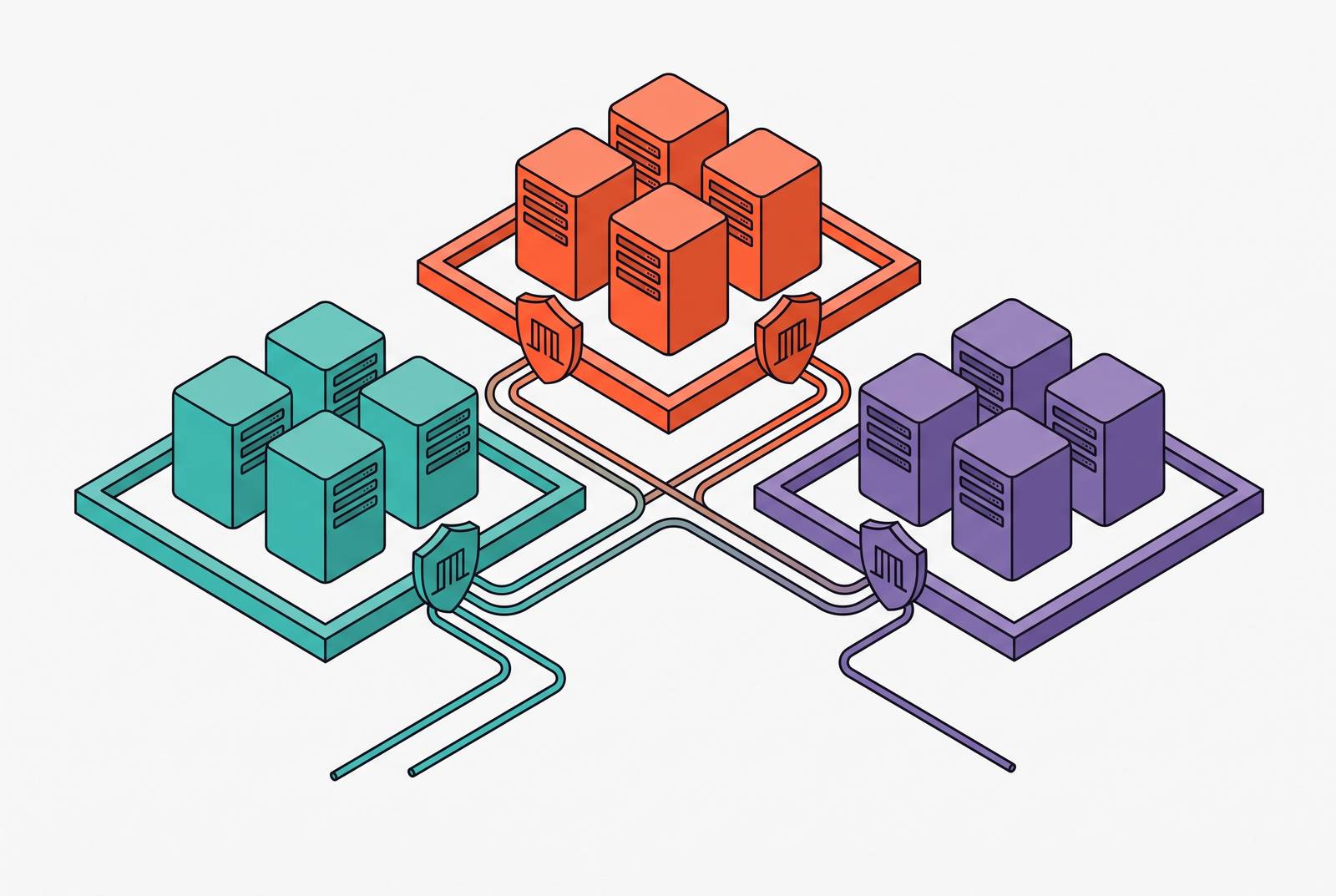
Enforcing data residency in a multi-region AI system is not something a compliance policy can do on paper. It has to be built into the infrastructure itself, because the moment data starts flowing through inference calls, embedding APIs, and logging pipelines, no legal document stops a load balancer from routing a prompt to the wrong country. This piece walks through why that gap exists, what regulators in different jurisdictions are actually demanding, where AI data quietly crosses borders without anyone noticing, and four architectural patterns that close the distance between policy and practice.
Three terms get used almost interchangeably in boardrooms, and that's where the trouble starts. Data residency is about where data physically sits: which data center, which country, which rack. Data sovereignty is about whose laws apply to that data, regardless of where it sits. Data localization is a step further still: a legal mandate that data must not only be stored locally but processed there too. An organization can satisfy the first term and still fail the second. Hosting a workload on a European region of a US-headquartered cloud provider checks the residency box, but the US CLOUD Act follows the company, not the server. Law enforcement in the provider's home country can compel that provider to hand over data sitting in another country, because the obligation attaches to corporate nationality, not geography. That single fact undoes a lot of assumptions enterprise legal teams have made about "going regional."
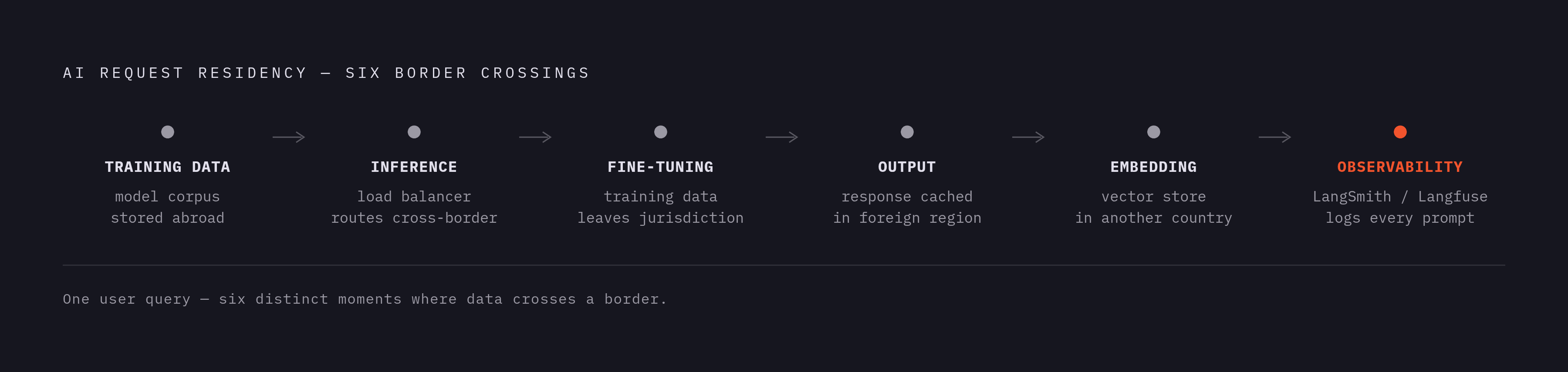
Traditional data residency was a storage question: where does the file live? AI turns that into a continuous flow problem, because a single AI request touches data at five or six different points, each with its own jurisdictional footprint. Training data residency asks where the model's original training corpus was stored and processed. Inference residency asks where computation actually happens when someone submits a query, since load balancers route to the nearest or least-loaded server, which might sit in a different country entirely. Fine-tuning residency asks where custom training data gets processed, and that can span regions even when an engineer thinks they've pinned it to one. Output residency asks where the generated response gets logged, since most providers retain prompts and completions somewhere in their infrastructure. Embedding residency asks what happens when a document gets sent to an external API to be vectorized. And observability tooling, LangSmith, Langfuse, and similar platforms, can log full prompts and completions to their own servers for debugging purposes. Every inference call is a small data transaction, and even data that only exists for a few milliseconds during inference can trigger sovereignty obligations if it crosses a border to get processed. AI systems are not just producing insights, they're creating fresh data liabilities at every single stage of the request cycle, and an organization that treats residency purely as a storage setting is going to miss most of them.
The scale of regulatory pressure enterprises are facing
Start with the enforcement record instead of the regulatory text, because fines tell a clearer story than statutes do. Meta was fined €1.2 billion. TikTok was fined €530 million. Uber was fined €290 million. None of those cases involved a breach. All three involved routine cross-border data flows that regulators simply decided did not meet the bar. That distinction matters: these were not failures of security, they were failures of architecture and legal basis.
Cumulative GDPR enforcement has reached €5.88 billion since the regulation took effect in 2018, with €1.2 billion of that landing in 2024 alone. Breach notifications hit roughly 443 per day in 2025, a 22% jump from the year before. Italy's data protection authority, the Garante, fined OpenAI €15 million over ChatGPT in 2024 for issues tied to training data transparency and GDPR violations (the Court of Rome later annulled that decision in March 2026, which itself says something about how unsettled this legal terrain still is).
Enterprises feel this pressure even where no fine has landed yet. In a Deloitte survey conducted in August and September of 2025, 73% of enterprises named data privacy and security as their top AI risk concern, and 77% said a vendor's country of origin now factors into AI purchasing decisions. Separately, more than 70% of organizations cited data residency as a top concern when expanding AI capabilities across borders, yet only 33% said they had full visibility into where their data actually lives. Seven in ten enterprises are worried about something that two in three of them cannot actually see.
Gartner tracked a 305% rise in client inquiries about cloud sovereignty and what it calls "geopatriation" in the first half of 2025 alone, a term Gartner introduced in its Top Strategic Technology Trends for 2026 to describe organizations moving workloads off hyperscale public clouds they see as carrying geopolitical risk, toward alternatives that offer more sovereign control. Gartner projects that by 2030, more than 75% of European and Middle Eastern enterprises will have geopatriated at least some workloads, up from under 5% in 2025. That's not a niche IT concern anymore. That's a boardroom-level shift in how enterprises think about where their infrastructure physically and legally sits, and it's happening because the 33% visibility gap noted above is exactly the space that architecture, not policy, has to fill.
What each major jurisdiction requires of AI systems
Enterprises today manage customer identity data across more than 190 countries while navigating upward of 120 data protection regulations. The fragmentation itself creates the operational difficulty, not any single rule in isolation.
Start with the European Union. GDPR does not require that personal data be stored locally, but it does restrict transferring that data to countries lacking "adequate" protection, and organizations lean on mechanisms like Standard Contractual Clauses, Binding Corporate Rules, or formal adequacy decisions to move data lawfully. The CLOUD Act causes an EU-region deployment on a US-headquartered hyperscaler to remain reachable by US legal process no matter where the servers physically sit. Layered on top of GDPR is the EU AI Act, which entered into force on August 1, 2024, with obligations for general-purpose AI models kicking in August 2, 2025, and high-risk system obligations following on a subsequent deadline. High-risk systems under Annex III need documented data governance, bias detection procedures, and risk management systems maintained across the model's entire lifecycle, plus automatic logging. Penalties under the AI Act can reach 7% of global turnover, which is higher than GDPR's ceiling. In April 2025, a European data protection oversight body released a (non-binding) risk management framework for large language models, produced under its Support Pool of Experts programme, stating that regulators need actual evidence, not assumption, that personal data cannot be extracted from a model before its output can be treated as anonymous. On the transparency side, a voluntary GPAI Code of Practice produced a Model Documentation Form in July 2025, and the European Commission followed with a Public Summary Template later that month, requiring, for the first time, public disclosure of basic facts about training datasets. France's CNIL issued guidance in June 2025 clarifying that "legitimate interest" can serve as a legal basis for training AI on publicly scraped data, though that guidance leaves copyright and database rights questions untouched.
The United States looks almost inverted by comparison: no federal AI or data residency law exists, and the landscape is stitched together from sector rules and state legislation, with 20 states now carrying comprehensive privacy laws as of 2025. California's Privacy Protection Agency updated CCPA rules to add annual cybersecurity audits, risk assessments, and automated decision-making requirements, effective January 1, 2026. Separately, a federal agency's Data Security Program, sometimes called the Bulk Transfer Rule, restricts bulk transfers of sensitive personal data and government-related data tied to six listed countries: China (including Hong Kong and Macau), Cuba, Iran, North Korea, Russia, and Venezuela. Its main prohibitions took effect April 8, 2025, with compliance program requirements following on October 6, 2025. The penalties are not symbolic: civil fines can reach $377,700 per violation, and criminal penalties reach up to $1 million and 20 years in prison. And the CLOUD Act sits over the entire US framework, letting law enforcement compel American companies to produce data even when it's stored abroad, which is precisely the sovereignty gap that a European server location alone cannot close.
China runs the tightest localization regime among major economies. PIPL requires personal data collected in China to stay within China for critical information infrastructure operators and for processors that exceed volume thresholds set by China's cyberspace regulator; other processors can move data abroad, but only through a security assessment, certification, or standard contract mechanism. AI systems handling data tied to Chinese citizens need to train and process that data inside China's borders. More than 302 generative AI services have registered under China's mandatory algorithmic disclosure regime. Shanghai authorities issued the first administrative penalty for unlawful cross-border data transfer in September 2025, setting an enforcement precedent that other regions are likely watching closely.
India's approach sits in between. The DPDP Act of 2023 doesn't impose blanket localization, but it gives the government power to whitelist or blacklist specific countries for data transfers. Sector regulators are considerably stricter than the general law: the RBI requires payment system data to stay exclusively in India, and sector regulators impose analogous in-country requirements across other regulated industries.
A handful of other jurisdictions are tightening fast. Indonesia mandates local data centers for specific categories of data. Vietnam's first national data protection law took effect in 2026, alongside a Cybersecurity Law that already required local storage of user data. Saudi Arabia's PDPL, enacted in September 2021 and fully enforced since September 2024, introduced its own residency provisions. Brazil's LGPD continues to evolve along lines that closely track GDPR. As of 2026, at least 34 countries have some form of national data localization law on the books.
Put the whole map together and the pattern is unmistakable: no two jurisdictions want the same thing. An architecture built to satisfy GDPR can violate PIPL outright. A setup that keeps India's sector regulators happy can still run headlong into the DOJ Bulk Transfer Rule. Which raises the real design question: can any single global architecture actually satisfy all of this at once, or does the infrastructure itself need to become jurisdiction-aware rather than jurisdiction-agnostic? The answer, covered in the final section, leans firmly toward the latter.
Where AI data moves inside a multi-region deployment, the hidden transfer points
Most AI infrastructure is built for global reach as a default setting. Data moves freely between regions unless someone actively configures a boundary to stop it, which means the burden of proof sits backward: the system assumes permission to move data everywhere, and compliance teams have to hunt down every point where that assumption needs overriding.
Inference routing is the most basic example. Load balancers send requests to whichever server is nearest or least busy, and that server can easily sit in a different country than the user. A query typed in one city might get processed on a server in another country without anyone in the loop realizing it happened. Per-token API inference compounds this: every request sends the actual prompt content to the API provider's infrastructure, and for workloads touching personal data, health records, financial details, or proprietary business information, that is a data transfer to whatever jurisdiction the provider operates in. Most vendor data processing agreements were written before generative AI became common, and they often say nothing specific about inference data, whether prompt content feeds back into model training, or which sub-processors might touch that data downstream. Enterprise teams need to go back to vendors and request AI-specific DPA addenda that spell out inference data handling, deletion timelines, and sub-processor disclosure, because the standard boilerplate simply doesn't cover it.
Embedding APIs create a secondary, often overlooked transfer: calling an external embedding endpoint sends the full document off-premises to get vectorized, and that transfer usually isn't addressed in the same DPA that covers the main inference relationship. Managed vector database services such as Pinecone or Weaviate Cloud store chunked documents on their own infrastructure, potentially in jurisdictions the deploying organization never reviewed. Retrieval-augmented generation pipelines leave retrieval logs and document chunks sitting in those vector stores, frequently with no retention or deletion policy tied to regional rules at all. Observability platforms built for debugging can log complete prompts and completions to a third jurisdiction that has nothing to do with either the user's location or the model's hosting region. Model registries and hub downloads log access metadata, and fine-tuning pipelines can move training examples and model weights across regions during checkpoint storage without anyone flagging it as a transfer. Even caching layers, prompt-response pairs sitting in GPU memory, on SSDs, or in cloud storage buckets, create residency exposure that lives between the inference layer and wherever data finally comes to rest.
Major providers' default retention practices matter because most organizations inherit these defaults without examining them. OpenAI's API retains data for 30 days for abuse monitoring, with Zero Data Retention available to organizations that qualify for it. Anthropic's Claude API cut its retention window from 30 days to 7 days as of September 2025, and offers its own ZDR addendum. AWS Bedrock does not store or log prompts and completions at all, keeping data in whatever region the customer selects. Azure OpenAI stores data within the resource's Azure geography, and its EU Data Boundary keeps processing inside the EU for EU customers specifically. Google Vertex AI retains data for abuse monitoring for somewhere between 30 and 55 days, with regional deployment options documented for customers who need them.
None of these defaults should be treated as a compliance strategy on their own. Each layer, inference, embedding, vector storage, observability, caching, needs its own explicit residency decision made by the organization deploying it. Inheriting a platform's global routing logic and calling that a residency policy is how the fines mentioned earlier actually happen.
Four architectural strategies for enforcing residency boundaries by design
Each pattern below offers a different compliance guarantee, and each comes with its own operational cost. The right choice depends on which jurisdictions actually apply to a given workload, not on which pattern is newest or most talked about.
Regional data siloing builds fully separate infrastructure per region: distinct data stores, distinct model deployments, distinct everything. It's the easiest pattern to explain to a regulator and the easiest to audit, because there's no ambiguity about where anything lives. Infrastructure spend and operational overhead both climb, though: every model update or product change has to roll out independently to each regional silo rather than shipping once globally. This pattern fits China's PIPL localization mandate well, and it fits India's sector-specific requirements from the RBI, SEBI, and IRDAI, along with any jurisdiction whose law explicitly demands in-border processing rather than just in-border storage.
Federated architecture with local processing takes a different approach: raw data never leaves its region of origin, and only anonymized or aggregated model updates travel to a central point. That lets a global model keep improving without raw personal data ever crossing a border. The catch is that "anonymized" has to mean something legally defensible, not just technically convenient. The EDPB's April 2025 guidance sets a fairly demanding bar here: to call a model's output anonymous, there needs to be actual evidence that personal data cannot be extracted from the model through reasonable means, and that outputs don't relate back to the specific people whose data trained it, with the likelihood of either happening reduced to something insignificant. That's a verification requirement, not an assumption an engineering team gets to make on its own. This pattern suits healthcare and financial AI, where data sensitivity is highest, and situations where a single global model needs to learn from usage across many regions without ever centralizing the underlying personal data.
Data classification with selective residency enforcement sorts data by sensitivity and regulatory category the moment it enters the system, then routes each category to wherever it needs to live. Anonymized analytics and aggregated telemetry can move across regions freely, while personal information, health data, financial records, and anything touching the DOJ's six countries of concern gets locked to its region of origin and routed through restricted pathways with restricted vendor access. This requires a policy engine sitting in front of every data movement decision, checking it against jurisdiction-specific rules before letting it proceed. An organization doesn't need to replicate its full infrastructure stack for data that was never going to be sensitive in the first place, which makes this the more operationally efficient option among the four, provided the classification logic itself is accurate and kept current.
Sovereign cloud deployment goes a step further than a standard regional cloud setup. It creates cloud environments that are physically and logically separated in a way that guarantees data stays inside a specific country's borders, structurally, not just by configuration choice. Hyperscalers have built dedicated offerings in response to this demand: AWS runs a European Sovereign Cloud, Google offers its own Sovereign Cloud, and Microsoft has Cloud for Sovereignty. The distinction that matters here is that a sovereign cloud can resolve where data resides and, depending on ownership and operational structure, can also close the sovereignty gap that a standard regional deployment leaves open, since the CLOUD Act ultimately concerns corporate jurisdiction, not server geography. That's the piece a purely regional deployment on a foreign-headquartered hyperscaler cannot fix on its own, no matter how carefully the region is chosen.
Looking across all four patterns, the common thread is that residency has to be decided at the architecture layer, upfront, for every stage of the AI request cycle covered earlier: training, inference, fine-tuning, embedding, and logging. Policy documents describe intent. Only infrastructure enforces it.