How to Verify a Vendor's Differential Privacy Claims
A practical checklist for pressure-testing vendor claims before buying.
The differential privacy market is set to jump from $1.8 billion in 2025 to $2.31 billion in 2026, a 28.1% annual growth rate, with The Business Research Company projecting the market will carry to $6.26 billion by 2030. That kind of growth pulls in vendors of wildly different quality, and it puts buyers in a bind: how do you tell a mathematically sound implementation from a marketing claim dressed up in dense mathematical notation? This piece walks through the specific questions, documents, and audit methods that let a buyer actually pressure-test a differential privacy claim before signing a contract, rather than just taking a vendor's word for it.
The stakes here are not abstract. De-identification, the older privacy technique that DP is increasingly replacing, has a track record of quiet failure: de-identified datasets have been repeatedly re-identified, often using surprisingly little outside information (Security Boulevard, September 2026). Differential privacy promises something de-identification never could, a provable mathematical bound on what an attacker can learn about any one person from a dataset's output. NIST said outright in Special Publication 800-226 that a vendor can claim re-identification is "impossible," and, absent a shared standard, there's no consistent way for a buyer to check that claim. That gap is what this article is meant to close.
What a vendor promises when it says "differential privacy", and where those promises can fall apart
The formal definition is not complicated to state, even if the math behind it takes some sitting with. A randomized algorithm is called ε-differentially private if, for any two datasets that differ by just one person's record, the probability of getting any particular output changes by no more than a factor of eᵉ. Epsilon is the privacy budget: the smaller it is, the harder it becomes to tell one dataset from the other by looking at outputs. That difficulty is what stronger privacy means in practice.
Then there's delta. Approximate DP, written (ε,δ)-DP, allows the mechanism to fail the pure privacy guarantee with probability delta. Common guidance sets delta well below 1 divided by the size of the dataset, so that the failure probability shrinks as the dataset grows. That sounds like a minor technical footnote. That sounds like a minor technical footnote, but it isn't. A vendor could hit a delta that's technically small in absolute terms but still large relative to a modest-sized dataset, and the guarantee would be far weaker than it looks on paper.
Composition adds another wrinkle. Every query against a privacy-protected dataset spends some of the privacy budget, and running multiple queries adds up the privacy loss. Basic composition just sums the epsilons; advanced composition theorems can do better than simple summation, but only at the cost of a small added delta. A vendor who tracks per-query epsilon but not cumulative epsilon spend across a session is not actually enforcing the guarantee it advertises.
None of this is one-size-fits-all, either. NIST SP 800-226's Table 1 lists several DP variants (pure DP, approximate DP, Rényi DP, zero-concentrated DP, and others), and they are not interchangeable protections. There is no scientific consensus on what epsilon value counts as "safe" for a given use case, and vendors can quietly exploit that gap. Values under 1 are generally treated as conservative; values used for public data releases often stay under 5. A vendor could pick an epsilon of 8 or 10, technically call the system differentially private, and offer protection that's weak in practice. Before evaluating anything else about a vendor, ask them to state, in writing, which DP variant they use, what epsilon and delta values apply, and how they account for composition across multiple queries.
The trust-model question vendors rarely answer upfront
Differential privacy comes in two basic flavors, and which one a vendor uses changes who you're actually trusting. In the central (or global) model, individuals hand over raw data to a curator, and the curator adds noise after aggregating everything. That only works if you believe the curator can't be compromised and won't misuse the raw data sitting on its servers. In the local model, each person's device adds noise to their own data before it ever leaves, so the curator never sees anything sensitive to begin with, and doesn't need to be trusted in the same way.
NIST's threat-model analysis notes that local DP gives stronger guarantees to any one individual, but the aggregated results tend to be less accurate than what the central model produces. NIST's threat-model analysis notes that local DP gives stronger guarantees to any one individual, but the aggregated results tend to be less accurate than what the central model produces, since noise added before aggregation compounds differently than noise added after. NIST also flags something buyers tend to skip past: understanding the implicit threat model matters because the model a vendor chose might not protect against the kind of attacker a buyer is actually worried about (PoPETs 2026).
So when a vendor says "we use differential privacy" without saying whether that's central or local, that omission is a missing answer to the question of what, exactly, the buyer is trusting the vendor to do. It's a missing answer to the question of what, exactly, the buyer is trusting the vendor to do. The question to ask directly: who adds the noise, your system or ours, and at what point in the data flow does that happen? For AI vendors specifically, this distinction cuts deep. A system built from the ground up so that sensitive data never reaches a central server at all is running a fundamentally different trust model than one that collects everything centrally and applies noise as a later processing step.
How NIST SP 800-226 gives buyers a structured evaluation framework
NIST published Special Publication 800-226, "Guidelines for Evaluating Differential Privacy Guarantees," on March 6, 2025. Joseph P. Near and David Darais wrote it, with Naomi Lefkovitz and Gary S. Howarth as editors, and it's aimed at a wide audience on purpose: policy makers, business owners, product managers, IT staff, software engineers, data scientists, and academic researchers.
The document's stated job is to help practitioners tell a genuine guarantee apart from what amounts to privacy theater, and it does this with flowcharts meant to walk through risk at each layer of a system. It also comes with interactive tools, sample code, and Python Jupyter notebooks that illustrate how noise calibration actually works in practice, rather than just describing it in prose.
Section B.7, "Evaluating Software Libraries for Differential Privacy," is the section buyers should read first, since it speaks most directly to procurement decisions rather than to researchers building new mechanisms. NIST's recommendation there is blunt: use well-tested implementations from established libraries instead of custom-built solutions, because custom code carries a much higher risk of subtle errors. Gary Howarth, the NIST scientist involved in the final publication, put the goal this way: the guidelines are meant to help leaders understand the trade-offs built into DP and understand what a DP claim actually means when a vendor makes one.
For a buyer, the practical move is to ask a vendor to map its implementation onto SP 800-226's framework directly, meaning which variant it implements, which deployment model it uses, and how noise gets calibrated. A vendor that can't or won't do this mapping has told you something important on its own. And the document is explicit that calibration isn't a "set it once" decision: applying noise incorrectly can either compromise privacy or wreck the usefulness of the data, sometimes both at once.
The NIST deployment registry for evaluating real-world DP implementations
NIST released an initial public draft of Internal Report 8588, "A Community-Driven Differential Privacy Deployment Registry," with public comments open through December 5, 2025. The idea is straightforward: build a shared, trustworthy database of real DP deployments so the industry has something to point to when arguing about what "best practice" actually looks like.
Three goals sit behind the registry. It's meant to help the industry converge on shared norms, give regulators a public snapshot of the landscape so they can judge new deployments in context rather than in a vacuum, and push vendors toward disclosing their implementation choices publicly instead of keeping them proprietary. An academic effort running in parallel, built with OpenDP and Oblivious, populated a registry prototype with a detailed schema covering 21 real-world deployments and ran a user study with 16 DP practitioners. That registry is live at registry.opendp.org.
It's not a frictionless process. Practitioners in that study flagged the real cost and risk of making implementation choices public, plus the ongoing work of moderating entry quality so the registry doesn't fill up with noise. Still, for a buyer, the registry is a reference class. Check whether a vendor's stated epsilon, deployment model, and noise mechanism line up with what's documented for comparable deployments elsewhere. An epsilon that's unusually high, or a delta that's undisclosed where comparable deployments disclose theirs, is worth a harder look. A vendor with no comparable public deployment to point to is essentially asking to be trusted with no external reference point.
Why implementation errors undermine mathematically sound designs, and how auditing methods catch them
A DP mechanism can be correct on paper and still broken in code. Implementations are notoriously prone to subtle bugs that quietly invalidate the theoretical guarantee, and catching those bugs is genuinely hard; a DP mechanism can be correct on paper and still broken in code. Formal verification tools tend to be too restrictive to apply broadly, while black-box statistical auditing struggles with complex pipelines and, even when it flags a problem, often can't say where the bug actually lives (PoPETs 2026, Issue 3, pp. 467-483).
History backs this up. Researchers demonstrated covert-channel attacks, including ones based on timing and internal state, against two well-known DP implementations, PINQ and Airavat; every attack tested worked against PINQ, and some worked against Airavat too. Separately, something as mundane as floating-point rounding has been shown to undermine the actual privacy guarantee a mechanism was supposed to provide, even when the underlying math was sound.
The field is responding with sharper tools. A 2026 paper in PoPETs introduced a "record-and-replay" auditing approach specifically built to catch implementation errors that black-box testing misses, representing something close to the current frontier of independent auditing. On the formal side, a tool called DiPApprox, presented at ACM CCS '25 in Taipei (October 13 to 17, 2025), can verify (ε,δ)-differential privacy for programs built on Gaussian and Laplace noise, and it's been validated against foundational mechanisms like the Gaussian Sparse Vector Technique and Noisy Max. There's also a cryptographic route: US Patent 12,536,161 B2, issued to Visa International on January 27, 2026, describes a method for efficiently verifying that query results are genuinely differentially private. And for buyers who can't get access to source code at all, black-box auditing methods using sequential, anytime-valid statistical tests can estimate privacy loss from the outside.
The question to bring to a vendor is simple even if the tools behind it aren't: has the implementation been audited by an independent third party using statistical or formal methods, and can they produce the audit report itself, not just a white paper summarizing it?
The documentation and contract clauses that separate credible vendors from those making unsupported claims
A few specific asks separate a vendor doing this seriously from one riding the marketing wave. Written epsilon and delta disclosure comes first: the specific values, the DP variant in use, and the method used to account for composition across repeated queries, all in writing rather than in a slide deck.
Threat-model disclosure matters just as much. Ask whether the system runs a central or local model, who in the data flow is actually trusted, and against which classes of attacker the guarantee is meant to hold. Library provenance is another marker: per NIST SP 800-226's own recommendation, a vendor using an established, well-tested library carries a different risk profile than one running custom code, and custom implementations need correspondingly stronger audit evidence to back them up.
Third-party audit reports separate rhetoric from substance. A vendor with only internal documentation to show has never had its own claims tested by anyone outside the building. Composition tracking deserves its own line item too: ask directly whether cumulative epsilon spend is tracked across queries over time, since a vendor that quietly resets the budget, or ignores composition altogether, isn't delivering the guarantee implied by its epsilon number.
Data retention rules affect whether a DP guarantee actually protects anyone in practice. A DP guarantee on outputs means little if the vendor is sitting on raw, unprotected input data somewhere in its systems; buyers should get clear deletion timelines and confirmation that noise gets applied before data leaves their own environment, not after. Finally, ask for the SP 800-226 mapping directly, and cross-check whatever numbers a vendor gives against registry.opendp.org. A vendor unwilling or unable to do either should be treated as unverified, full stop.
How privacy-by-architecture differs from privacy-by-configuration for long-term trust
NIST's warning about noise calibration goes deeper than a one-time setup step. If privacy is a configuration setting rather than something structurally built into the system, that risk doesn't go away after the initial deployment, it just sits there, waiting for a future change to reintroduce it.
Go back to the local-versus-central distinction from earlier: a vendor whose architecture physically prevents raw data from reaching its own servers is not asking a buyer to trust its internal controls, because the threat model is enforced by the structure of the system itself, not promised in a contract clause. SP 800-226 draws a related line between implementations built on well-tested, established libraries with documented composition tracking, and DP bolted onto an existing conventional data pipeline as an afterthought.
Ask vendors directly whether DP was designed in from day one or retrofitted onto a system that wasn't built with it in mind, since retrofits tend to leave gaps exactly at the seams where the new privacy layer meets the old data flow. A vendor worth trusting should be able to describe, with no hand-waving, what an attacker who saw every single query output could learn about any one person, and that answer needs to be bounded by the epsilon value they already gave you. For anyone handling health records, financial data, or other sensitive personal information, the architecture and the epsilon value are really the same issue, just examined at two different levels of detail.
A structured verification checklist buyers can use before signing
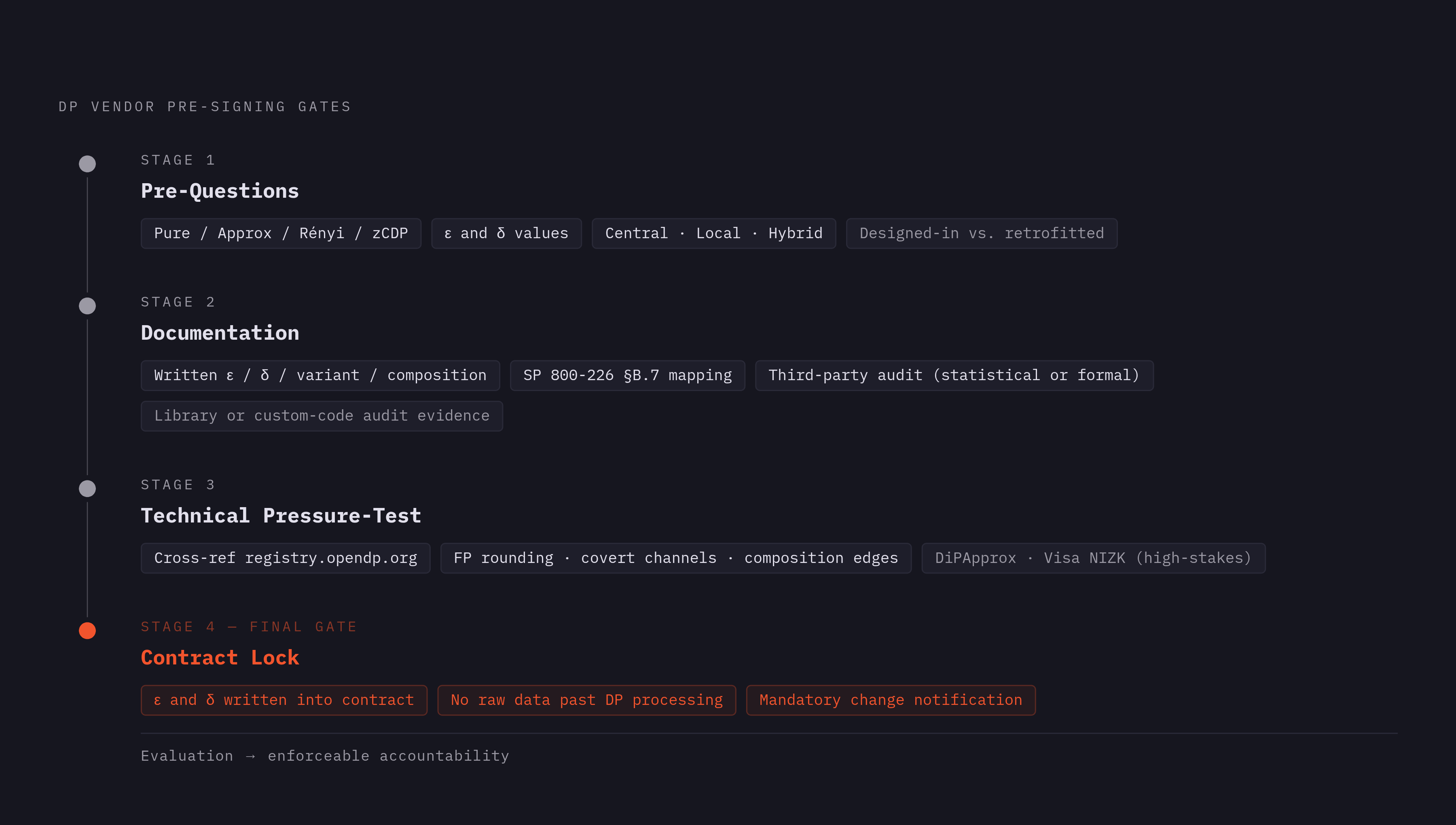
Before any technical review starts, get four questions answered: which DP variant is implemented (pure DP, approximate DP, Rényi DP, or zCDP, as categorized in SP 800-226's Table 1), what the stated epsilon and delta values are and for which specific operations, whether the trust model is central, local, or hybrid, and whether DP was designed into the architecture from the outset or added later.
On documentation, demand a written disclosure covering epsilon, delta, DP variant, and the composition accounting method, a mapping of the vendor's implementation to SP 800-226 (Section B.7 specifically), a third-party audit report built on statistical or formal verification rather than an internal white paper, and clear identification of which established library is in use, or, if the implementation is custom, the audit evidence that justifies that choice.
For technical pressure-testing, bring in advisors who can cross-reference the vendor's stated epsilon against comparable entries at registry.opendp.org, ask whether the implementation has been tested against known failure modes like floating-point rounding errors, covert channels, or composition edge cases, and for anything high-stakes, ask whether the vendor has been evaluated against formal tools like DiPApprox or cryptographic proof methods along the lines of the Visa NIZK patent.
None of this belongs in a slide deck alone. Get the epsilon and delta values written into the contract itself, alongside the marketing materials. Require that raw input data doesn't get retained past the DP processing step, and require notification if epsilon values, noise mechanisms, or composition methods ever change down the line. A market growing at a fast clip year over year is going to attract plenty of vendors happy to say and leave it there. The math behind the term is genuinely rigorous. Whether a given vendor's implementation lives up to it is a question with a specific, checkable answer, and buyers now have the standards, the registry, and the audit methods to go find it.
Sources
- How Differential Privacy Will Transform Enterprise Data Strategy - Security Boulevard
- Approximate Algorithms for Verifying Differential Privacy with Gaussian Distributions
- 12536161
- NIST Finalizes Guidelines for Evaluating ‘Differential Privacy’ Guarantees to De-Identify Data
- nvlpubs.nist.gov
- Who is using differential privacy? A new registry aims to make it visible
- nist.gov
- petsymposium.org