Cryptographic Proof of Data Deletion for AI Training Pipelines

Neural networks don't store personal data the way a database stores a row. They compress it into millions or billions of interdependent parameters, and once that compression happens, the individual record is gone in any structural sense. That single fact is why "delete my data" has become one of the hardest engineering and legal problems in AI, and why cryptographic proof, not procedural assurance, is emerging as the only credible answer.
Consider what happens during training. Stochastic gradient descent nudges every weight in a network a tiny amount based on each example it sees, and that nudge compounds across millions of iterations. By the time training finishes, a single data point's influence has been smeared across the entire parameter space. No index says "this weight corresponds to this person's medical record" or "that attention head learned from this specific email." A large language model doesn't retain text; it retains a statistical shadow of the corpus it was shown, with no back-reference to who contributed what.
That breaks every assumption baked into conventional data deletion. In a relational database, complying with an erasure request is close to mechanical: find the row, delete the row, log that you did it. AI training pipelines offer no row to find and no pointer to follow. The user who asked to be forgotten is structurally undeletable from the model that learned from them, even if their name never appears anywhere in the weights.
That's the problem this piece works through. It starts with what regulators now expect organizations to prove, moves through crypto-shredding as a partial fix for raw data stores, covers the current state of machine unlearning research, and then gets into the cryptographic proof mechanisms, Merkle commitments, zero-knowledge proofs, unlearning receipts, that are starting to close the gap between "we deleted it" and "here's mathematical proof we deleted it." The last section sketches what a layered, deployable proof-of-deletion stack actually looks like, because this stopped being an academic exercise the moment regulators started asking for evidence.
What regulators are demanding and the proof they expect
Regulators stopped accepting assertions a while ago. In March 2025, 30 European data protection authorities plus the European Data Protection Supervisor opened a coordinated investigation built around one question: can organizations actually prove they delete personal data when someone asks them to? The EDPB picked the right to erasure as its enforcement priority for the cycle, with findings expected in early 2026. Erasure is now a core GDPR compliance obligation. It's the test case regulators are using to see whether the entire framework holds up against modern AI systems.
The legal position that's crystallized alongside that investigation is blunt: training a model on personal data is processing, so Article 17 of the GDPR applies to the model itself, not just to whatever database fed it. That single interpretive move changes what "erasure" has to mean. Purging a customer record from a CRM isn't enough if that same record helped shape a model still running inference in production.
Italy's Garante already put a number on this. It fined OpenAI 15 million euros, the first generative AI penalty issued under GDPR, for processing personal data to train ChatGPT without an adequate legal basis. That penalty sits inside a much larger pattern: cumulative GDPR fines have now passed 5.88 billion euros, with a substantial share of that total issued in 2025 alone, signaling real financial risk for companies running training pipelines. Those aren't rounding errors. They tell any company running a training pipeline that data protection authorities are willing to price this risk in real money.
The EDPB has also been explicit that erasure must be verifiable and irreversible. Suppressing a record from query results, or flipping a flag so it doesn't appear in a search, does not satisfy Article 17. That distinction between suppression and actual deletion matters a great deal here, because most of what the AI industry currently calls "deletion" is suppression dressed up in different language. Call it what it is: a filter, not an erasure.
The EU AI Act adds a second, parallel obligation under Article 10, governing data practices across the entire lifecycle: design, collection, preparation, labeling, cleaning, enrichment, aggregation, bias examination, gap identification, documentation. High-risk obligations under Article 10 were originally set for August 2, 2026, but the Digital Omnibus (Regulation (EU) 2026/1744) pushed that deadline to December 2, 2027. Reading that delay as breathing room would be a mistake. The underlying obligation didn't disappear, and the fines attached to it are severe: up to 15 million euros or 3% of global annual turnover for Article 10 violations, and up to 35 million euros or 7% for prohibited AI practices.
Article 10 also requires that special categories of personal data get deleted once bias correction work is complete or a retention period ends, whichever comes first, and that records of processing explain why using those special categories was strictly necessary. By 2026, "the team reviewed the data" will not satisfy an auditor. Organizations need controls that can be checked after the fact, covering provenance, what changed during preparation, how bias was handled, and confirmation that the deployment context still matches what the data was originally collected for.
The pattern extends well past a single region. Deletion and erasure duties with evidentiary requirements now appear across more than a dozen regulated markets: GDPR and UK GDPR, California's DELETE Act, India's DPDP Act, China's PIPL, Brazil's LGPD, plus a growing set of financial services rules, health sector rules, and product-passport regimes. India's DPDP Act grants a right of erasure under Section 12 and mandates deletion on withdrawal of consent under Section 8(7). Yet the statute, like most of its peers, offers no technical guidance on what erasure actually means once data has trained a statistical model.
GDPR pushes toward rapid deletion. The EU AI Act requires long-term archival of system documentation. Naming the tension between the two demands keeps them visible instead of letting the drive to smooth it over hide the conflict organizations must actually resolve. Organizations building AI products now have to satisfy both at once: delete the personal data fast, but keep detailed records of how the system was built and governed for years. France's CNIL has already pointed toward machine unlearning and traceability as the components that resolve that tension, and industry commentary has started calling for deletion and unlearning to become callable operations with captured evidence attached, rather than one-off engineering favors granted when legal asks nicely.
Crypto-shredding: provable deletion of source data before and during training
If deletion can't happen the old way, hunting down and physically erasing every copy across a sprawling, distributed system, then the alternative is to make copies unreadable instead of unfindable. That's the entire idea behind crypto-shredding.
The mechanism is straightforward, even elegant. Each user's data gets encrypted with its own per-user key at the moment it's ingested. When a deletion request comes in, the system doesn't go hunting for every place that data might have landed. It destroys the one key. Once the key is gone, the ciphertext sitting in immutable logs, append-only event stores, and backups becomes cryptographically indistinguishable from random noise. The data is still physically present on disk somewhere, but it's mathematically inert.
That sidesteps the hardest operational challenge in data deletion: coverage. A typical AI pipeline doesn't hold one copy of a person's data. It holds several, scattered across systems that don't talk to each other on a deletion event. Crypto-shredding doesn't need to find every copy, because destroying a single key makes every copy encrypted under that key unreadable at once.
Proof matters as much as the mechanism here. A well-built implementation produces a signed, timestamped certificate from the key vault, embedding the key's fingerprint and a summary of its lineage. Chaining certificates together in this way forms a tamper-evident structure. Inserting or removing a certificate anywhere in that chain causes every certificate after it to stop linking correctly, which is a structure that breaks visibly under tampering rather than a log file someone can quietly edit. HSM or KMS audit trails add a second layer of confirmation that key destruction was secure and complete, and entropy analysis of the underlying dataset can confirm the file structure now reads as cryptographically randomized, with no recoverable pattern.
None of this is instantaneous, though. Warehouse snapshots and pipeline replay logs are often retained for 30 to 90 days, which creates a real exposure window during which source data could technically still be recovered before key destruction propagates fully through a system. A regulator asking how long after a deletion request the data actually became unreadable everywhere deserves a precise answer.
The limit that sits at the crux of the entire subject is this: crypto-shredding proves the source data is inaccessible. It does not prove that a trained model has unlearned the influence of that data. It's a control on raw data stores, ingestion pipelines, vector stores, and backup infrastructure, full stop. The weights of a neural network that already learned from that data before the key was destroyed sit entirely outside its reach. Treat crypto-shredding as one necessary layer in a compliance stack that leaves Article 17 as applied to a trained model unanswered. That question stays open until the next section.
Crypto-shredding also only works for systems that encrypt data at the individual level from day one. It cannot be bolted onto a model that already trained on plaintext data sitting in an unencrypted warehouse. That makes the case for privacy-by-design a hard technical requirement: the deletion mechanism has to exist before training starts.
Machine unlearning: the spectrum from exact removal to approximate influence reduction
Crypto-shredding handles the data going into a model. Machine unlearning tries to handle what's already inside one, and that turns out to be one of the genuinely hardest open problems in machine learning research.
Three broad families of approach exist, and each trades exactness for cost in a different way. Exact unlearning, meaning full retraining from scratch without the data point in question, gives the strongest guarantee available: the resulting model behaves exactly as if the data had never been there, because it never was. But retraining a large model from zero every time someone exercises a deletion right is computationally prohibitive at scale. It's realistic for simpler models. It is not realistic for a large language model trained across weeks on expensive hardware.
Approximate unlearning tries to get most of the benefit at a fraction of the cost. It updates model parameters using influence functions or curvature estimates to reduce a specific data point's effect on the model's behavior, without full retraining. That's efficient, but it carries a real weakness: the approximation offers no exactness guarantee, and there's no independent way to verify the influence was actually reduced to zero rather than just reduced somewhat. An auditor looking at an approximately unlearned model is taking the vendor's word for how close "approximately" gets to "actually."
SISA training (sharded, isolated, sliced, and aggregated) tries to structurally reduce the cost of retraining. Training data gets partitioned into shards and slices ahead of time, which localizes each data point's influence to a specific, known chunk of the training process. When an unlearning request arrives, only the affected shard needs retraining, starting from the last checkpoint saved before the slice containing that data point was introduced. Retraining cost falls substantially as the number of shards increases, a real efficiency gain over full retraining. Applied correctly, SISA offers a privacy guarantee equivalent to full retraining.
The catch is structural. SISA has to be designed into the training pipeline from the start; it cannot be applied retroactively to a model already trained without shard boundaries in place. Nor does it scale cleanly to large language models: checkpointing at the frequency SISA requires carries heavy computational and memory costs, and increasing the number of shards to reduce unlearning cost raises training and inference costs while degrading ensemble-level performance, since shards grow more heterogeneous the more finely you slice them.
A newer line of work takes a different route entirely: deterministic training combined with write-ahead logging, which turns the training process itself into a deterministic, auditable program rather than a black box that happens to produce a model. That framing is aimed specifically at operationalizing Article 17 for LLMs, achieving a deletion that is exact by construction. The deletion can be shown to be exact because the training process that produced the model, and the process that removes a data point's trace from it, are both fully specified and replayable.
Separately, researchers at UC Riverside presented a certified unlearning method at ICML in July 2025 in Vancouver that works without access to the original training data. That constraint affects how erasure claims can be verified, because in many real pipelines the original data is long gone by the time a deletion request lands: overwritten, archived elsewhere, or deleted for unrelated reasons. Their framework aims to erase private and copyrighted material from a trained model, and to certify that erasure, even when there's nothing left to compare the retrained model against.
Even with all of that progress, the field still lacks agreement on what "successful" erasure means in a probabilistic system. The NeurIPS 2023 Machine Unlearning Challenge tried to establish benchmarks for exactly this question, and the fact that a dedicated challenge was necessary tells its own story. There was no existing consensus to fall back on.
Unlearning research alone can't answer the question that matters most to a skeptical outsider: how would anyone, user or third-party auditor, actually verify a model has forgotten a data point? Comparing parameters before and after the claimed unlearning doesn't settle it, because prior work has shown a model's parameters can come out identical whether or not a specific data point was included in training. Same weights, different training histories. Unlearning can change a model. Proving to someone outside the company that the change happened the way it was claimed is a separate problem, and that gap is exactly where cryptography stops being optional.
Cryptographic proof mechanisms: Merkle trees, SNARKs, and verifiable unlearning receipts
Zero-knowledge proofs offer a way out of the verification impasse because of how specifically they fit this problem. A cryptographic proof technique lets one party certify that a computation, training run, evaluation, inference, produced a claimed result, without revealing the sensitive data or the proprietary parameters involved in producing it. A company needs to prove a deletion happened without exposing the rest of its training data or its model weights to the person asking for proof. That's exactly the shape of unlearning verification.
Researchers have formalized this specific application as a Zero-Knowledge Proof of Unlearning, or ZKPoU: a process that verifiably removes a specific training sample and its influence from an already-trained model, without revealing either the current or the revised model weights to the party checking the proof.
The foundational cryptographic definition for verifiable unlearning, developed by Eisenhofer and colleagues and updated in March 2025, lays out the mechanism in three steps. First, the server computes a proof that the model was actually trained on a specific, committed dataset. Second, when a deletion request for a data point arrives, the server runs its unlearning algorithm and updates the model accordingly. Third, the server produces a proof that the unlearning algorithm executed correctly, and that the deleted data point is genuinely absent from the new training dataset. The construction relies on SNARKs (Succinct Non-interactive ARguments of Knowledge) paired with hash chains, and it's been implemented and validated across three different unlearning techniques, tested against linear regression, logistic regression, and neural network models.
Merkle-tree commitments are the quiet infrastructure making the hash-chain side of this work. A commitment to the training dataset at an initial point in time, paired with a commitment to the post-unlearning dataset at a later point in time, creates an auditable record showing how the two data sets differ, and nothing else. Alter a single element anywhere in either committed set, and the chain breaks in a way that's detectable without needing to inspect the underlying data directly.
Putting the pieces together produces a verifiable unlearning receipt: proof of original training set membership, proof the unlearning algorithm ran correctly, and proof the target data point is absent from the resulting training set, all without exposing model weights or the rest of the training data to whoever is checking the receipt. That's a genuinely different object than a compliance memo asserting deletion happened. It's a chain of cryptographic artifacts that can be checked independently, by someone who doesn't have to trust the company that produced them.
The computational reality has to be stated honestly, though. Zero-knowledge proofs of training have historically been too expensive to run against large-scale neural networks. Recent advances have pushed ZKPoT into feasible territory for smaller, useful models, but the technique isn't yet deployable at the scale of a modern large language model without engineering investment that most organizations haven't made. This is active research territory, still waiting on a shelf product.
What makes this combination valuable is less any single proof and more the chain, linking a dataset commitment made at ingestion, a key destruction certificate from crypto-shredding, an unlearning execution proof, and a post-unlearning dataset commitment. Individually, each artifact proves something narrow. Together, they constitute something closer to a full account of what data went in, what was removed, and how the removal was verified, rather than a company's word for it.
This isn't purely a privacy-compliance conversation anymore. A joint cybersecurity information sheet issued by the NSA, CISA, FBI, and counterpart agencies in several allied nations explicitly recommended digital signatures and data provenance tracking across the AI system lifecycle. That's a national security framing, not a regulatory one, and it suggests cryptographic integrity in AI pipelines is turning into a baseline security requirement rather than a nice-to-have for companies trying to look good to auditors.
What a deployable proof-of-deletion stack looks like in practice
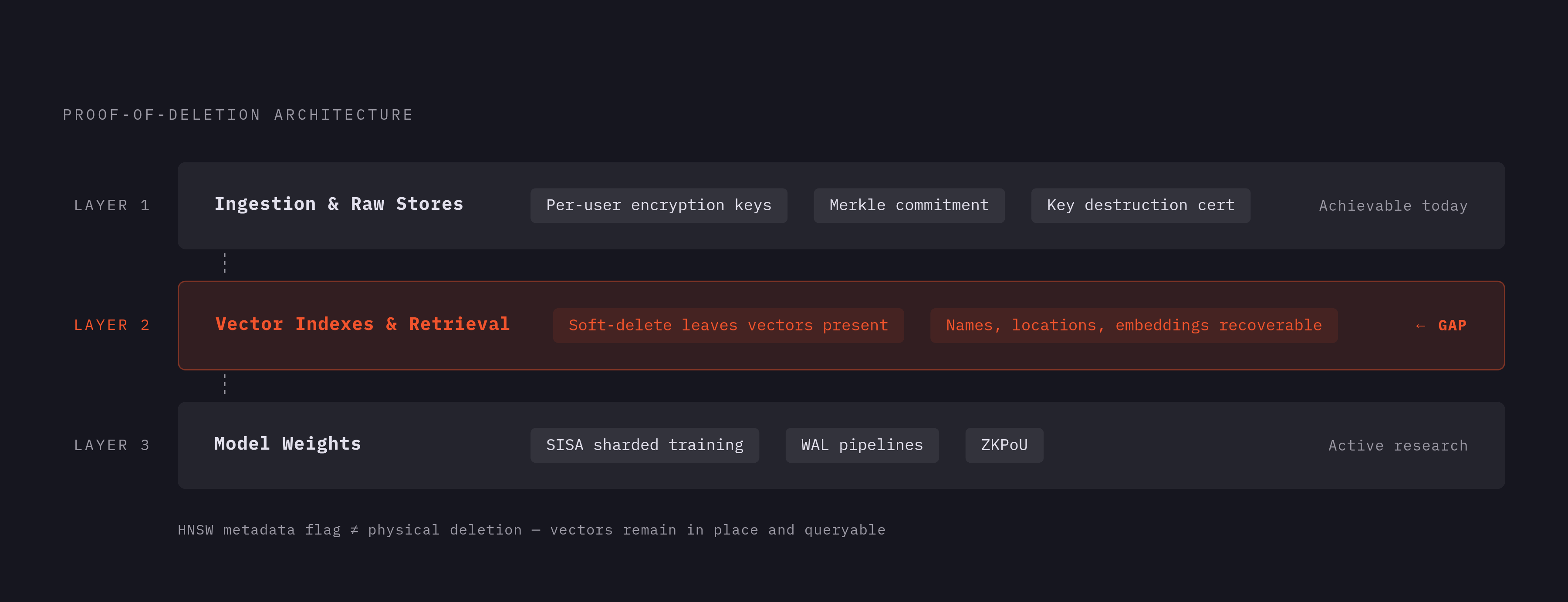
No single technique covers the whole deletion surface, and treating any one of them as sufficient is the mistake most organizations are still making. A defensible posture means layering mechanisms so each one covers the part of the pipeline it's actually suited for.
The first layer sits at ingestion and in raw data stores: per-user encryption keys applied from the moment data enters the system, a Merkle commitment to the training dataset captured at training time so there's a tamper-evident record of what went into the model, and key destruction certificates generated as auditable artifacts any time a deletion request comes in. This layer is achievable today with existing cryptographic tooling. It's the part of the stack organizations have the least excuse for not building.
The second layer covers vector indexes and retrieval systems, a quieter liability than most teams assume. Most HNSW-based vector stores handle deletion by flipping a metadata flag rather than physically removing the underlying vector. The data still sits in the raw index files at the storage layer, waiting for anyone who reads the disk directly. Research into soft-deleted embeddings found that a meaningful share of exact person names and geographic locations, and effectively all structured fields and facial embedding identities, remained recoverable this way. A proof-of-deletion stack that stops at the primary training corpus and ignores the vector database has left a substantial, working copy of supposedly deleted data sitting in plain reach. That's the failure mode most compliance teams don't even know to check for.
Layer three addresses what's already in the model's weights. This is where machine unlearning and its cryptographic proofs come in: SISA-style sharded training where architecturally feasible, deterministic and write-ahead-logged training pipelines where LLM scale makes SISA impractical, and zero-knowledge proofs of unlearning where the computational cost can be justified against the regulatory exposure of not having one.
None of these layers substitutes for another, and that's the point the entire piece has been building toward. Crypto-shredding without unlearning proves the wrong thing: that source data is gone, while the model's learned influence of that data stays fully intact. Unlearning without cryptographic proof changes the model but leaves an auditor with nothing more verifiable than trust in the vendor's word. And any stack that ignores the vector database and its soft-delete habits is building an audit trail with a hole in it wide enough to walk through.
Call the honest summary what it is: "unlearning-ready" architecture, one that generates cryptographic commitments at ingestion, tracks provenance through every fan-out copy, and can produce a verifiable receipt on demand, isn't standard practice anywhere in the industry yet. But regulators have made clear, through fines already in the billions and investigations aimed squarely at erasure, that bare assertions of deletion won't hold up much longer. The organizations building this proof chain now, before it's mandated rather than after, will be the ones with an answer ready when a data protection authority asks the only question that actually matters: prove it.
Sources
- Your AI Agent Remembers Everything. Can It Prove It Forgot? | by Manav Patel | Medium
- media.defense.gov
- The Right to Digital Erasure: Cryptographically Verifiable Machine Unlearning
- The User You Can't Delete: Right to Be Forgotten in AI Systems - TianPan.co
- Pioneering a way to remove private data from AI models
- A Framework for Cryptographic Verifiability of End-to-End AI Pipelines
- arxiv.org
- arxiv.org