Differential Privacy Mechanisms in Large Language Model Fine-Tuning
Differential privacy reduces model leakage but degrades accuracy at scale.
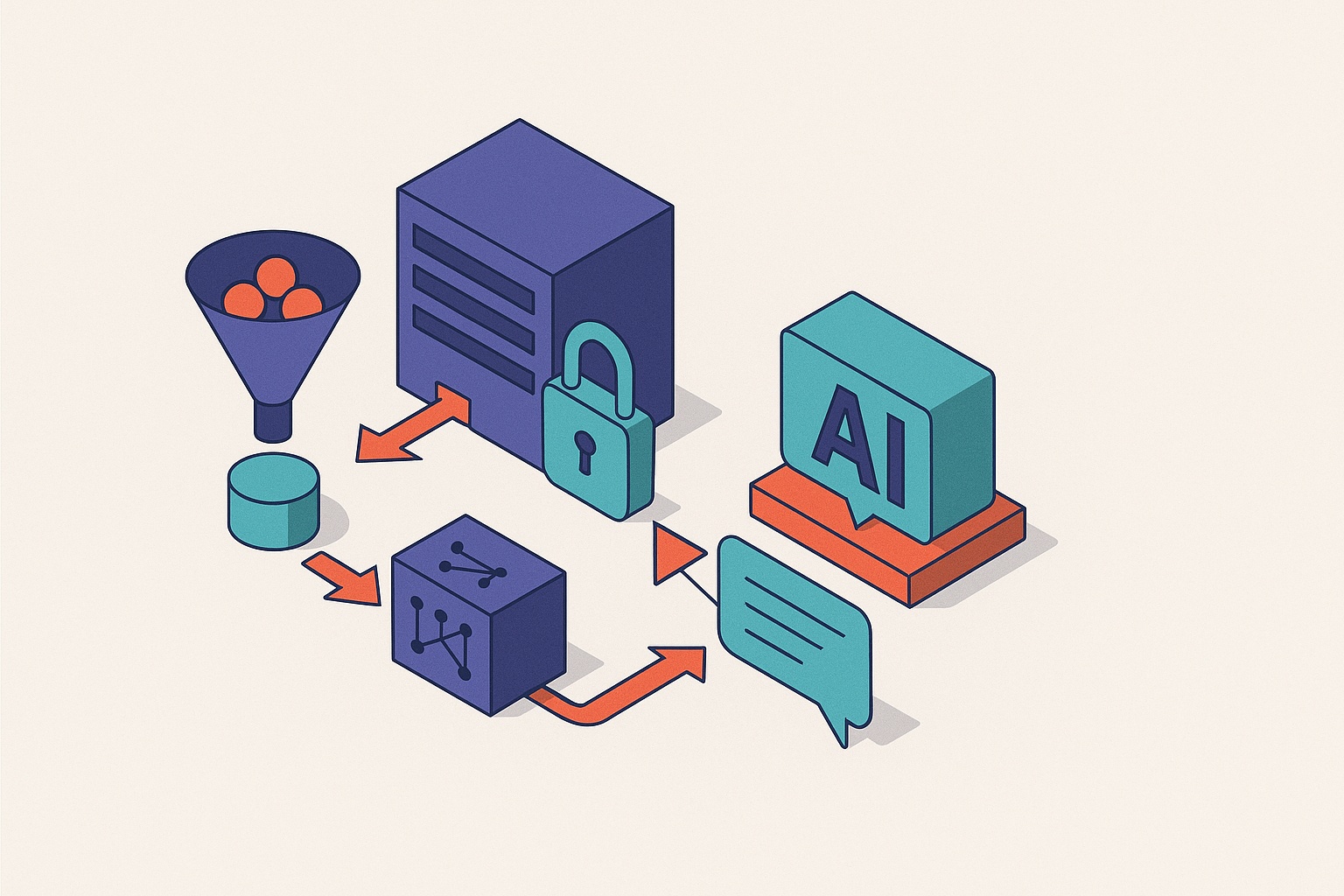
Differential privacy, formalized by Dwork in 2006, provides a mathematical bound on how much any single training example can influence a model's output distribution. Adding or removing one record changes that distribution by at most a multiplicative factor of e raised to the power ε, with a small additive slack δ capturing the probability that the bound fails. Smaller ε means stronger privacy: the model is constrained from leaning heavily on any individual record. δ should be negligibly small relative to dataset size; treating it as a tunable convenience parameter is a common and consequential mistake practitioners make more often than the literature acknowledges.
What DP does not guarantee is at least as important as what it does. It fails to prevent a model from being wrong or biased. It does not protect aggregate population patterns, only individual contributions. A model trained with DP can still encode demographic signals, systematic biases, or distributional properties of a population; the guarantee is narrower than its reputation sometimes suggests, and I have seen that gap cause real confusion in production system design.
The reason DP has become the baseline standard for privacy-preserving ML is that it is the only framework offering a mathematically auditable bound on information leakage per individual. Data anonymization and output filtering offer heuristic protections that can be circumvented; DP's guarantee is compositional and provable. But tighter ε constrains how much signal the model can absorb from any individual example, which directly limits learning. That tradeoff is not philosophical. It is a calibration problem every practitioner must solve explicitly, and there is no universal answer.
How DP-SGD Applies the Guarantee During Gradient Descent
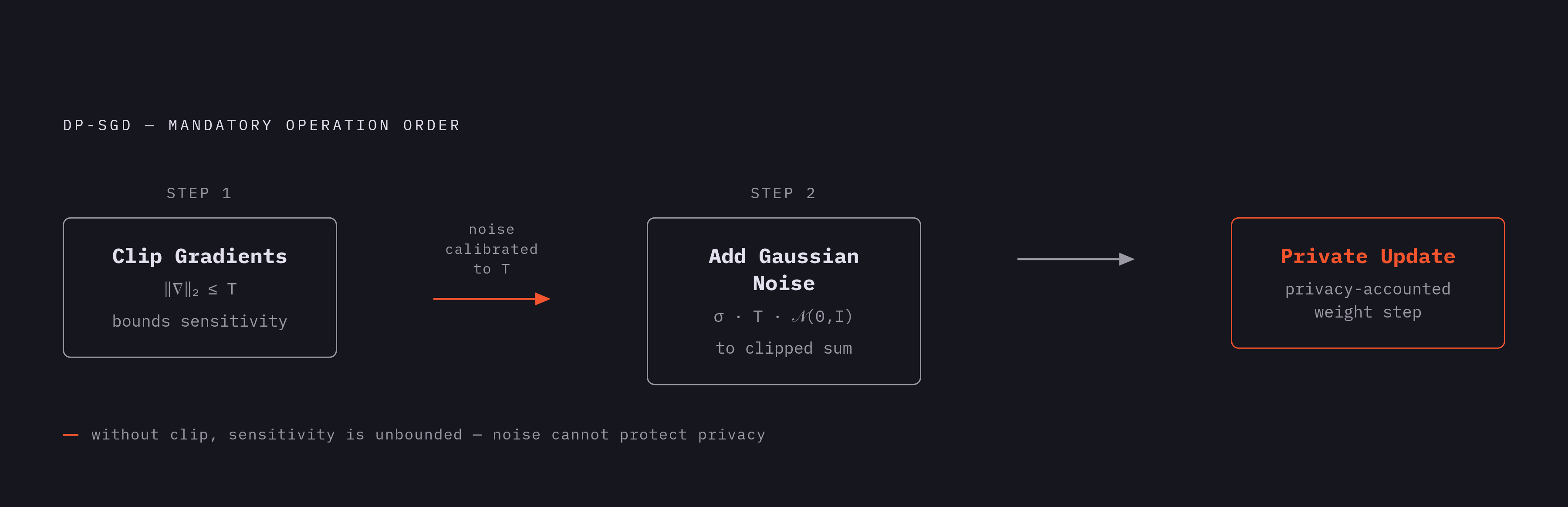
The mechanism introduced by Abadi et al. in 2016, DP-SGD, applies the DP guarantee through two operations at every gradient update. First, each training example's gradient is clipped to a maximum L₂ norm threshold T, bounding how much any single record can shift the model weights. Second, calibrated Gaussian noise is added to the clipped, aggregated gradients before the update is applied.
The ordering matters more than it might appear. Clipping must precede noise addition because without bounding gradient magnitude, outlier examples still dominate even after noise is injected. Clipping establishes the sensitivity of the gradient computation; the noise is then calibrated to that sensitivity. Without the first step, the second is insufficient, and I have watched engineers implement the steps in the wrong order and then spend days wondering why their privacy accounting looked wrong.
DP-Adam extends the same logic to Adam's moment estimates, applying clip-and-noise to the first and second moment accumulators. In practice, fine-tuning with DP-SGD or DP-Adam at ε values between 3 and 8 yields strong performance across a range of NLP tasks, though the right value is task- and data-dependent. The key parameters, clipping threshold T, noise multiplier σ, and privacy budget ε, interact in ways that resist simple rules of thumb.
The memory problem is practical and significant. Per-example gradient computation requires storing gradients separately before aggregation, and memory costs scale with batch size and model size simultaneously. Ghost clipping addresses this by avoiding explicit materialization of per-example gradients, achieving nearly the same memory footprint as non-private training at the cost of one additional backward pass per batch. For teams working under real infrastructure constraints, ghost clipping is often what makes DP-SGD viable at all, not an optimization but a prerequisite.
Where DP-SGD Struggles at LLM Scale, and Why Parameter-Efficient Fine-Tuning Changes the Calculus
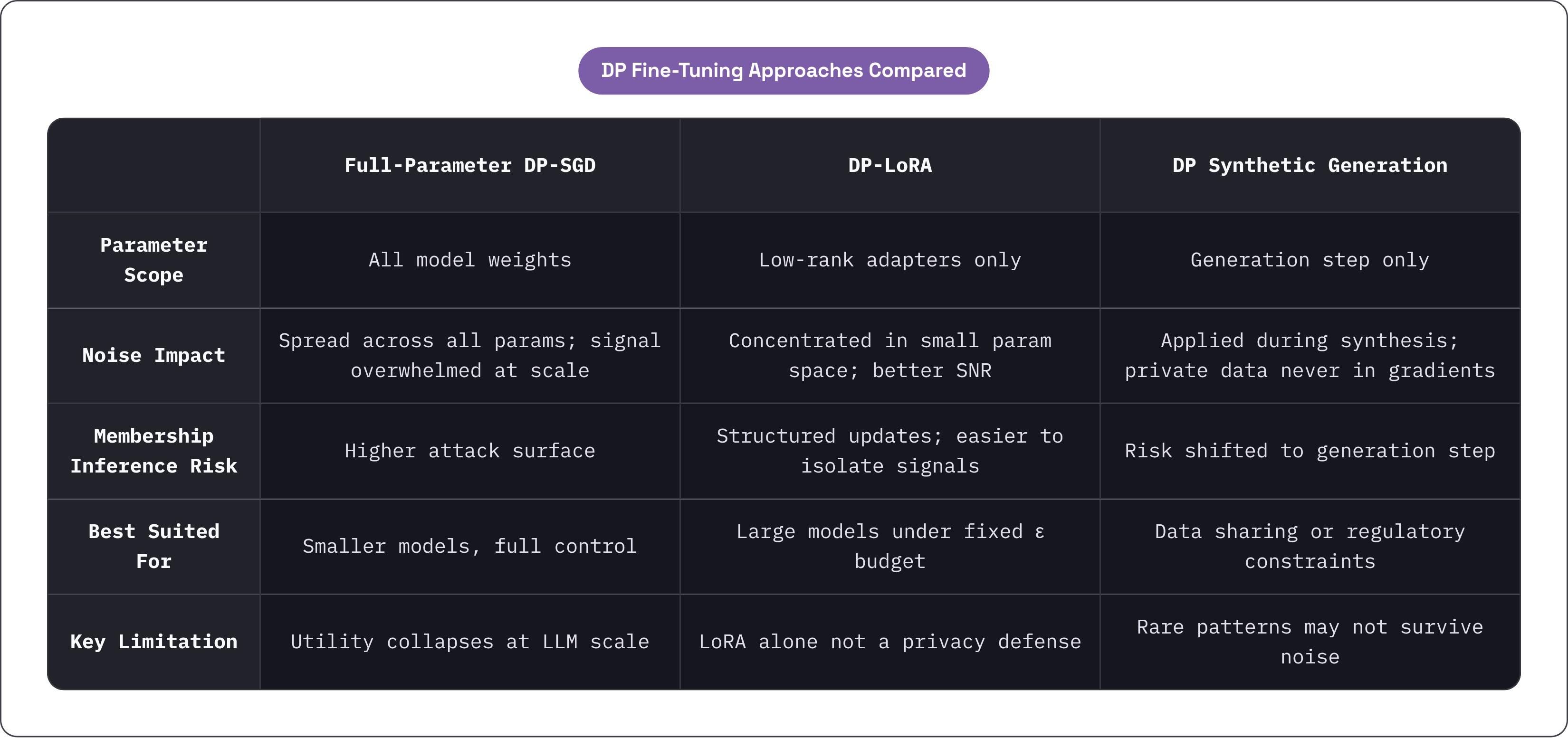
At billion-parameter scale, the dimensionality problem becomes acute. Noise must be added across every trainable parameter; in a large model, the noise required to maintain even a moderate ε overwhelms the gradient signal. The signal-to-noise ratio degrades with model size under a fixed privacy budget, and the utility cost compounds accordingly. This is not a limitation that better hardware resolves; it is structural.
Parameter-efficient fine-tuning offers a structural response. If the number of trainable parameters is reduced by one or several orders of magnitude, the space across which noise must be spread shrinks proportionally, and the signal-to-noise ratio at a fixed ε improves. This is the intuition behind applying DP-SGD to LoRA rather than to the full model.
LoRA, Low-Rank Adaptation, freezes the base model and learns low-rank update matrices for selected weight layers. The trainable parameter count drops dramatically relative to full fine-tuning. A 2025 ACM study found that LoRA reduces privacy risks more effectively than full fine-tuning under equivalent conditions. There is also a theoretical dimension worth examining: when LoRA's A matrices are frozen, the update is mathematically equivalent to applying Gaussian random sketching to batch gradients, which inherently resembles a DP mechanism. A 2024 arXiv analysis suggests LoRA may provide partial DP-like behavior by design, not just by accident, though that property alone does not substitute for explicit noise injection.
DP-LoRA, the combination of explicit DP noise with LoRA's reduced parameter space, yields better accuracy at a given ε than full-parameter DP fine-tuning. The remaining performance deficit relative to non-private LoRA fine-tuning is real and has not been eliminated by the field. It has been narrowed, which is meaningful progress, but practitioners should avoid mistaking narrowing for closing.
Membership Inference Attacks Still Threaten LoRA-Adapted Models
LoRA's architectural properties that make it attractive for DP, concentration and interpretability of updates, also make it particularly exposed to membership inference. An adversary with access to the publicly available pre-trained base model can use it as a reference distribution to distinguish fine-tuning members from non-members. The difference between the base model and the LoRA-adapted model is smaller and more structured than in full fine-tuning, which makes membership signals easier to isolate. A 2026 arXiv study documents this exposure in detail, and the finding still surprises practitioners who had assumed that a smaller update surface meant a smaller attack surface.
LoRA alone does not constitute a privacy defense. The reduction in trainable parameters changes the geometry of the attack surface but fails to eliminate it. Even DP-LoRA requires careful ε accounting; the architectural benefit does not substitute for the formal guarantee. Deploying LoRA-adapted models on sensitive data and assuming the parameter reduction provides meaningful protection is a miscalibration the attack literature has now made empirically legible.
Utility and threat modeling must be updated together. A decision to adopt LoRA is simultaneously a decision about attack exposure, and that connection should be explicit in any system design that handles personal data.
Federated Settings, Adaptive Noise, and Tighter Accounting as the Current Engineering Frontier
Federated DP fine-tuning distributes training across clients without centralizing private data, and it surfaces the utility cost of DP in its most severe form. Full fine-tuning under federated DP typically causes substantial performance degradation. DP-DyLoRA addresses this more effectively: in benchmarks with one million clients and a stringent privacy budget of ε = 2, it holds accuracy degradation to under two percent and word error rate increase to under seven percent. DP-LoRA consistently outperforms other DP-PEFT methods across published benchmarks from 2024 and 2025.
Adaptive noise allocation represents a different angle on the same problem. Rather than distributing noise uniformly across all parameters, adaptive methods add less noise to parameters carrying more task-relevant signal and more noise to less important parameters. This directly addresses the blunt-instrument character of uniform noise injection; EMNLP 2024 findings support the approach's efficacy in practice.
Tighter privacy accounting is a third direction, and perhaps the most underappreciated one. EW-Tune's Edgeworth accountant produces tighter per-iteration bounds on DP-SGD's privacy expenditure, translating directly into a utility gain of up to 1.1 percent without changing the formal privacy guarantee. Better mathematics, not looser privacy, recovers utility. These three directions converge on the same insight: the utility cost of DP is not a fixed physical constant. It is a function of how carefully noise is allocated and how accurately privacy expenditure is tracked. None of these improvements are dramatic in isolation; their cumulative effect in a well-engineered system is what makes production DP feasible.
Example-Level vs. User-Level DP, and Why the Distinction Determines Who Is Actually Protected
Most LLM fine-tuning implementations treat each text record as the unit of privacy protection. This is example-level DP, and it is the default because it is simpler. It is also frequently the wrong choice for real deployments involving human subjects, and the field has been slow to confront this mismatch.
The problem is structural. A user who contributes many records receives weaker protection than one who contributes few, because the guarantee bounds the influence of each individual record, not each individual person. Heavy contributors, often the most sensitive users in a medical or financial dataset, are the least protected under example-level DP. The guarantee becomes uneven precisely where it matters most.
User-level DP reframes the privacy unit as the person rather than the data point, ensuring each user receives the same guarantee regardless of contribution volume. Google Research published a systematic evaluation of two mechanisms for user-level DP, Group Privacy and User-wise DP-SGD, applied to LLM fine-tuning on natural language generation tasks in 2025, investigating data selection strategies and parameter tuning for each. The practical cost is real: per-user sensitivity is higher, requiring more noise or a larger ε to maintain the guarantee, which means more computation per unit of privacy budget spent.
For practitioners, the choice between example-level and user-level DP is a product decision as much as a technical one. It forces a precise answer to the question of what protecting a person actually means in a given deployment context. Deferring that question to a default setting is itself a consequential choice, and one that tends to favor organizational convenience over the people the system is ostensibly protecting.
How the Privacy Budget Interacts with Model Scale and the Empirical Shape of the Utility Cost
A 2025 arXiv study found that DP training provides an 85 percent reduction in privacy leakage relative to unprotected fine-tuning, with meaningful accuracy costs and higher computational overhead. The headline figure is encouraging; the accompanying costs are real, and anyone building a business case around the 85 percent number without accounting for the overhead is reading only part of the paper.
Experiments on Pythia, Gemma, and Llama2 demonstrate that the noise-utility relationship is monotonic and model-specific: lower noise yields better utility but weaker privacy, and the curve's shape varies across architectures. Larger models face harder limits on achievable utility under DP-SGD. In Vicuna-7B, dropping ε to 1 pushes accuracy to approximately 86 percent. Counterintuitively, models with strong zero-shot capability can maintain instruction-following even under tight budgets, because scale partially substitutes for a relaxed ε. That interaction between model capability and privacy budget is underexplored in the literature, and I suspect it will matter considerably as frontier models grow larger.
The RoBERTa and Flan-T5 results introduce a practically important nuance. Increasing ε improves accuracy as expected, but membership inference vulnerability increases only marginally even as ε reaches theoretically large values. Empirical privacy may hold reasonably well even when the formal bound is loose. A large ε can therefore serve as a practical fallback when small-ε training is infeasible, though it should never be mistaken for a formal guarantee.
At very conservative budgets, the DP zeroth-order approach warrants attention. At ε = 0.5 on SQuAD, zeroth-order DP achieves 80.10 percent accuracy against a 46.23 percent baseline with no optimization, the first method to achieve non-trivial utility under pure DP at that budget level. There is no universal ε. The right budget depends on model size, dataset size, task sensitivity, and whether empirical or formal guarantees drive the deployment requirement.
VaultGemma as a Test of Whether DP Can Be Built Into a Production LLM From the Start
In September 2025, Google released VaultGemma, a one-billion-parameter LLM built on Gemma 2's decoder-only architecture, trained with differential privacy from the ground up rather than retrofitted after the fact. The model uses 26 layers, Multi-Query Attention, and a sequence length capped at 1,024 tokens.
The benchmark result is notable. VaultGemma performs comparably to GPT-2 at a larger parameter count across HellaSwag, BoolQ, PIQA, SocialIQA, TriviaQA, and ARC-C/E: a DP-trained model at one billion parameters matching a larger non-private model on standard tasks. Google also introduced formal scaling laws for private training, mapping relationships among compute, privacy budget, and utility, claiming these laws generalize to models far larger than one billion parameters.
Two aspects of the release distinguish it from prior work. First, the DP guarantees were independently reviewed, separating VaultGemma from the broader category of models that assert privacy-preserving behavior without formal audit. Second, Google open-sourced the weights and codebase on Hugging Face and Kaggle, which matters because reproducible, verifiable DP training is more useful to the field than a proprietary benchmark result.
The open questions are real, though. At one billion parameters and a 1,024-token context, VaultGemma operates well below frontier model scale. Whether the scaling laws hold at much larger sizes remains to be demonstrated empirically. The architectural argument, privacy built in from the start rather than layered on post-hoc, is sound in principle, but validating it at frontier scale is the outstanding empirical question, and the gap between one billion and frontier scale is not small.
DP Synthetic Data Generation as an Alternative When Fine-Tuning on Private Data Is Not Necessary
Not every use case requires fine-tuning directly on private data. When the downstream task can tolerate some distributional approximation, synthetic data generation with DP offers a fundamentally different threat model: the private data never enters the gradient computation directly.
The logic is straightforward. An LLM generates synthetic data that mimics the private distribution; DP noise mechanisms are applied during the generation process, ensuring each generated record reflects many original records but is dominated by none. The downstream model is then trained entirely on synthetic data, and privacy leakage risk shifts to the generation step, where it can be controlled.
This approach is attractive in specific circumstances: when an organization needs to share training data across teams or with external parties without exposing original records; when regulatory constraints prohibit direct use of personal data in model training; or when the task is general enough that a synthetic approximation of the private distribution is sufficient for acceptable downstream performance. It is also the right framing for data augmentation rather than domain adaptation, since the synthetic data need not reproduce individual records, only the statistical structure of the population.
The limitations are real. Synthetic data quality degrades under tight DP budgets, and distributional approximation errors can compound in ways that are difficult to characterize before deployment. For tasks that depend on rare but important patterns in the private data, those patterns may not survive the generation and noise process intact. Practitioners sometimes reach for DP synthetic generation because it feels architecturally cleaner than direct DP fine-tuning, but that intuition can mislead. It is a complement, chosen when the use case genuinely supports it, rather than a universal shortcut around the harder problem of training with formal guarantees.
The combinations that sophisticated deployments are now attempting, DP fine-tuning layered with LoRA, federated training, and synthetic augmentation in sequence, require practitioners to reason carefully about how privacy budgets compose across pipeline stages. That compositional accounting is where things go wrong in practice, quietly and without obvious failure signals, until someone runs the membership inference numbers.