How Differential Privacy Actually Works in Deep Learning
Noise added during training protects individual privacy without exposing sensitive data.
Deep learning models do not just learn the broad shape of their training data. They memorize specific details of individual records, and that memorized detail can be pulled back out by anyone with the right query strategy. Membership inference attacks exploit exactly this weakness: an adversary queries a trained model and, from how confidently or how precisely it responds, infers whether a particular person's record was part of the training set. What these three attack types establish together is that the privacy failure lives inside the trained model, in the parameters it carries forward, not merely in the raw data it was built from. That distinction sets the terms for everything that follows: the question is not whether to add noise to data, but how to add noise to the learning process itself.
Differential Privacy's Mathematical Guarantee
Differential privacy answers that question with a formal commitment. A mechanism M is said to be (ε, δ)-differentially private if, for any two datasets differing by exactly one record and any output set S, the probability that M produces an output in S from the first dataset is bounded by e^ε times the probability of the same output from the second dataset, plus δ. In plain terms, the presence or absence of any single individual's record can shift the model's output only by a tightly controlled amount. Epsilon measures how tight that control is: a smaller ε forces outputs to look nearly identical whether or not any given person's data was included, while a larger ε allows more daylight between the two cases and more room for an individual's information to show through. None of this makes a model immune to every attack under every condition. The guarantee bounds how much information leaks about any one individual, not how much the model reveals about the dataset as a whole, and that distinction keeps DP honest about its own limits. The composition property of differential privacy is what turns ε into something closer to a budget than a single setting: because individual ε values across multiple analyses can be summed, every training step spends down a portion of the total privacy allowance, and that allowance depletes steadily as training runs across more steps and more epochs.
How DP-SGD implements that guarantee inside a training loop
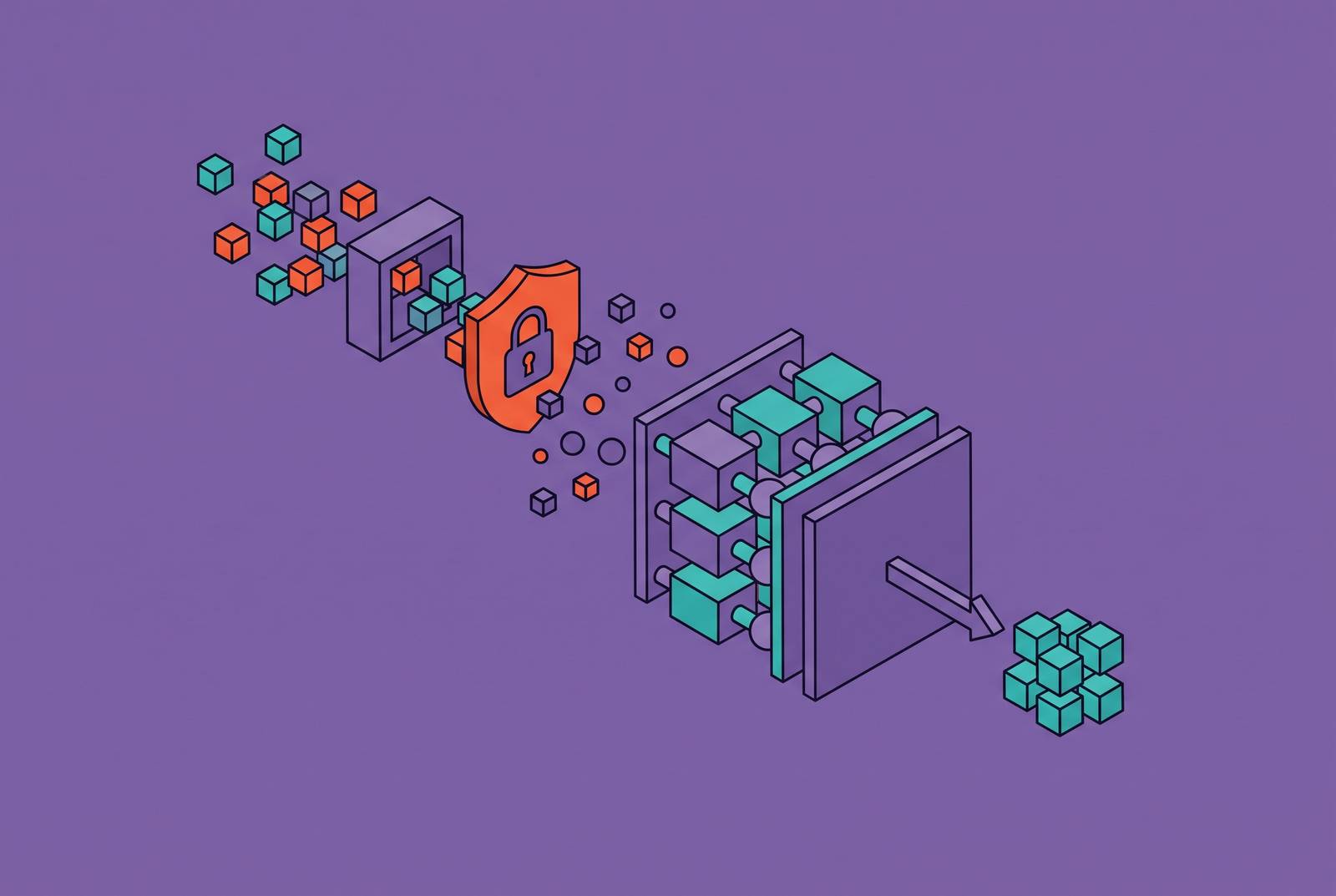
Differentially Private Stochastic Gradient Descent, introduced by Abadi et al. in 2016, is the mechanism that turns this abstract budget into something a training loop can actually execute. It modifies an ordinary training loop at exactly two points in every step: clipping and noise injection, and both have to happen in that order for the privacy accounting to hold.
The first operation is per-sample gradient clipping. Rather than computing a single averaged gradient for a batch, DP-SGD computes a gradient individually for each training example, then clips it according to Clip(g, C) = g · min(1, C/‖g‖₂), which bounds the ℓ₂-norm of every individual gradient to a fixed threshold C. This step controls sensitivity: it caps how much any single data point, however extreme, can push the model's parameters in one update. Without that cap, a single outlier record could swing the gradient arbitrarily far, and there would be no fixed quantity to calibrate noise against.
The second operation is calibrated noise injection. Once every per-example gradient has been clipped, the clipped gradients are summed and Gaussian noise with standard deviation Cσ, where σ is the noise multiplier, is added to that sum before the optimizer applies the update. The two-operation structure is literally what executes at every training iteration, and the privacy accountant's job is to make sure the sum of all those iterations still falls inside the budget set at the start of training. Batch size enters the accounting here too: larger minibatches sample a bigger fraction of the dataset per step, which changes the privacy amplification effect that subsampling normally provides and alters how much of the budget each step actually consumes.
Why the clipping threshold C is the mechanism's hardest practical problem
If gradient clipping and noise injection are the two moving parts of DP-SGD, the clipping threshold C is the dial that decides how well they work together, and it resists easy calibration. If C is set too small, the clipping operation truncates real signal from legitimate examples, introducing bias that appears as underfitting. If C is set too large, the Cσ noise term grows proportionally, burying the gradient signal under noise that was only supposed to protect it. Both failure modes interact with learning rate, model architecture, and the geometry of the loss surface in ways that rarely transfer cleanly from one task to another, so a value of C tuned for one dataset offers little guidance for the next.
Finding a workable C in practice usually means running hyperparameter sweeps, and those sweeps themselves consume privacy budget, since each trial run is itself a query against the private data. That creates an uncomfortable loop: tuning the mechanism meant to protect the budget eats into the budget it is protecting. Research on DC-SGD addresses this directly by using differentially private histograms to estimate the distribution of gradient norms during training and adjust C dynamically, cutting down on the need for expensive manual sweeps. This is not a settled fix so much as a live research direction, and it illustrates the deeper point: the mathematical guarantee behind DP-SGD is only as sound as the engineering choices made around it. A poorly chosen C can produce a model that technically satisfies its stated ε while being functionally useless, or a model that performs well while the clipping and noise calibration quietly undercut the privacy claim attached to it.
PATE as an architecturally different way to achieve the same guarantee
DP-SGD is not the only route to a differential privacy guarantee, and the existence of a genuinely different architecture matters for understanding which tradeoffs come from DP itself versus which come specifically from gradient-level noise. Private Aggregation of Teacher Ensembles, or PATE, sidesteps gradients. The private dataset is split among several teacher models, each trained separately on its own partition. Those teachers then vote on labels for a separate public dataset, with calibrated noise added to the vote aggregation step, and a student model trains only on those noisy labels. The student never touches the private data directly at any point.
That structure gives PATE a real advantage in auditability: the private data stays compartmentalized by design, and the entire student-facing training pipeline is public, which makes the privacy argument easier to inspect from the outside. The tradeoff is availability. A newer line of work on individualized PATE variants is pushing at one of DP's more rigid assumptions, the idea that every record deserves the same ε regardless of how sensitive it actually is. Whichever mechanism a practitioner chooses, DP-SGD's gradient-level noise or PATE's teacher-student structure, the choice determines which of the following tradeoffs get inherited and which get avoided.
The real accuracy and fairness costs that any honest DP deployment must account for
Differential privacy does not come free, and the honest accounting of its cost has two layers: one expected, one far less discussed. The accuracy tradeoff is the expected one. A 2026 scoping review by Mohammadi et al. in npj Digital Medicine, synthesizing 74 eligible studies through March 2025, found that DP-SGD can hold clinically acceptable performance in medical imaging under moderate privacy budgets around ε ≈ 10, while strict privacy settings near ε ≈ 1 often cause substantial accuracy loss, with the degradation amplified in smaller or more heterogeneous datasets. That loss is not evenly spread across tasks: imaging tends to tolerate moderate DP noise reasonably well, while tasks involving high label noise or limited training data suffer more.
The fairness cost is the one that deserves more attention than it typically gets. Gradient clipping does not treat every subgroup's data equally in practice, even though the mechanism applies the same threshold to everyone. The Mohammadi et al. review found that only a minority of the studies it examined even evaluate fairness at all, and among those that do, several report that DP widens the performance gap between subgroups. Fairness auditing, in other words, remains a gap in how DP systems get evaluated, not a settled part of deployment practice. Choosing an ε is therefore not purely a technical decision about privacy strength. It carries equity consequences for whichever groups are underrepresented in the training data. Batch size compounds the tension: larger minibatches reduce the noise needed per step, which helps utility, but they also sample a larger share of the dataset per step, which weakens the privacy amplification that subsampling would otherwise provide. The two effects pull against each other, and there is no batch size that satisfies both simultaneously.
Where DP-SGD strains under LLMs and complex inference pipelines
The mechanics described above were largely developed and tested on comparatively small models, and they do not scale painlessly to large language models. The noise required to hold a fixed ε grows with the number of parameters being trained, and at LLM scale that noise can overwhelm the gradient signal outright, producing a model that technically meets its privacy target while being too degraded to serve its purpose. The computational burden compounds the problem. Per-sample gradient clipping requires tracking each example's gradient separately rather than relying on standard batched backpropagation, and at billion-parameter scale that per-example tracking becomes memory-intensive and slow in ways that do not occur at smaller scales.
VaultGemma, a model trained entirely with DP-SGD, shows that DP pretraining at real scale is achievable and produces no detectable memorization of its training data. Google's Gboard keyboard takes a different architectural approach to the same underlying goal, using federated learning with device-level DP for next-word prediction; for a user with a single device, that device-level guarantee corresponds directly to user-level DP, demonstrating that the noise does not always have to be injected at the gradient level during centralized training to achieve a meaningful guarantee.
None of this addresses what happens once a model, DP-trained or not, gets embedded in a working pipeline. Retrieval-augmented generation setups, in-context learning, and tool-augmented reasoning systems all introduce privacy exposure through sensitive prompts, retrieved documents, and generated outputs, none of which DP-SGD's training-time noise ever touches. A model trained under a rigorous ε can still leak information introduced after training, at inference time, through the surrounding pipeline, and there is currently no standardized defense for that category of risk comparable to DP-SGD for training. That gap reframes what DP-SGD actually is: one component of a privacy architecture, not the architecture itself.
What the NIST framework and emerging standardization demand
Standardization has become necessary precisely because so many DP claims in the published literature cannot be checked against each other. Under a framework like that, the phrase "we use differential privacy" becomes something that can be checked.
But meeting a technical standard is not the same as meeting the goals that standard was built to serve. The fairness auditing gap documented in the medical DP literature makes that distinction concrete: a deployment can report consistent ε and δ values, satisfy every requirement in NIST SP 800-226, and still widen the performance gap between subgroups, because the standard evaluates the privacy mechanism's parameters, not its downstream equity effects. A system can pass the formal test and still fail the principle the test was meant to protect.
What genuine privacy-preserving AI requires beyond DP training
Everything covered up to this point, the clipping and noise mechanics, the budget logic behind ε and δ, the accuracy and fairness costs, the strain LLMs place on the whole apparatus, points toward one conclusion: DP-SGD gives a provable, auditable guarantee at the gradient level, and that guarantee stops there. Inference, retrieval pipelines, prompt handling, and output generation all sit outside what training-time DP covers, and that is exactly where privacy failures in deployed systems increasingly originate. A system that trains under a strict ε and then collects, stores, or monetizes the data it sees at inference time has secured one channel mathematically while leaving another wide open. The architecture as a whole decides whether the privacy claim holds, not the training step in isolation.
Apple's use of local differential privacy for telemetry collection shows one way to close that gap: noise is added on the device itself, before any data leaves it, so the server never receives an unperturbed individual signal. That sits at a different layer of the system than training-time DP-SGD, but it answers to the same underlying principle, that the point of data collection is where the guarantee needs to be enforced, not an afterthought applied downstream. Privacy built into a system's architecture from the outset, rather than bolted onto a gradient optimizer while every other layer stays exposed, is what separates a system that is genuinely privacy-preserving from a system that merely contains a privacy-preserving component. Confidant is built around that exact distinction, treating data sovereignty as a requirement the architecture has to satisfy from the start.
A trustworthy privacy claim must meet four conditions at once, and none of them substitutes for the others: the mechanism is specified and auditable, with ε and δ reported consistently against a standard like NIST SP 800-226; the risks introduced at the pipeline level, in retrieval, prompting, and output generation, are actually addressed; the fairness implications across subgroups are evaluated rather than assumed away; and the data itself never reaches the provider. Understanding how DP-SGD actually works, down to the clip and the noise and the budget they draw from, is what makes it possible to tell which of those four conditions a given system has actually met, and which it has simply implied.
Sources
- Dynamic differential privacy technique for deep learning models
- Differential privacy for medical deep learning: methods, tradeoffs, and deployment implications
- Differential Privacy Has Disparate Impact on Model Accuracy Eugene Bagdasaryan
- DC-SGD: Differentially Private SGD with Dynamic Clipping through Gradient Norm Distribution Estimation
- Differential privacy for medical deep learning: methods, tradeoffs, and deployment implications
- Individualized PATE: Differentially Private Machine Learning
- [1607.00133] Deep Learning with Differential PrivacyAugust 8, 2026