What Re-Identification Risk Actually Looks Like in Aggregated AI Telemetry
Quasi-identifiers in AI telemetry can uniquely fingerprint individuals.
Stripping names, emails, and device IDs out of AI telemetry does not make that data anonymous. What survives the scrub, timestamps, session lengths, prompt categories, device types, combines into a fingerprint precise enough to single out one person in a dataset of millions, and this piece walks through the mechanism, the evidence, and what actually has to change.
Removing direct identifiers from AI telemetry does not make it anonymous
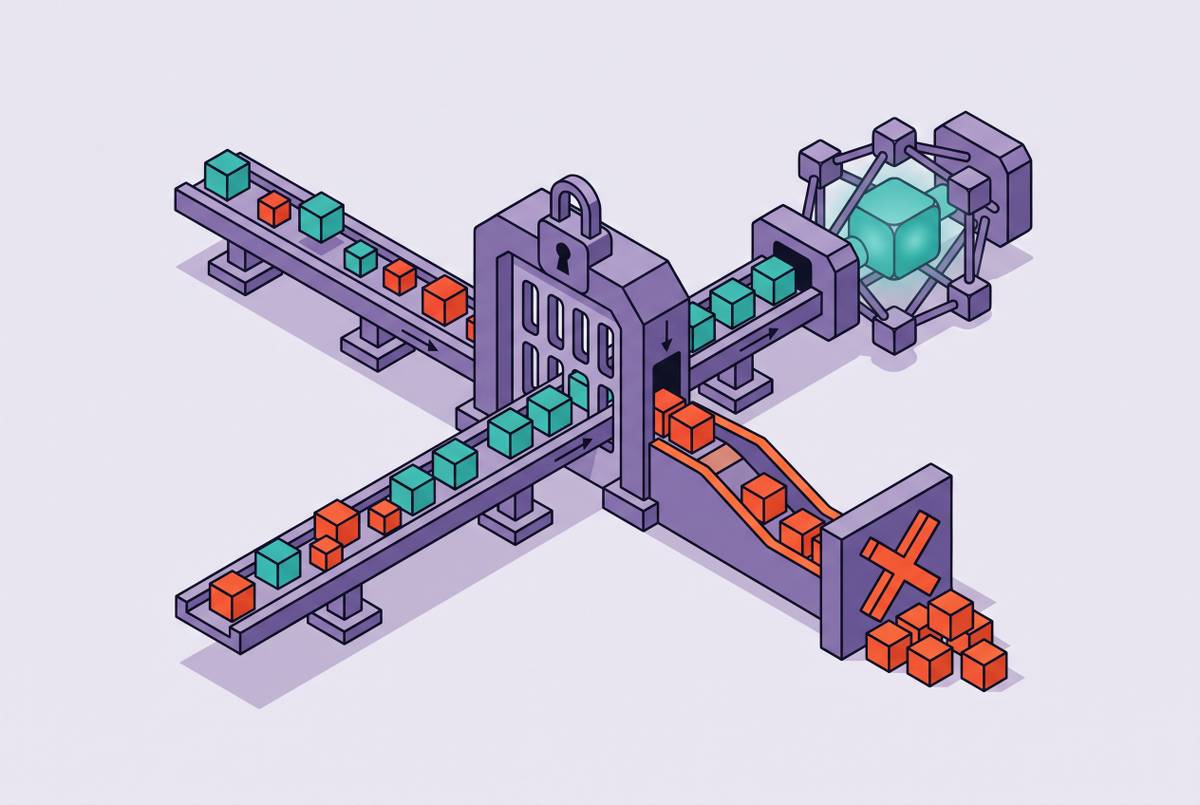
Most organizations handling AI telemetry operate on a simple rule: strip the name, strip the email, strip the device ID, and the data is clean. That rule rests on an assumption nobody has managed to defend under real scrutiny: that what's left behind can't point back to a person. AI telemetry is a behavioral trace, a log of when a session started, how long it ran, what kind of prompt came in, what device sent it, what topic the exchange fell under. None of those fields is a name. None looks dangerous sitting alone in a column. But a field doesn't need to identify someone by itself to help identify them in combination, and that's the gap the common practice never closes. AI governance analysis published in January 2026 makes the point directly: AI systems' pattern-recognition capabilities can defeat anonymization techniques that used to provide adequate privacy protection, and models trained on aggregated or anonymized datasets may allow re-identification of individuals when combined with outside information or through inference attacks. The rest of this piece is about how that happens, concretely, inside the kind of telemetry pipeline most AI products run every day.
How quasi-identifiers in telemetry combine into an identifying fingerprint
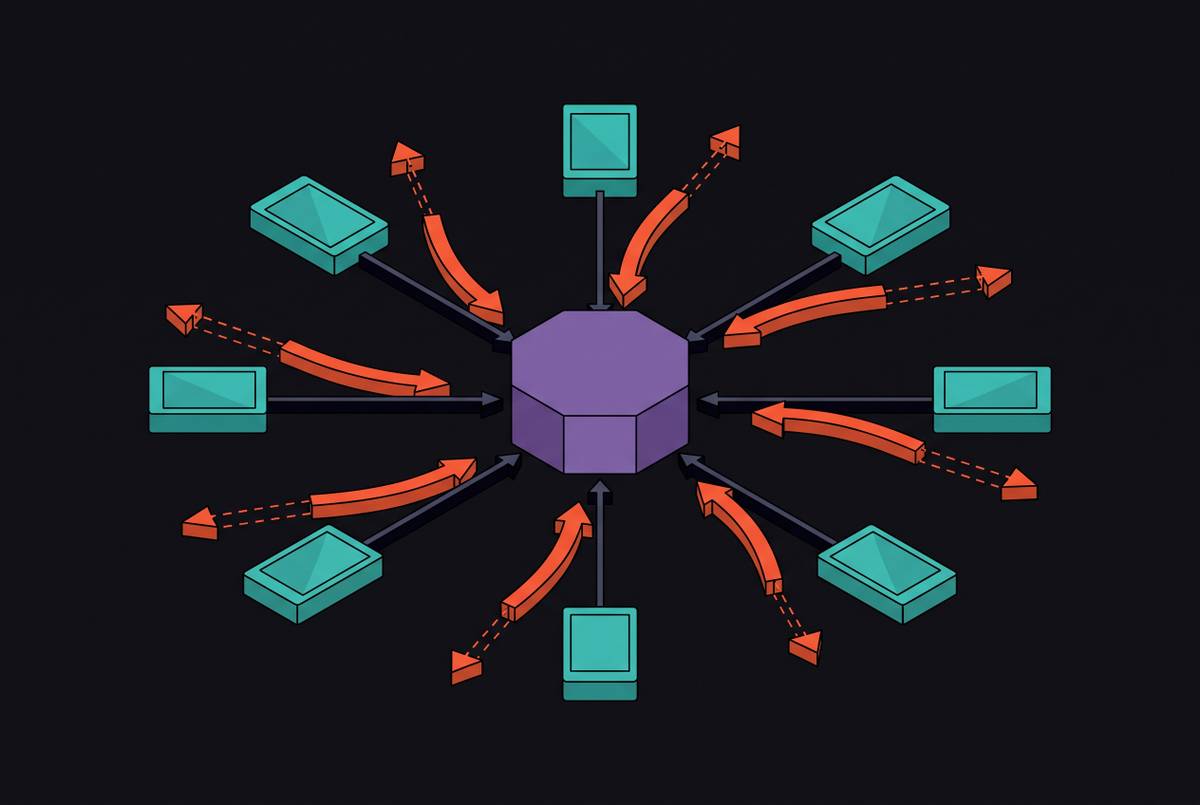
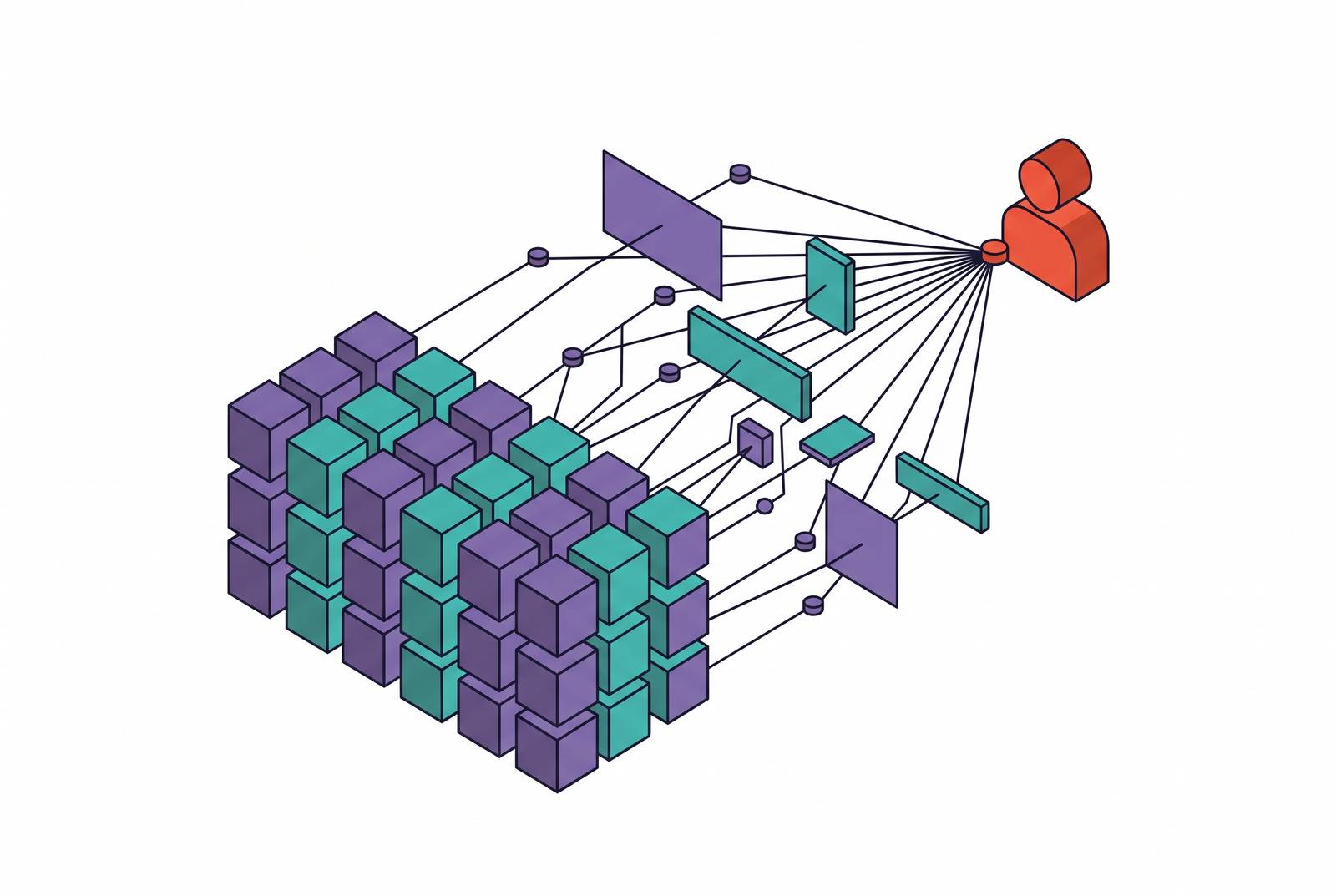
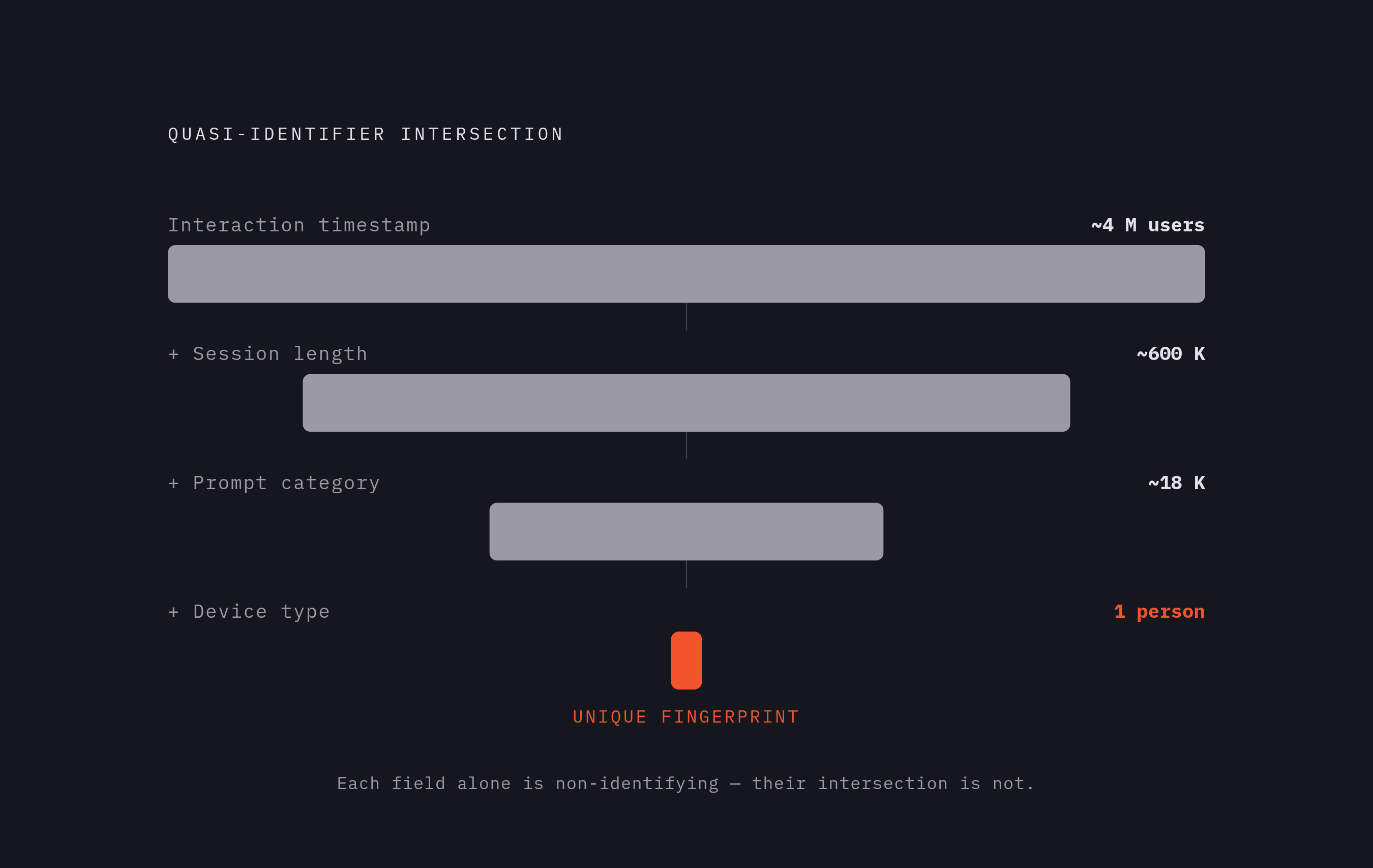
The technical term for the fields that survive a typical scrub is quasi-identifiers, data elements that don't name a person outright but narrow the field of who they could be. The danger in AI telemetry specifically comes from three properties these fields tend to share: they're correlated with each other, stable across time, and sparse in how they're distributed across a user population. Take interaction timestamps. A user who starts sessions between 6:14 and 6:22 a.m. on weekdays isn't just logging in early. That person is exhibiting a habitual pattern, and habitual patterns cut the population of possible matches down fast. Session length also matters, since it tracks task complexity and personal work style. Prompt category or topic cluster matters too, tracking professional context and the kinds of problems someone habitually brings to a model. Add device type, which narrows things further still. None of these four fields, on its own, picks out an individual. But what if the real risk isn't in any one field but in how they stack? These fields don't add identifying power when combined, they multiply it. Four moderately rare values, intersected, can be unique across a dataset holding millions of records. A trained model can memorize this same way, and later surface facts about individuals it was never explicitly told to recall. A membership inference attack asks if a specific record was part of a model's training data, and it works off this same combinatorial signal, which carries straight into the next section's evidence.
What re-identification attacks against real anonymized datasets have demonstrated
The quasi-identifier mechanism isn't a hypothetical risk confined to academic papers. It has been run, successfully, against real anonymized datasets, and the pattern holds across very different kinds of data and very different attack methods.
In December 2025, Anthropic released a public dataset of 1,250 interviews, including 125 with scientists, about how researchers use AI in their work. People in the general workforce subset were told that what they shared "won't be personally attributed to you." Researchers tested that promise using widely available LLMs equipped with web search and agentic tool use, and found they could link six of twenty-four scientist interviews to specific published papers, in some cases uniquely identifying the interviewee, using nothing but natural-language prompts instructing the model to search the web and cross-reference details. A second research group pushed the attack across all 125 scientist participants, and their agents correctly re-identified at least 9 of them. They describe this capability as something that "comes for free": no custom code, no specialized dataset, just a frontier agent given a summary of an online profile and asked to recover the identity behind it. Among transcripts that mentioned at least one published work, the rate of successful de-anonymization reached one in four, and the cost of running each attempt was minimal.
The STALKER framework, presented at ACM IWSPA 2026, moved the same kind of attack into structured e-commerce telemetry, working against data from the Mercari marketplace. The paper found that pseudonymizing user IDs and normalizing event timestamps, two of the most common anonymization steps applied to consumer platform data, weren't enough to protect behavioral privacy. Researchers reconstructed detailed behavioral profiles from 92,034 anonymized transaction records, focused on the ten highest-activity users, and they measured leakage across a broader random sample with varying histories. The reconstruction needed no outside data and no real-world identity information: structured quasi-identifiers, stable timing patterns, and semantic signal buried in free-text item titles were enough on their own.
A 2025 paper titled "Stronger Re-identification Attacks through Reasoning and Aggregation" tested the limits of text redaction using the Text Anonymization Benchmark, a set of European Court of Human Rights cases that had been manually de-identified by human annotators. The paper found that LLM reasoning over composed quasi-identifiers significantly beat simple direct-identifier matching at recovering who the redacted text was actually about. The same reasoning ability that makes a language model useful for drawing inferences across scattered facts turns out to make it an effective engine for re-identification, once it's pointed at text that has been redacted but never structurally transformed.
A study in Nature Communications closes out the pattern with social graph structure. Researchers found that a neural network could link individuals to their own anonymized interaction data using just one week of records, and that adding information about a target's contacts raised the identification rate substantially. Four separate attack surfaces, four separate data types, and each time, the anonymization held up only until someone with the right tools tried to break it.
Agentic AI with tool use lowers the cost and expertise barrier for re-identification
What makes the current moment different from the re-identification research of the past two decades is who can now act on the risk. Re-identification used to require a specific kind of attacker: someone with domain expertise, a curated auxiliary dataset, and real computational resources to throw at the problem. Agentic LLMs with tool use have worn down that barrier, and the Anthropic dataset attacks show how. The researchers who re-identified interview participants wrote no bespoke code, and they built no auxiliary database. A frontier agent got a natural-language instruction, then broke the task into smaller subtasks that each looked harmless on its own, and together these subtasks accomplished the full attack.
That shift matters because of where agents like this actually run. Reco AI's State of Agent Security 2026 found that a large majority of AI tools in enterprise environments operate with no IT oversight at all, and that many published agent tools combine the ability to read local data with the ability to reach the internet in a single package. The same combination that lets an agent exfiltrate data outward lets it cross-reference anonymized records against public information inward. The same report counted hundreds of vulnerabilities disclosed across agent and LLM tooling over a recent 18-month period, a significant share of them rated critical. Agents working on telemetry face internal re-identification risk and external exploit risk at the same time. Under GDPR, Recital 26 asks whether re-identification is "reasonably likely by any means." An agent that can complete a re-identification attack in minutes, at a cost of pennies per target, makes a far stronger case that this standard is already met for telemetry datasets that organizations currently file under "anonymous."
Where re-identification risk accumulates in the AI telemetry pipeline
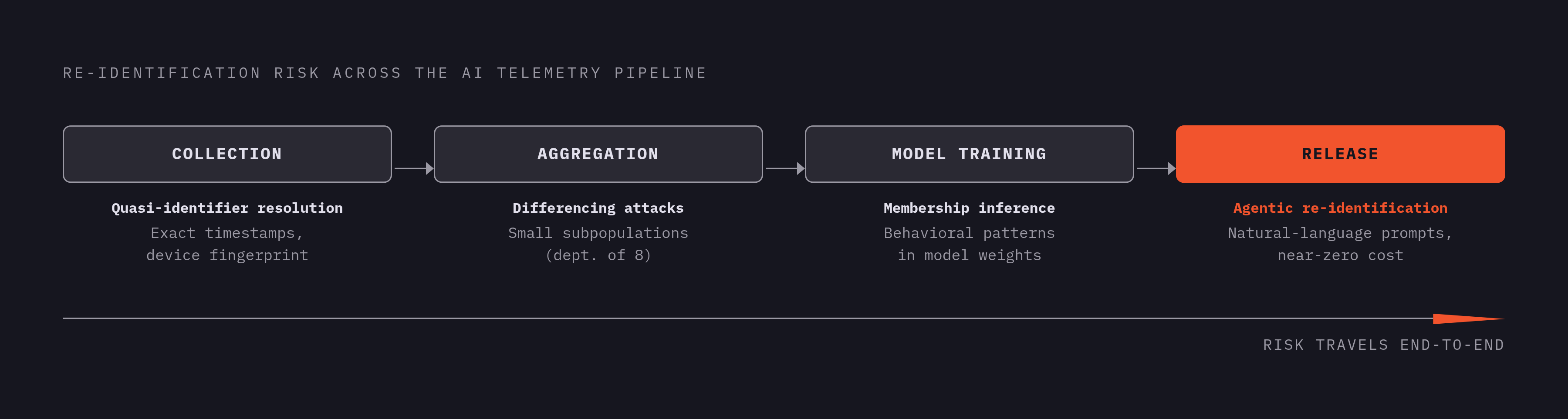
Re-identification risk in AI telemetry doesn't sit at one point of failure. It builds as data moves through collection, aggregation, model training, and downstream release, and each stage adds its own version of the problem.
At collection, raw telemetry carries full quasi-identifier resolution: exact timestamps, precise session durations, unredacted prompt text, a complete device fingerprint. This is the highest-risk point in the whole pipeline simply because nothing has been transformed yet. At aggregation, batching records into summaries cuts down some of that precision, but it opens a different door. Statistics computed over small subpopulations, a department of eight people, a cohort of early-morning users, can be individually attributed through differencing attacks, where someone compares aggregate outputs from before and after a known individual joins or leaves the group. At the training stage, the risk changes shape again. The International AI Safety Report 2026 identifies membership inference attacks as a foundation of privacy threats against large language models: a model trained on telemetry can encode behavioral patterns belonging to specific users directly in its weights, recoverable later through targeted prompting without ever touching the original dataset. And at downstream use and release, the Anthropic Interviewer case and the legal-text reasoning paper both show that data released after de-identification still carries enough residual signal for an agentic re-identification attempt to succeed. The risk doesn't end when data leaves the training pipeline. It travels with the data.
Why standard anonymization techniques fall short
The strongest objection to everything above is that properly configured anonymization already prevents re-identification: run k-anonymity or differential privacy correctly, and the problem disappears. That objection deserves a fair hearing, because both techniques do real work when conditions are right.
K-anonymity, when applied with sufficiently large k values, genuinely raises the cost of linking a record back to a person. But the research found that re-identification risk was critical for both standard k-anonymized datasets and HIPAA-compliant datasets, largely because the k values used in practice were small enough that they left meaningful gaps. K-anonymity also struggles with temporal stability: a user who appears across many sessions gives an attacker repeated chances to intersect quasi-identifier sets, which erodes whatever protection a given k value was supposed to provide.
Differential privacy has a different, more honest limitation. Adding enough statistical noise to block inference against fine-grained behavioral data, session-level timestamps, prompt-category distributions, tends to destroy the very signal that made the telemetry useful for improving a model. That tradeoff is why differential privacy gets discussed constantly in research and deployed narrowly in production AI telemetry pipelines: teams can afford the privacy guarantee or they can afford the data utility, and fine-grained behavioral telemetry rarely lets them have both. The broader body of de-anonymization research backs this up: across years of sustained scrutiny, no single anonymization technique has held up as reliably privacy-preserving once determined researchers went looking for its failure points.
The regulatory exposure that follows when re-identifiable telemetry is treated as anonymous
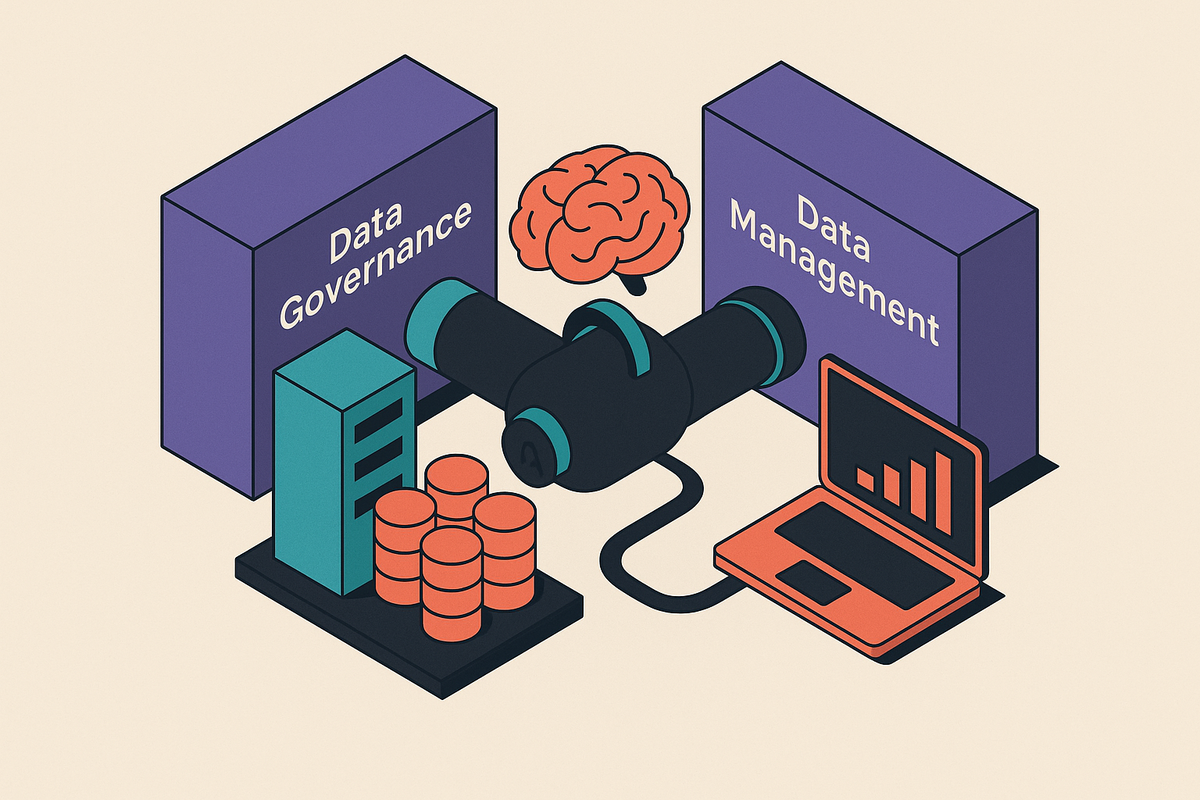
None of this is only a technical concern. Organizations that treat quasi-identifier-rich telemetry as anonymous data take on the full regulatory exposure attached to personal data under GDPR and HIPAA, because both frameworks define protection around re-identifiability, not around whether a name field happens to be present. AI governance analysis from January 2026 states that both HIPAA and GDPR treat re-identifiable data as personal data subject to full protection, and that organizations need to validate their de-identification methods because AI can re-identify "anonymized" data through pattern correlation. The GDPR recital standard, asking whether re-identification is "reasonably likely by any means," comes closer to being satisfied with every demonstration that an agentic LLM can complete the task in minutes at near-zero cost.
The exposure extends past GDPR and HIPAA into the AI Act framework, where high-risk systems that process personal data face mandatory impact assessments and technical controls, and these obligations cover the telemetry infrastructure feeding those systems, not just their visible outputs. The practical failure point for most organizations is simpler than any of the legal theory: inventory. Governance analysis recommends that organizations keep detailed inventories of their AI systems, documenting data sources, categories of personal information processed, retention periods, and cross-border transfers. Most telemetry pipelines in production today don't have that inventory built. The gap between what regulators expect and what most teams can actually produce on request is already wide.
What architectural privacy design does that post-hoc anonymization cannot
Every case examined in this piece traces back to the same structural decision: privacy was handled as a step applied after data had already been collected at full resolution, rather than as a constraint shaping what got collected. Post-hoc anonymization can only work on data that already exists in full detail. Architectural privacy design works earlier than that, shaping what data comes into existence at all, and telemetry that was never captured at full quasi-identifier resolution cannot be fingerprinted later, not even by an agentic LLM with web access and unlimited patience.
That principle points toward specific, concrete choices. Generalizing timestamps at the point of logging, recording session hour instead of exact start time, cuts temporal fingerprint resolution before any downstream anonymization step even begins. Limiting collection to the fields a defined analytical purpose actually requires removes entire quasi-identifier combinations before they can ever form, without needing complicated suppression or noise-injection after the fact. Aggregating on-device or at the edge, computing behavioral summaries locally and transmitting only the aggregate, means individual session traces never leave the device in the first place, removing the dataset-level re-identification surface. And differential privacy applied at the point of collection, before aggregation happens, can preserve its mathematical guarantee without demanding the heavy noise levels that destroy analytical value once applied to data that's already been aggregated.
The case running through every section of this piece points to one conclusion: privacy-preserving AI architecture is a distinct technical category from compliance-driven anonymization applied after the fact. A system designed from the outset to collect less, and to avoid retaining behavioral traces detailed enough to identify someone, removes the re-identification surface before it can form. The question worth asking of any AI telemetry pipeline is whether the data being protected needed to exist in that form at all, not whether its anonymization technique is strong enough to survive the next re-identification paper.