Randomized Response and Local Differential Privacy in On-Device AI
Privacy is added on devices before data leaves, making breaches irrelevant.
In 1965, statistician S. L. Warner published a technique for getting honest answers to sensitive survey questions without exposing any individual respondent. The mechanic was disarmingly simple: a respondent flips a coin in private, and if it lands one way, they answer truthfully; if it lands the other, they answer randomly. The analyst, knowing the coin's probability, can recover the population distribution without ever knowing what any single person said. Warner called it randomized response. For nearly four decades it sat quietly in the survey methodology literature, a clever social-science workaround with no particular home in computer science. Then Cynthia Dwork and colleagues formalized differential privacy in the mid-2000s, and Warner's coin flip finally found both its mathematical foundation and its way into the operating systems of billions of devices.
Differential privacy's central contribution is a single quantifiable parameter, epsilon (ε), that governs how much noise a mechanism adds. Smaller epsilon means more noise, stronger privacy, and lower accuracy on any given query. The formalism makes a precise guarantee: the probability of any observable output changes by at most a factor of e^ε, whether or not any single individual's data is included. That bound holds regardless of what an adversary already knows.
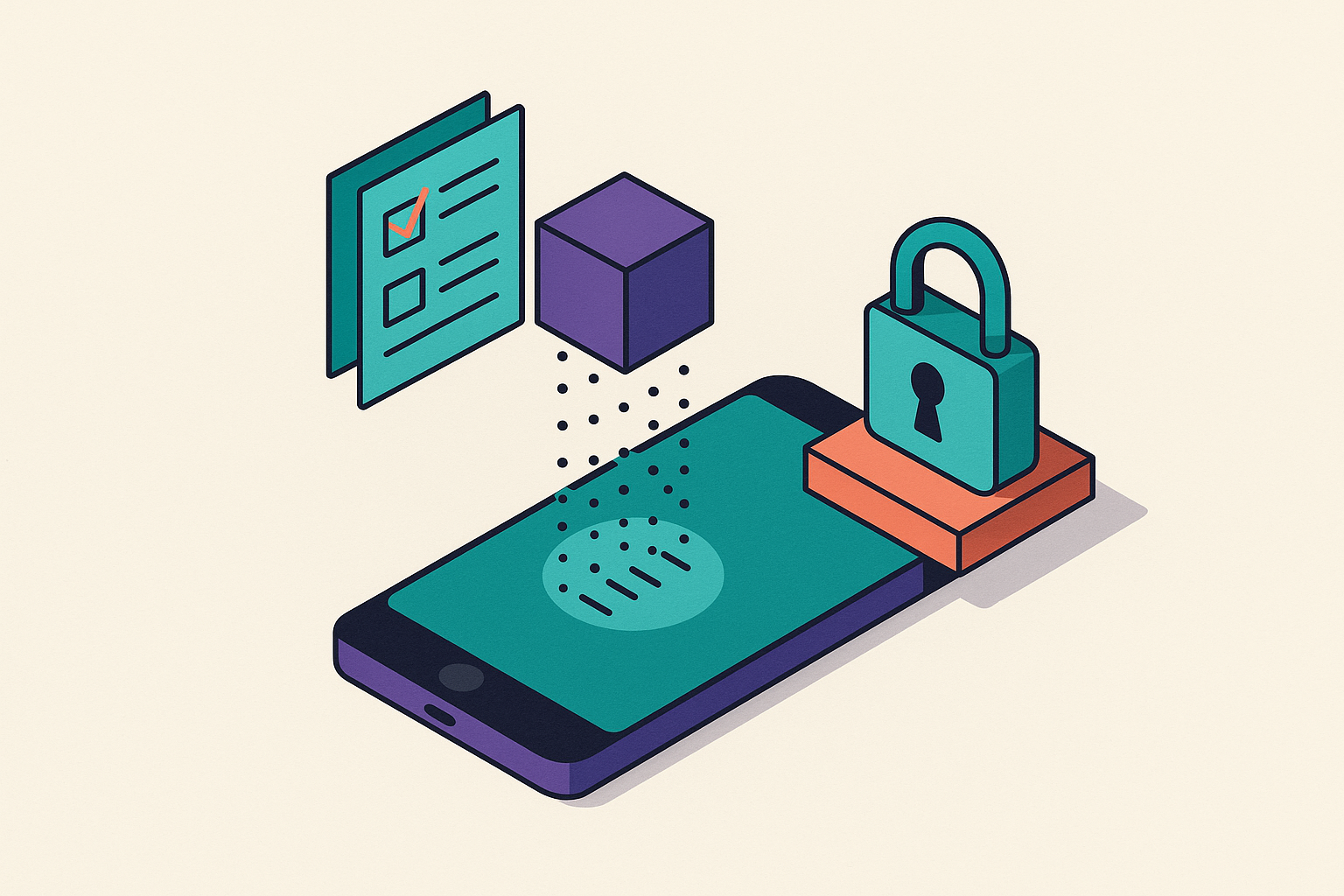
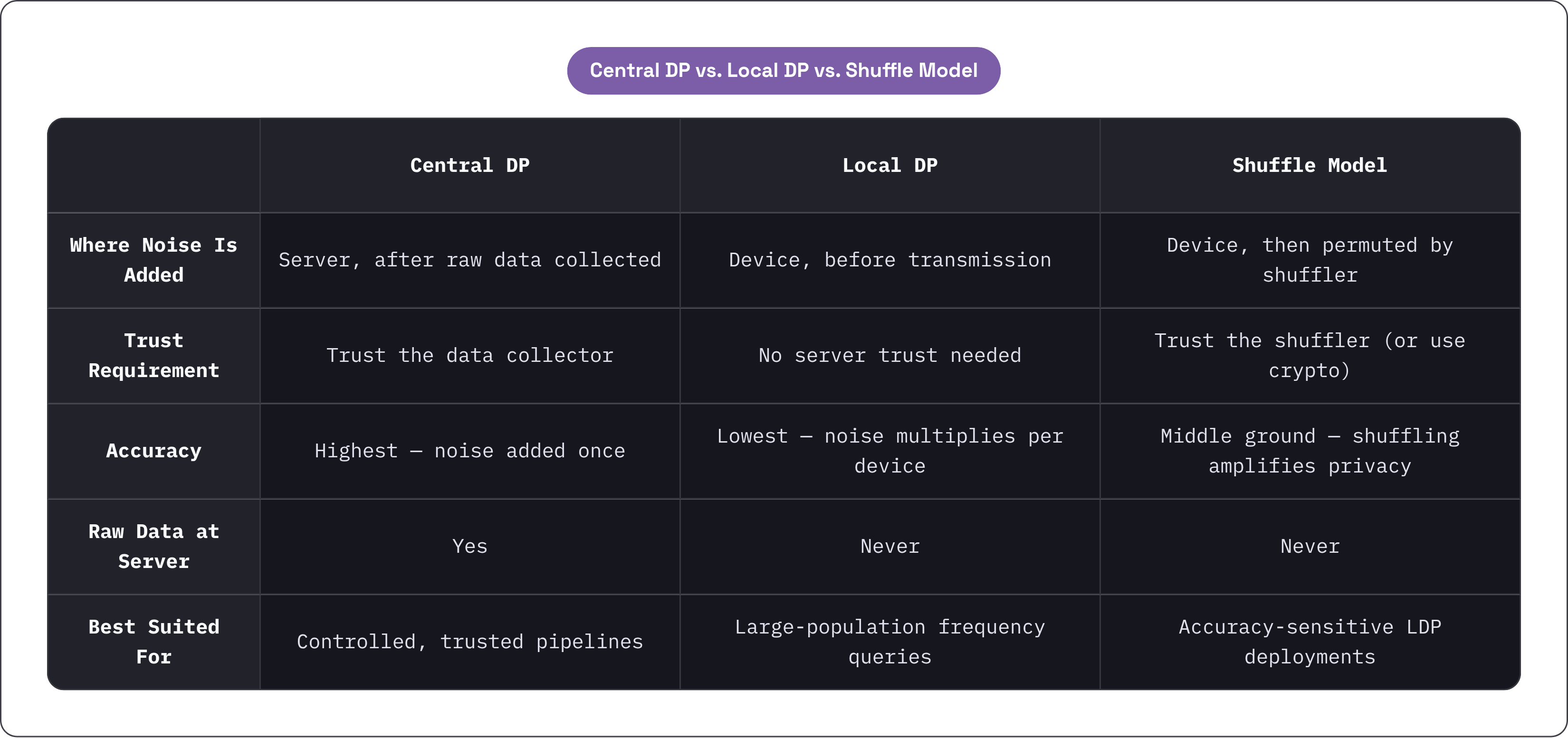
The architectural question that produces local differential privacy is: where does the noise get added? Central differential privacy adds noise at the server after collecting raw data, which requires trusting the data collector. Local differential privacy adds noise on the device before anything is transmitted. No raw signal ever crosses the wire.
Randomized response is simply the binary special case of local DP. A user holds a true bit, answers truthfully with probability governed by ε, and lies otherwise. The server sees only the noisy bit. Across a large enough population, the noise cancels and the true distribution becomes estimable. Generalize from a single bit to a categorical variable and you get unary encoding: the true value is represented as a bit vector, and randomized response is applied per coordinate. Extend to continuous numerical data and you get the Laplace or Gaussian mechanism, which adds calibrated real-valued noise instead of a coin flip. For high-cardinality domains, hashing-based techniques like Count Mean Sketch encode the value first and then apply the flip, keeping the representation compact while preserving the guarantee.
The property that matters most for architecture, and the one that separates LDP from every form of post-hoc anonymization, is irreversibility before transmission. A server that is breached, a channel that is intercepted, a subpoena served on a cloud provider: none of these can reconstruct individual inputs, because those inputs were never transmitted. The guarantee is a structural property of the data pipeline, not a policy or a contractual promise.
The Cost of Keeping Secrets on the Device: Accuracy Loss That Only Large Populations Can Absorb
Local DP's defining liability is statistical. Each device adds its own independent noise, and the analyst must average across all devices to recover a useful signal. In central DP, a trusted server holds the raw data and adds noise once, in aggregate; the noise burden is shared efficiently. In local DP, the noise burden is distributed and multiplied: accuracy is typically orders of magnitude lower than central DP at the same privacy cost.
This is an engineering failure that cannot be patched away. It is a structural property of the model, and it has direct consequences for who can deploy LDP and what questions they can reasonably ask it to answer. The set of computationally viable queries under local DP at reasonable epsilon values is narrow: frequency estimation, heavy hitter detection, low-dimensional marginals. Complex inference tasks, fine-grained behavioral modeling, anything requiring high accuracy on rare events — these face accuracy penalties the mechanism cannot absorb regardless of how cleverly the system is engineered.
The practical implication is that LDP is, functionally, a technology for large platforms. The noise cancels when the denominator is very large. Companies with hundreds of millions of users can recover useful population statistics from locally noisy reports. A company with ten thousand users generally cannot. I have watched organizations attempt to retrofit LDP onto pipelines built for populations an order of magnitude too small, and the results are striking: the estimates are so wide as to be useless, and the team is left defending a privacy claim while discarding the data. That sequencing mistake matters enormously, and it is more common than the published literature suggests.
This constraint shapes the competitive landscape in ways worth taking seriously. It is a reason to be precise about what local DP can and cannot support before committing to it architecturally, rather than a reason to dismiss it.
Google RAPPOR: Deploying Randomized Response Across Hundreds of Millions of Chrome Browsers
Google introduced RAPPOR, Randomized Aggregatable Privacy-Preserving Ordinal Response, in 2014, and it remains one of the most instructive real-world deployments of LDP. The target data was mundane by technical standards: which homepage Chrome users had set, which default search engine was configured. The engineering challenge was protecting those values across a population large enough that aggregate statistics would be meaningful, while ensuring the server never saw a raw value.
The architecture adds noise on-device before any transmission. The server receives only the randomized reports. The implementation is open-source, which matters for auditability in a way proprietary systems categorically cannot replicate. When researchers wanted to scrutinize the privacy accounting, the code was there to scrutinize.
The key engineering addition over bare randomized response is the use of Bloom filters. Rather than encoding a value directly and applying the coin flip, RAPPOR first encodes the value into a Bloom filter — a compact probabilistic data structure — before the randomization step. This reduces the representation space and tightens the privacy guarantee by making it harder to reverse-engineer any individual's value from their report. One privacy budget is assigned per value per metric, a design choice that becomes significant in contrast to Apple's approach.
What RAPPOR demonstrated at scale is that the accuracy constraint is manageable when the question is frequency-based and the population is very large. It also demonstrated that LDP deployments can be architecturally transparent. The open-source release gave the research community something to actually evaluate, rather than just a white paper describing claimed properties.
Apple's On-Device LDP: How Count Mean Sketch Handles Emoji, Safari Queries, and Health Data at iOS Scale
Apple launched its local differential privacy implementation with macOS Sierra and iOS 10, subsequently expanding coverage to Safari query patterns, keyboard autocorrect, and Health data. The stated position was direct: local DP is a superior form of privacy because data is randomized on device before transmission, and no raw data reaches Apple's servers.
The emoji use case is the clearest worked example Apple has made public. The goal is to determine which emojis are most frequently used per locale without learning any individual user's emoji history. The mechanism is Count Mean Sketch using SHA-256 hash variants. Each coordinate of the encoded sketch vector is flipped with probability governed by the privacy parameter; a random coordinate from the sketch matrix, not the full sketch, is transmitted, keeping within the per-day privacy budget. Apple published epsilon values of ε = 4 for emoji frequency and ε = 2 per day for most other data types.
Apple's budget management design differs meaningfully from Google's per-value, per-metric approach. Apple assigns privacy budgets to categories of related metrics. All emoji reports draw from the same "keyboard.Emoji" budget rather than each emoji type receiving its own budget. This directly addresses a correlation risk that per-value budgeting can underestimate: related metrics, if collected independently with separate budgets, can be combined by the analyst to narrow in on individual behavior even when each metric individually satisfies its own guarantee. Bounding correlated metrics together limits that combinatorial exposure.
The temporal accumulation problem is harder to dismiss. Daily collection across months or years means cumulative privacy loss is non-trivial even with per-day caps. Apple retains locally differential private data for up to three months. The privacy guarantee applies to each day's report; the composition of many days' reports is a harder accounting problem, and one the literature on differential privacy composition is still actively working through.
What Critics Found When They Reverse-Engineered Apple's Epsilon Choices
Researchers who reverse-engineered Apple's macOS implementation found that the epsilon values in actual use were higher than what the academic differential privacy literature typically treats as providing strong privacy protection. Apple disputed the researchers' interpretation of those values. The disagreement itself is the more instructive finding.
Epsilon is not a universally agreed-upon threshold. Apple's published values of ε = 2 to 4 per day sit in a range that some researchers consider permissive; the academic literature often works with substantially lower values in controlled settings. The U.S. Census Bureau used a considerably higher epsilon for the 2020 decennial release and faced significant criticism from statisticians. No regulatory or standards body has set a binding definition of what epsilon value constitutes "sufficient" privacy for any given use case or population.
That gap raises an uncomfortable question for practitioners. What does a privacy claim actually mean when the parameter behind it is unevaluated against any agreed standard? A system described as differentially private spans an enormous range of actual guarantees depending on the epsilon chosen, the composition across multiple queries, and the size of the population. The label alone is uninformative without the parameter. The parameter alone is uninformative without context about the use case, the adversary model, and the accumulation over time.
This is a property of the framework itself, rather than a criticism of Apple specifically — one the field has not yet resolved into deployable standards. The academic community has produced substantial work on privacy accounting, composition theorems, and tighter bounds, but the translation from research result to deployable standard has not happened. Until it does, privacy claims based on differential privacy remain formally rigorous and practically ambiguous at the same time.
Federated Learning Adds a Second Layer: LDP Applied to Model Gradients, Not Just Data Collection
Google's 2017 proposal for federated learning changed the architecture of distributed machine learning. Instead of sending raw data to a server for training, devices train a model locally on their own data and send only the model weight updates, the gradients, to a central server that aggregates them into a global model. Raw training data never leaves the device.
The residual privacy problem is that gradient updates can leak sensitive information. Research has shown that raw gradients can, under certain conditions, be used to reconstruct training inputs or infer membership. The solution is to apply local differential privacy directly to the gradients: Gaussian noise is added to weight updates before transmission, and the server aggregates noisy gradients.
The standard mechanism for this is DP-SGD, Differentially Private Stochastic Gradient Descent. It clips per-sample gradients to bound their sensitivity, then adds calibrated noise before aggregation. The privacy guarantee is formal and quantifiable. The practical costs are real: reduced model utility, increased memory requirements, slower convergence. These costs scale with the strength of the privacy target, and no algorithm has eliminated that relationship; it has only been made more tractable.
Combining federated learning with LDP on gradients creates a two-layer architecture. Raw data stays on device by design; gradient updates are noised before leaving. Each layer provides a partial guarantee; together, they reduce the attack surface substantially. The remaining trust assumption is that the aggregation server behaves honestly, which is a weaker assumption than trusting it with raw data, but a genuine one that should be addressed plainly in architectural descriptions rather than papered over.
Why Fine-Tuning Rather Than Full Training Has Become the Practical Path for DP in Large Language Models
Full differentially private training of large language models is, at current scales, computationally expensive enough to be practically prohibitive. The noise required to satisfy meaningful privacy guarantees degrades model quality substantially when applied across the full training run of a very large model from scratch. The research community has largely converged on a more tractable target: DP fine-tuning on private, domain-specific data. This is also where the real privacy risk concentrates. A general-purpose model trained on public data carries less individual-level sensitivity than one fine-tuned on a hospital's patient records or a company's internal communications. The threat model and the architectural intervention should be calibrated to each other.
Google's research from 2023 and 2024 produced an empirically important finding: DP-SGD's relative accuracy cost decreases as model scale increases. Very large models absorb noise better than smaller ones, suggesting that models at very large parameter scales may eventually support meaningful DP guarantees at acceptable accuracy. This is an empirical regularity, rather than a complete theoretical explanation, but it has shifted how the field thinks about the feasibility horizon.
Ghost clipping, developed by Li and colleagues, addresses a separate bottleneck: the per-sample gradient computation in DP-SGD requires storing individual gradients for each training example before clipping and aggregating them, which creates memory overhead that scales prohibitively with model size for transformer architectures. Ghost clipping restructures the computation to recover per-sample gradient norms without materializing the full gradients, making DP-SGD practical for large transformers without proportional runtime overhead.
Active research threads in 2025 and 2026 include Tensor Train Decomposition to improve privacy-utility trade-offs under DP-SGD, device-cloud collaboration frameworks like PrivTune for efficient private fine-tuning, and FlashDP for faster DP-SGD on large models. The direction across all of these is consistent: reduce the utility tax of DP without relaxing the privacy guarantee.
The Shuffle Model: How Inserting a Permutation Step Between Device and Analyst Narrows the Accuracy Gap
The accuracy problem in pure local DP is structural. Each device's independent noise contribution must be averaged out by the analyst, and the averaging requires a very large population to recover a useful signal. The shuffle model introduces an architectural element between device and analyst: a secure shuffler that randomly permutes all reports before they reach the analyst.
The privacy amplification effect of shuffling is well-established. When reports are shuffled, the analyst cannot link any report to its originating device. This anonymization of the source allows the analyst to recover better accuracy than pure local DP for the same epsilon, or equivalently, to achieve the same accuracy with a meaningfully lower epsilon. Shuffling adds an additional layer of anonymity on top of the local noise, and the analyst can exploit that structure to extract more signal.
Heavy hitter estimation benefits particularly from the shuffle step. The task is inherently suited to aggregation, and the permutation step significantly reduces the accuracy penalty. A 2024 paper published in PVLDB, volume 17, issue 8, addressed a gap in the theoretical foundation: prior analyses of privacy amplification via shuffling lacked both tightness and generality. Tighter accounting matters because it allows system designers to claim stronger guarantees from the same architecture without changing the underlying mechanism.
The shuffle model does require trusting the shuffler to avoid linking reports to users. This is a weaker trust assumption than central DP, which requires trusting the analyst with raw data, but it is a genuine assumption. Architecturally, the shuffler can be replaced by cryptographic protocols, such as secure multi-party computation or trusted hardware enclaves, that provide the permutation step without requiring trust in any single party. Deployments that eliminate the trusted shuffler assumption represent a meaningful step toward fully trustless local DP, though the computational overhead of those cryptographic protocols is non-trivial and remains an active constraint.
Recent Algorithmic Advances in Randomized Response Itself: Personalization and Bipartite Classification
Standard randomized response applies a uniform noise parameter to every user and every value. This uniformity is conservative by design, but it is also inefficient. Users vary in the sensitivity of their data; domains vary in the distribution of values across the population. Applying identical noise everywhere sacrifices accuracy that could be preserved without weakening the privacy guarantee.
Adaptive personalized randomized response, described by Zhang and colleagues in the International Journal of Information Security and Privacy in 2024, tailors noise to individual user sensitivity rather than applying a blanket epsilon. Users whose data is less sensitive contribute more accurately; the aggregate estimate is better than what uniform noise would produce for the same worst-case privacy guarantee. The mechanism preserves the formal DP bound for each user while exploiting population structure to recover aggregate accuracy.
Bipartite randomized response, proposed by Zhang and colleagues in a 2025 arXiv preprint, addresses a different inefficiency that becomes acute when the domain is large. Standard randomized response assigns similar release probabilities to the true answer and to all other candidates in the domain. When the domain is large, this is wasteful: most candidates are clearly wrong, and treating them symmetrically with plausible alternatives dilutes the informativeness of every response. The bipartite approach classifies candidates into high-utility and low-utility groups, assigning high release probabilities selectively to the former, recovering accuracy without loosening the privacy guarantee.
Both advances matter specifically for on-device AI because mobile devices deal routinely with large categorical domains: emoji vocabularies, natural language tokens, app usage categories, query strings. These are precisely the domains where standard randomized response degrades fastest. The gap between what uniform noise can accomplish and what personalized or bipartite mechanisms can accomplish is widest exactly where consumer AI applications need accuracy most.
What Privacy-by-Architecture Means for AI Systems That Can't Afford to Learn From Breaches
The property that local differential privacy provides, and that anonymization and access controls categorically cannot, is that the server never had the raw data to begin with. There is no breach scenario that exposes it, no subpoena that compels its production, no insider threat that can retrieve it, because it was never there. Post-hoc anonymization strips identifying information from data that has already been collected; local DP ensures the identifying information is never transmitted. The distinction is architectural, rather than operational.
Medical AI makes this concrete. Research published in Electronics in January 2025 highlights federated learning with LDP for distributed medical devices, and the reasoning is straightforward: health data is sensitive enough that on-device noise injection is a requirement for responsible deployment, beyond merely a privacy enhancement. The sensitivity of the domain raises the cost of any failure; architecture that eliminates the data collection point eliminates the failure mode itself.
The lesson from Google's and Apple's deployments is that LDP works at population scale, but it requires architectural commitment from the start. RAPPOR and Apple's keyboard and emoji pipelines were built around the constraint that raw data would leave the device under no circumstances. They were not retrofitted onto systems designed to collect raw data. That sequencing matters more than any downstream noise-addition strategy. A system designed to collect first and protect later is fundamentally different from a system designed to avoid collecting in the first place, and no amount of downstream privacy engineering closes that gap.
The epsilon transparency problem remains unresolved. Without a standard definition of what epsilon value constitutes adequate privacy for a given use case, users and regulators cannot meaningfully compare competing claims. A system reporting ε = 4 per day may be genuinely private for frequency estimation over a very large population; it may be inadequate for a smaller population or a more sensitive query. The number alone does settle the question, and the field has yet to produce the standards infrastructure that would let it do so. Until that infrastructure exists, architectural choices — specifically the decision to avoid collecting raw data — carry more practical weight than any epsilon value a system can report.
Warner's coin flip, formalized by Dwork and deployed by Google and Apple, is now sixty years old as a concept. The field has spent the last decade making it rigorous, scalable, and increasingly compatible with capable AI systems. The open problems are real, particularly around epsilon standardization, temporal composition, and the population-size constraint. But the core architectural insight — that you cannot leak what you never held — is a settled design principle. And it is the one that scales.