When Synthetic Data Actually Protects Privacy in AI Training
Synthetic data's privacy value depends entirely on generation method, not marketing claims.
When Synthetic Data Actually Protects Privacy in AI Training.
Synthetic data's shift from niche tool to mainstream AI training strategy
Synthetic data carries no automatic guarantee of privacy. Its actual protective value depends entirely on how it's generated, and the gap between the marketing claim and the technical reality is the subject of this piece. IBM defines it simply as artificial data designed to mimic real-world data, which sounds modest until you look at how fast the practice has scaled. The global synthetic data market reached $351 million in 2023 and is projected to grow to $2.34 billion by 2030 at a CAGR of 31.1% Nitor Infotech Synthetic Data in 2026: Solving Privacy Challenges Without Losing Acc…. Per Gartner's data strategy report, 75% of enterprises are now using synthetic data in some capacity for AI model training, up from under 40% in 2024.
Part of the push is supply. The Harvard/JFK School of Government paper "The Synthetic Mirror" argues that between 2026 and 2032, large language models will run through essentially all the human-generated text available on the open internet Synthetic Data in 2026: Solving Privacy Challenges Without Losing Acc…. Synthetic data fills that gap, whether or not every use case actually calls for it Synthetic Data in 2026: Solving Privacy Challenges Without Losing Acc…. And this is where the sales pitch gets slippery: vendors and adopters routinely describe synthetic data as something that "protects privacy" almost by definition, as if generating fake-looking numbers automatically severs any tie to the real people behind them.
The rest of this piece depends on a hard line drawn early. Anonymized data is still real data, just with names and obvious identifiers stripped out. Synthetic data is different in kind: it's generated from a statistical or generative model that learned patterns from the original dataset, then produces new records that were never attached to an actual person. That distinction sounds clean in theory. Whether it holds up in practice is a separate question, and the answer turns out to depend heavily on method.
How synthetic data generation methods affect privacy
There are three broad families of generation methods, and each carries a different privacy profile. Statistical models, things like parametric sampling, copula models, Monte Carlo simulation, stochastic processes, fit a probability distribution to the real data and then sample from that distribution. How private the output is depends on how much the fitted model actually retained about individual records. A distribution fit on millions of records behaves very differently from one fit on a few hundred.
Generative adversarial networks work through a different mechanism entirely: a generator and a discriminator compete, the generator producing fakes and the discriminator trying to catch them, until the outputs are good enough to fool an expert. GANs are strong at capturing complex, non-linear relationships and show up widely in healthcare imaging and financial fraud detection. But the generator learned from real data at some point, so what it memorized in the process matters just as much as what it produces.
Variational autoencoders take a third route. They compress real data into a latent representation, then decode new samples from that compressed space. VAEs are common in financial risk modeling and insurance, but the latent space itself can still encode individual-level signal, which means the compression doesn't automatically wash out identity. Diffusion models and LLM-generated synthetic content round out the picture, increasingly used for text and tabular data Synthetic Data in 2026: Solving Privacy Challenges Without Losing Acc…. An arXiv paper from researchers at NUS and ETH Zurich specifically flags diffusion-generated synthetic data as one of four paradigms whose privacy claims need rigorous scrutiny, not just a passing nod Synthetic Data in 2026: Solving Privacy Challenges Without Losing Acc….
The tension running through all four families is the same: every one of them learns from real data first Synthetic Data in 2026: Solving Privacy Challenges Without Losing Acc…. The open question is how much of that original signal survives into the synthetic output. That's the variable this entire article keeps circling back to, because method choice is a privacy decision, whether or not the people making it think of it that way.
The specific conditions under which synthetic data genuinely breaks the link to real individuals
So when does synthetic data actually do what the marketing claims? Four conditions need to hold, and they're cumulative rather than interchangeable Synthetic Data in 2026: Solving Privacy Challenges Without Losing Acc….
The first is a formal differential privacy guarantee. Differential privacy is a well-established mathematical framework for bounding how much information can leak from a dataset, and it guarantees that no single individual's data can be reverse-engineered from the output. Mechanically, this works by injecting carefully calibrated noise, controlled by a privacy budget parameter called epsilon. Lower epsilon means a stronger guarantee, but usually at some cost to how faithful the synthetic data is to the original. A hands-on tutorial on dev.to describes the pairing of DP with synthetic data as rapidly becoming the standard: it holds up better than k-anonymity, which modern LLMs are increasingly good at cracking by inferring identity from subtle patterns.
The second condition is that the generative model doesn't overfit to rare or unique records. A patient with an unusual combination of conditions, or a customer with an outlier transaction history, risks getting encoded almost exactly if the model is powerful enough and the dataset small enough. Protection is strongest when the underlying population is large and varied enough that no single record can dominate what the model learns.
Third, the data needs to be generated at the level of the population distribution, not record by record. Statistical sampling from a properly fitted distribution, with enough abstraction built in, genuinely severs the link to individuals. Compare that to coreset selection or dataset distillation, which compress or summarize real records directly. Those techniques can retain far more individual-level signal than people assume, a point the Zhao and Zhang paper drives home.
Fourth, the downstream task shouldn't demand high fidelity at the tail of the distribution. If the application can tolerate some statistical approximation, DP noise can be dialed in at a level that genuinely protects people. If it needs precision on rare events or small subgroups, satisfying all four conditions at once gets a lot harder Synthetic Data in 2026: Solving Privacy Challenges Without Losing Acc…. Which raises the obvious follow-up: where do these conditions actually line up in practice, rather than just on paper?
Conditions most reliably met: healthcare, finance, and simulation-first domains
Rare disease research is a good place to start. The field runs into a stack of obstacles at once: limited patient data, strict rules under HIPAA, and a need for cross-border collaboration that real patient records can't easily support. Synthetic patient data that mirrors real health records lets diagnostic algorithms get trained without exposing actual patient confidentiality, according to an NIH/PMC study. The population involved is small and sensitive, which is exactly the setting where DP-backed generation earns its keep. The conditions line up when formal guarantees are applied and the fidelity target is population-level patterns rather than any one patient's individual trajectory.
Finance tells a similar story. Fraud cases are rare by nature, which makes them hard to model well using real data alone, so synthetic datasets that simulate a wide range of fraudulent patterns fill a real gap without exposing actual customer transactions. Institutions can share synthetic "patterns of crime" instead of actual bank statements, collaborating on anti-money-laundering efforts while staying compliant with the Gramm-Leach-Bliley Act. Financial services firms using synthetic data report cutting model development time by 40 to 60%, according to Data Science Society, which suggests privacy and operational efficiency are pulling in the same direction here rather than trading off against each other.
Then there's the cleanest case of all: simulation-first domains where no real personal data enters the pipeline to begin with. Autonomous vehicle companies, Waymo and Tesla among them, build synthetic driving environments to cover edge cases, a pedestrian stepping out unexpectedly, an obstacle appearing mid-lane. Because that data was never derived from real people, the privacy protection is structural rather than probabilistic. There's no noise budget to calibrate, no re-identification risk to bound, because the link to a real individual was never there to sever.
Language model training shows a version of the same logic. Microsoft's Phi-3 combines LLM-generated synthetic "textbook quality" content with curated web data, a design choice that avoids the need for real personal data in the first place and sidesteps privacy risk at the architecture level rather than patching it after the fact. NVIDIA's Nemotron-4 340B family follows a related path: open models built specifically to generate synthetic training data for other LLMs across industries, addressing data scarcity without requiring access to sensitive personal records. Across all these examples, the pattern holds. Genuine privacy protection appears most reliably when the task is learning population-level patterns, the generation method carries formal guarantees, and the domain has regulatory teeth pushing organizations to apply those guarantees carefully rather than loosely.
Cases where synthetic data does not protect privacy, despite claims that it does
A catch undercuts a lot of the optimism above. The more realistic and statistically faithful synthetic data becomes, the more it risks re-encoding private information about the individuals it was built from, according to Ada Lovelace Institute analysis. This isn't a bug that better engineering fixes. If the synthetic output has to preserve the same relationships found in the original data, some re-identification risk survives no matter what, a mathematical trade-off rather than an oversight. Fidelity and privacy pull against each other by construction.
The February 2025 Zhao and Zhang paper puts a number on how bad this gets in practice. The researchers examined four paradigms: coreset selection, dataset distillation, data-free knowledge distillation, and diffusion-model-generated synthetic data. All four "often claim to preserve privacy Synthetic Data in 2026: Solving Privacy Challenges Without Losing Acc…." The paper's central finding says otherwise: almost none of these approaches provide meaningfully stronger protection than the basic differential privacy baseline, DPSGD. And the evaluation wasn't soft on itself: it used worst-case membership inference attack frameworks rather than average-case ones, which matters because average-case reporting can badly understate how much risk actually exists.
One finding from that paper deserves a moment's attention. For some dataset distillation methods, the success rate of membership inference attacks came out very low, yet the synthetic data visually resembled the private data closely. The researchers were direct about what that means: low attack success under those conditions doesn't count as meaningful privacy protection, because the resemblance itself is the leak.
Real-world attacks back this up. The MIDST Competition at SaTML 2025 tested membership inference against multi-table synthetic data generated by ClavaDDPM, under both white-box and black-box conditions. The winning attack didn't even bother with the auxiliary tables. It focused entirely on one main table and still won, which says something uncomfortable about how much sophistication an attacker actually needs. A related finding from the same competition: the more faithfully a model preserves the dependencies within and across tables, the more vulnerable it becomes. Fidelity and privacy trade off directly, not as an occasional exception but as a rule.
Even routine, unglamorous techniques carry risk. A paper by Ganev and colleagues, titled "SMOTE and Mirrors," found privacy leakage specifically tied to synthetic minority oversampling, a method used constantly to fix class imbalance in training data. It's a default step in a huge number of machine learning workflows, quietly introducing a vulnerability nobody was screening for.
Decentriq's 2025 position paper takes the argument further and makes it a practitioner-facing claim rather than an academic footnote: synthetic data alone is not enough to satisfy GDPR. There are also downstream risks that fall short of classic privacy failures yet can still degrade model outputs and compliance standing. A Nature study documented "model collapse," where AI systems trained repeatedly on AI-generated text degrade over successive generations, producing increasingly nonsensical output. And synthetic data can amplify bias baked into the original dataset, scaling up demographic imbalances so models perform unevenly across groups, which compounds the harm specifically where minority populations were already underrepresented in the source data.
What the regulatory environment currently requires
Regulators haven't ignored any of this, but the frameworks in place weren't built with synthetic data specifically in mind. GDPR sets out consent requirements, a right to deletion, and data minimization rules, and synthetic data simplifies compliance somewhat by removing real personal data from the pipeline. HIPAA requires strict de-identification of protected health information, which synthetic generation can satisfy, provided formal guarantees are actually applied rather than assumed. The EU AI Act, with 2026 enforcement dates, adds specific requirements around documenting training data and auditing for bias, which puts pressure on organizations to record exactly how their synthetic data was generated and validated.
But here's the gap. Current regulation generally asks for de-identification or privacy protection as an outcome. It doesn't specify that formal differential privacy guarantees are the mechanism required to get there. That means an organization can satisfy a regulator's checklist with synthetic data that still leaks in exactly the ways the MIDST competition and the Zhao and Zhang paper documented Synthetic Data in 2026: Solving Privacy Challenges Without Losing Acc…. The Harvard "Synthetic Mirror" paper makes the case that existing AI and data governance frameworks weren't built to handle synthetic data's specific failure modes, and argues for targeted amendments that treat synthetic data as its own regulatory category, rather than an entirely new regime built from scratch. Passing an audit and actually protecting people turn out to be two different achievements, and conflating them is where a lot of the false confidence in this space comes from. As Nitor Infotech reports, a Gartner report notes that synthetic data cuts audit times by 50% in regulated sectors, giving organizations strong practical reasons to adopt it. IBM reported that the global average cost of a data breach exceeded $4 million in 2025, and the financial case for avoiding real-data exposure reinforces the compliance case.
Privacy-preserving AI architecture as the difference synthetic data alone cannot make
Pull the threads together and one insight holds across every section above: synthetic data is a tool, not a guarantee. Whatever privacy protection it delivers gets decided by choices made at the architecture level, both before the data is generated and after.
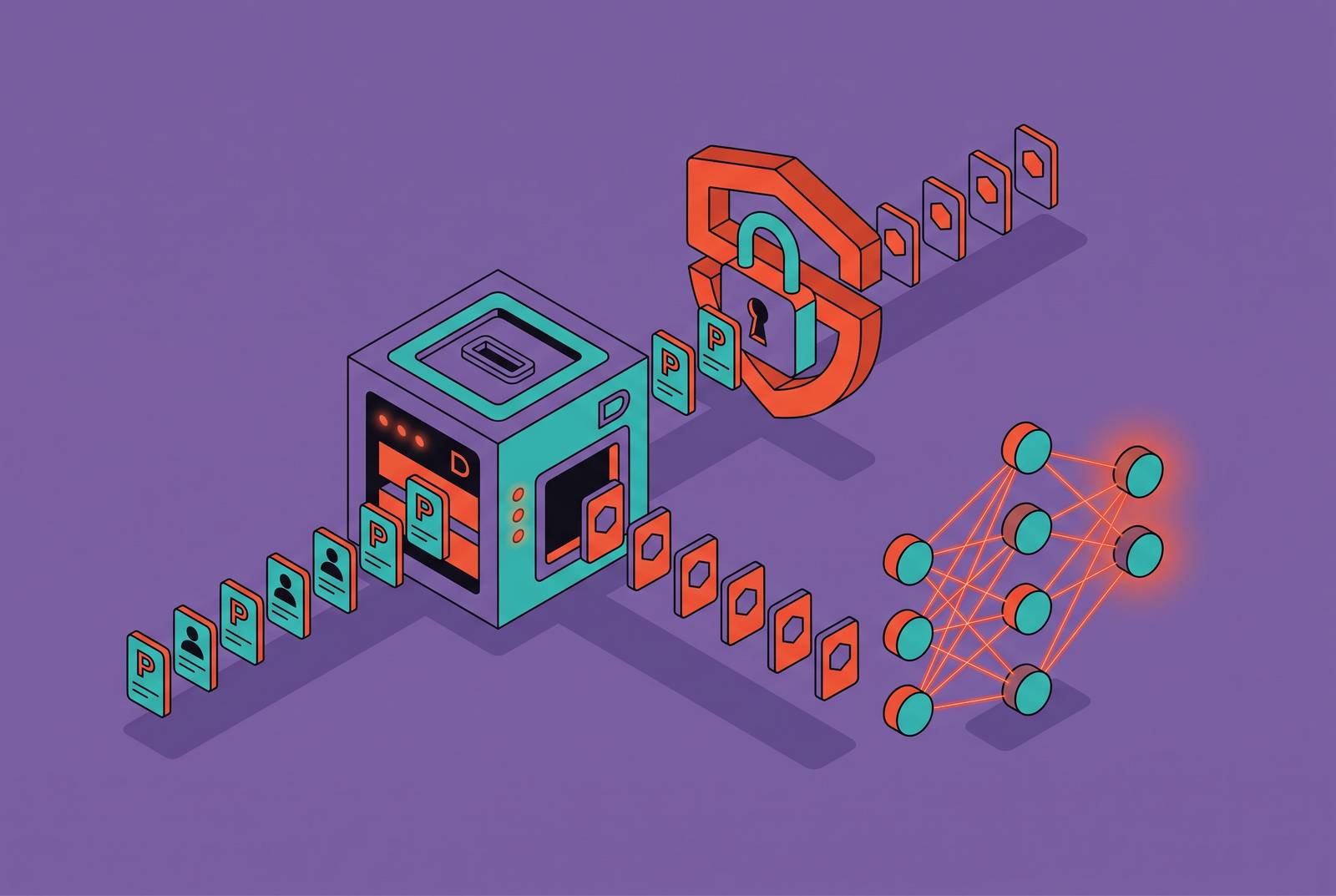
What does that architecture actually need to include? Differential privacy built into the generation process itself, not bolted on afterward as an afterthought. Membership inference testing treated as a routine validation step, using worst-case attack models rather than the average-case reporting that understates real risk. Design decisions that ask what the model actually needs to learn, rather than how realistic the output can be made to look. And provenance tracking that records what real data any given synthetic dataset was derived from, and under what DP parameters, treated as a first-class artifact.
Put the Decentriq position next to the Zhao and Zhang findings and the implication is hard to avoid: organizations treating synthetic data as their entire privacy strategy are exposed, whether or not they realize it yet. Closing that gap doesn't come from picking a fancier generation method. It comes from system-level architecture that doesn't need real personal data to enter the pipeline in the first place. Synthetic data can be part of that architecture. It was never built to be the whole of it. For AI systems.
Sources
- The Synthetic Mirror -- Synthetic Data at the Age of Agentic AI
- Synthetic Data for Secure ML Training | Nitor Infotech
- Does Training with Synthetic Data Truly Protect Privacy?
- Synthetic Data in 2026: Solving Privacy Challenges Without Losing Accuracy – Data Science Society
- How to DP-fy Your Data: A Practical Guide to Generating Synthetic Data With Differential Privacy
- Synthetic Data and Health Privacy
- Empirical Evaluation of Structured Synthetic Data Privacy Metrics: Novel experimental framework
- Synthetic Data: Methods, Use Cases, and Risks