Private AI for Source Protection in Investigative Journalism
How cloud AI tools routinely expose journalists' sensitive sources to legal demands and breaches.
The newsrooms that most need to understand AI infrastructure are the ones least likely to have a technologist on staff to explain it. That gap concerns me more than any specific vulnerability, because the threat to source protection embedded in standard cloud AI tools is not exotic. It is ordinary. It follows from how the systems are built, not from any unusual malice or negligence.
Roughly 82% of newsrooms report using AI today, up from 37% in 2019. That adoption curve has outrun any serious institutional reckoning with what happens to the material journalists feed these systems. The question I keep returning to, having spent years working at the intersection of investigative practice and information security, is this: when a reporter submits a sensitive document to a cloud AI tool, where does that document go, and who can reach it?
The answer is not reassuring. And it is not primarily a question of trusting or distrusting any particular company.
The four ways cloud AI infrastructure exposes source material
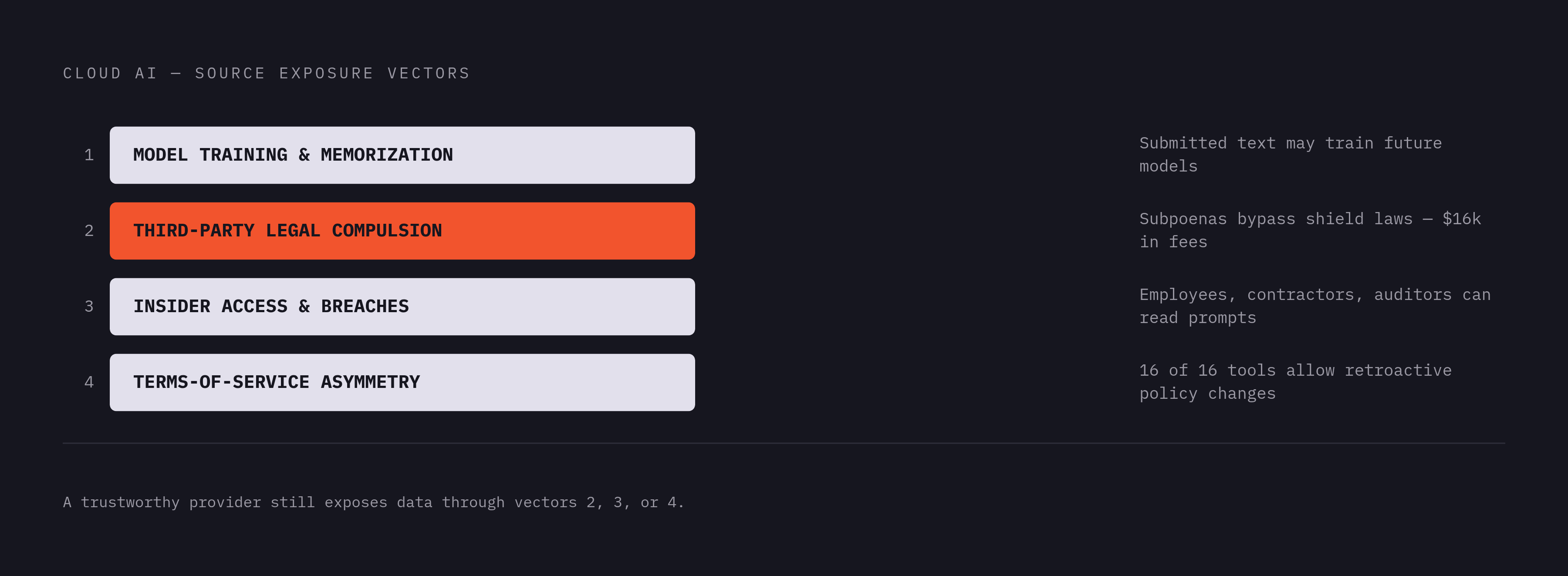
The conversation about AI and privacy in newsrooms tends to collapse distinct risks into a single undifferentiated anxiety. That conflation makes the problem harder to reason about and easier to dismiss. There are four independent vectors, each worth naming on its own terms.
Model training and memorization
When you submit material to a cloud AI model, the standard terms of most services permit that material to be used to improve future model versions. Even where a provider takes a deliberately protective stance, the underlying architecture creates a memorization risk: models trained on large corpora have been shown, under certain prompting conditions, to reproduce verbatim text from their training data. A source's name, a leaked document's distinctive phrasing, a communication that identifies a whistleblower's institutional role — any of these could, in principle, be surfaced in a response to a completely unrelated future user. The provider need not be negligent. The risk is structural.
Third-party legal compulsion
Investigators seeking a journalist's communications have a well-worn alternative to confronting the journalist directly: they go to the third party that holds the records. Phone companies, email providers, and internet service providers have long been the targets of subpoenas that the journalist never sees, cannot contest in time, and may never learn about at all. The same mechanism applies directly to cloud AI providers. Prompt data stored on any major cloud platform is held by a third party subject to precisely this kind of legal demand. No shield law intervenes at that stage, for reasons addressed in the next section.
Insider access and security breaches
Cloud AI services process data at enormous scale, which means the workforce with access to that data is also large. Employees, contractors, and third-party auditors may have technical access to stored prompts. Beyond insider risk, cloud services represent high-value targets for cyberattacks: a breach of a major AI platform's stored query data would be extraordinarily valuable to a range of adversaries, state and non-state alike. A provider's intentions are entirely separable from its exposure to these pressures.
Terms-of-service asymmetry
A 2025 review of sixteen AI tools' terms of service found that most contracts granted developers the right to change terms without notice. The practical consequence for a journalist is that the data policy governing material submitted today may not be the policy in effect six months from now, when a legal demand arrives or a breach occurs. The contractual ground shifts retroactively.
These four vectors are independent of one another. A provider could be fully trustworthy and still expose data through a court order or an external breach. The question is not whether to trust a given provider. The question is whether any cloud arrangement is structurally compatible with source protection.
Why shield laws don't protect what journalists put into AI systems
Forty-one states and Washington, D.C., have statutory shield laws as of 2025. Forty-nine states and D.C. recognize some form of reporter's privilege; Wyoming alone offers none. There is no federal shield law.
The federal gap is significant in its own right. The Supreme Court's 1972 decision in Branzburg v. Hayes established that reporters have no blanket First Amendment right to refuse grand jury testimony. Federal appellate courts have since recognized a qualified privilege, but its scope varies by circuit and it remains uneven in application.
The deeper structural problem, though, is the third-party subpoena mechanism. Shield laws protect a journalist's own records and testimony. They do not travel with data once that data is in someone else's hands. When investigators want a journalist's communications, they do not necessarily subpoena the journalist. They subpoena the phone company, the email provider, or the internet service provider. The journalist may never know it happened.
The same mechanism applies to cloud AI providers. Prompt data submitted to any major cloud AI platform is held by a third party. Shield law protection, even where it exists and is robustly interpreted, was not written with AI cloud data in mind and does not extend to it automatically.
The Department of Justice revised 28 C.F.R. § 50.10 in 2025 to require Attorney General authorization before federal prosecutors can subpoena third parties to obtain journalists' communication records. That is a meaningful procedural step. It is not an absolute bar. It does not apply to state prosecutors or to private litigants. It does not address foreign governments.
The cost of contesting these demands is not theoretical. One newspaper spent $16,000 in legal fees in 2022 fighting a subpoena over an investigative story about a diocese, even after a judge characterized the demand as a fishing expedition. The expense and exposure materialized anyway. For the majority of local newsrooms already operating on diminished budgets, that cost is not a minor inconvenience. It is existential.
Shield law protection attaches to the journalist. It does not follow the data.
The press freedom environment that makes this more urgent now
Federal FOIA has become less reliable. Agencies have closed requests capriciously, shuttered FOIA offices, fired inspectors general, and avoided compliance by reclassifying records. The documentary record that investigative reporters once obtained through formal channels has grown harder to access through those channels.
The predictable consequence is increased dependence on human sources: whistleblowers, current or former government employees, people inside institutions willing to share what formal disclosure processes are obscuring. Those sources are also increasingly reluctant to come forward, because the environment for retribution against them has grown more permissive.
The confluence matters. Journalists are now more reliant on confidential sources at exactly the moment when the scrutiny those sources face is highest and the tools journalists are using to process sensitive material have expanded to include cloud AI systems with the vulnerabilities described above. This is not a hypothetical worst case. It is the present condition.
What local AI architecture actually means and how it works
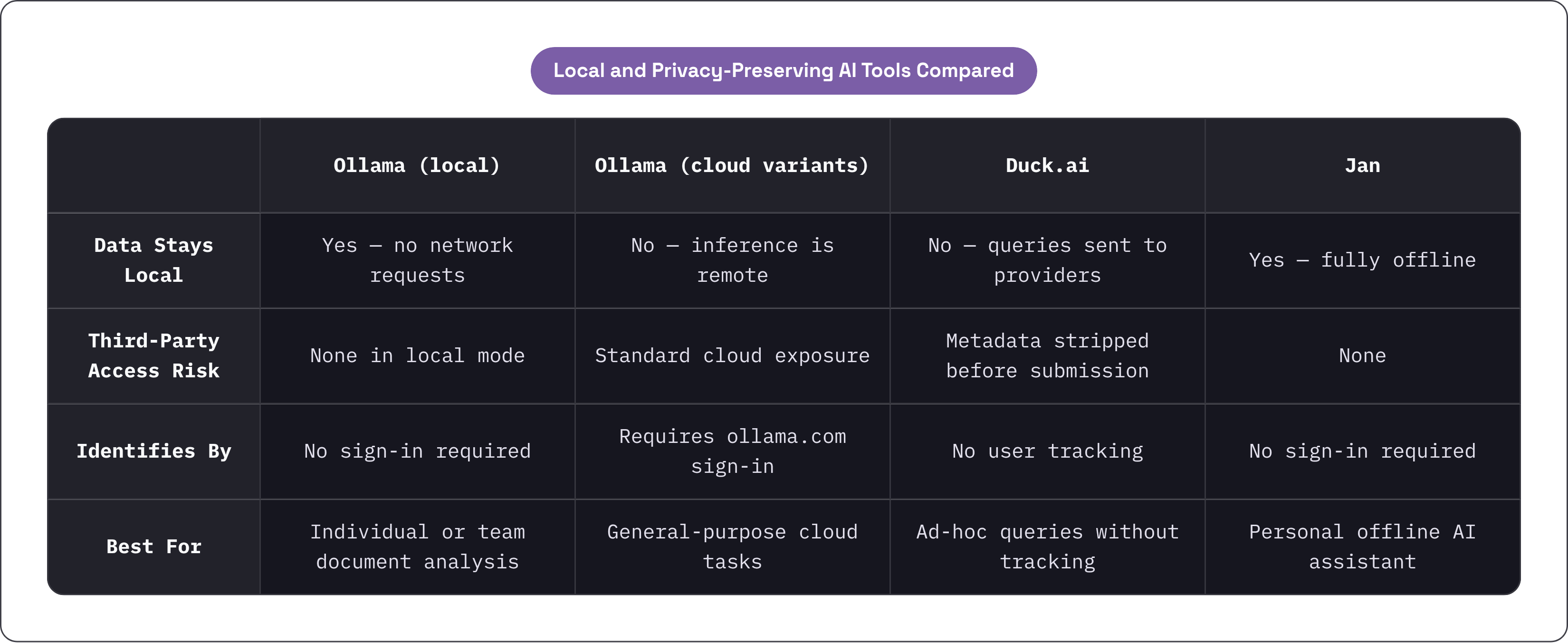
The principle is simple enough to state plainly: running a language model locally means data never leaves the machine. No API calls traverse the internet. No cloud storage holds query logs. No provider data policy governs what happens next.
The primary deployment framework for local AI is Ollama, an open-source platform that packages model weights, configuration, and system prompts into a single portable file. It runs via a command-line interface and a built-in REST API. In local mode, it generates zero network requests, zero logging, and zero third-party access. For a journalist, the practical experience is indistinguishable from using a cloud tool, except that everything happens on hardware the journalist controls.
One distinction that cannot be glossed over: Ollama's version 0.12 release in April 2025 introduced cloud models running on datacenter hardware, identifiable by tags ending in "-cloud" and requiring sign-in to ollama.com. Inference for those variants happens remotely. They do not carry the same privacy guarantees as local deployment. The distinction is easy to miss and consequential.
Other documented options worth knowing: Duck.ai removes all metadata before submitting queries to underlying models and does not train on user material. Jan is a fully local desktop application designed around the premise of personal AI that answers only to the user.
The hardware requirement is real. Small models in the 7 billion parameter range need roughly 8 gigabytes of RAM to run comfortably. Larger models require 16 gigabytes or more. Apple Silicon hardware, with its unified memory architecture, handles local inference unusually well. Machines with sufficient GPU memory are similarly capable.
For teams rather than individual reporters, the architecture scales. A dedicated internal server running a larger model — Llama 3.3 70B is a reasonable current benchmark — exposed via Ollama's API gives a full editorial team access without requiring each reporter's laptop to carry the computational load. In the most sensitive environments, an air-gapped setup with models loaded from local storage and no internet connection after initial download provides the strongest possible isolation.
How local AI fits into a document-heavy investigation, and where hallucination risk enters
The investigative use case that makes local AI most relevant is document analysis: searching, summarizing, and synthesizing large collections of records. This is precisely the work where submitting material to a cloud system is most dangerous, and it is also where AI offers genuine time compression. The ability to synthesize information across thousands of pages of sensitive records in hours rather than weeks is not a marginal efficiency gain. It changes the scope of what an investigative team can pursue.
The relevant technique is retrieval-augmented generation, known as RAG. Rather than feeding documents into a model's training data, RAG directs the model to retrieve relevant passages from a local document store and produce answers grounded in that retrieved material. It combines the pattern-matching fluency of a language model with the precision of a document search. For investigative work, this is the right architecture: the model reads documents it is given, rather than drawing on a training corpus the journalist cannot audit.
The caveat is serious and must not be minimized. LLMs hallucinate. They produce plausible-sounding text that is factually wrong, sometimes in ways that are difficult to detect. In investigative journalism, where every published claim carries legal and ethical weight, error propagation through multi-stage synthesis is a genuine threat to credibility. Research presented at the Computation + Journalism Symposium in 2025, supported by the Knight Foundation, found that model performance varies dramatically depending on training data overlap with the corpus being analyzed. Which model you choose for a specific document collection is itself an editorial decision, not a technical one.
PII scrubbing before documents enter any AI pipeline, even a local one, is a necessary complement to local deployment. Techniques like name substitution and data masking reduce the risk of the model regurgitating identifying information from prompts or retaining it across multi-turn conversations within a session. Local deployment eliminates external exposure. It does not eliminate the need for human oversight of everything the model produces.
The performance gap between local and cloud models, and when it matters
The gap is real and should be stated honestly. Local models at the 7 billion parameter range do not match the performance of leading cloud models on complex multi-step reasoning tasks. Anyone who tells you otherwise is either working with different benchmarks or selling something.
The more useful framing is that this is a trade-off, not a binary. For simple summarization, keyword extraction, and question-answering against a retrieved document, the gap narrows considerably. The Computation + Journalism Symposium research cited above found that local, resource-efficient models are capable enough for newsroom document analysis when the system is designed with auditability as a priority. The gap is not prohibitive for the core investigative use cases.
The practical answer is hybrid routing. Sensitive document processing, source-related queries, and any task involving confidential material routes through local models. Complex analytical tasks that involve no sensitive information can route through cloud APIs. This is not a compromise of the privacy architecture. It is a deliberate allocation of computational resources according to risk.
An emerging possibility, not yet widely deployed, is a journalist-controlled model fine-tuned specifically for investigative tasks: identifying document patterns, flagging inconsistencies in financial disclosures, parsing bureaucratic language. A purpose-built model optimized for those specific functions may actually outperform a general-purpose cloud model on the work that matters most in this context.
The adoption asymmetry is worth acknowledging. Custom tooling is practically accessible only to the largest and wealthiest news organizations. Local open-source deployment via Ollama is the accessible path for most newsrooms, and it is genuinely accessible — a technically literate reporter or editor can have a working local model running in an afternoon.
Where SecureDrop ends and local AI needs to begin
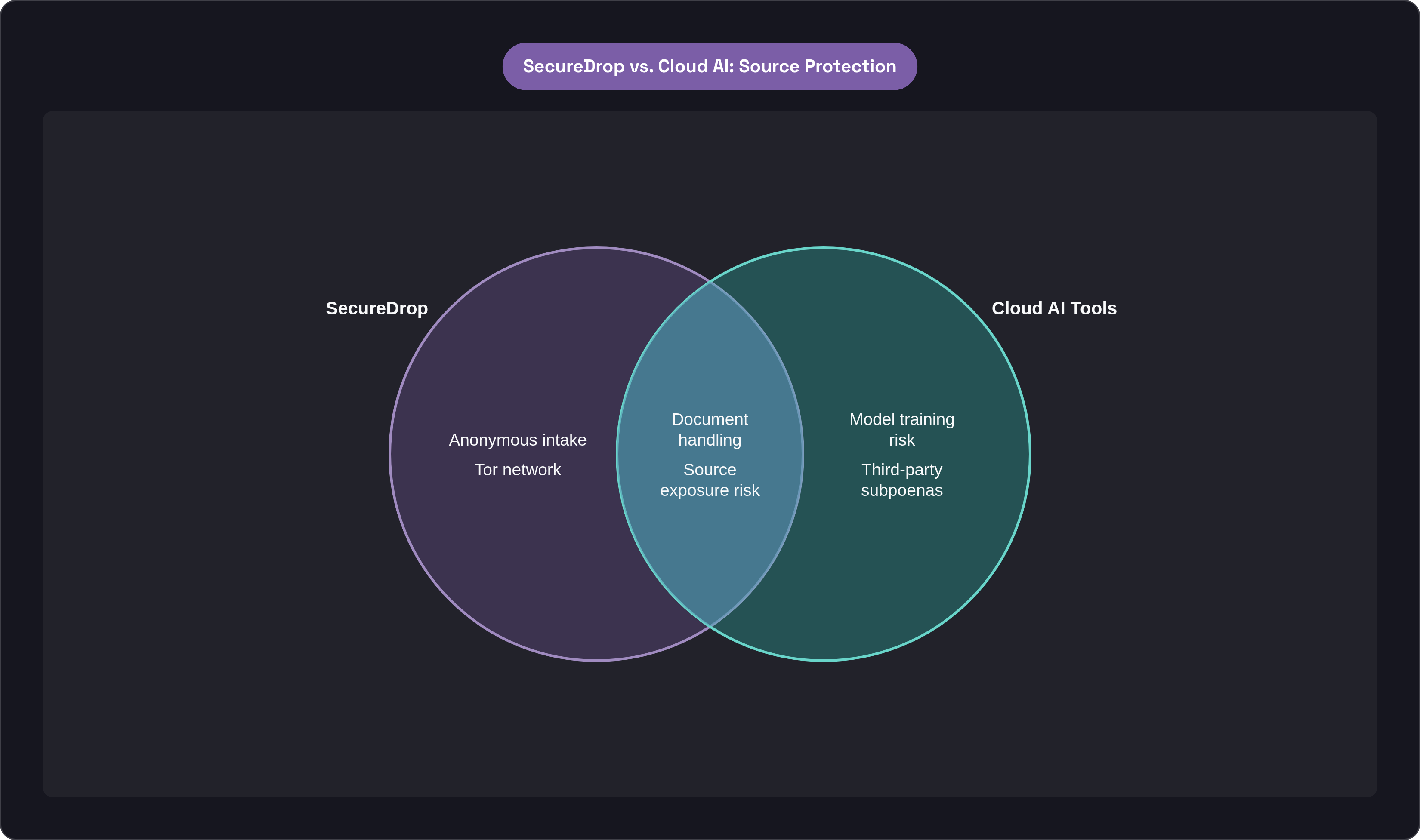
SecureDrop, maintained by the Freedom of the Press Foundation, has become the field's established model for secure source communication. It uses the Tor network to facilitate anonymous contact between sources and journalists, designed so that neither party learns the other's identity or contact information through the channel itself. More than 65 news organizations globally have adopted it. In 2025, the Freedom of the Press Foundation developed a new SecureDrop Protocol for end-to-end-encrypted messaging, with its security properties being formally verified in collaboration with researchers at ETH Zurich. That combination of wide adoption and formal verification represents a meaningful maturation of the tool.
SecureDrop is an intake and communication system. It does not analyze documents.
That gap is the crux of the problem. Documents received through SecureDrop must be processed somewhere. The moment a journalist takes those documents and submits them to a cloud AI tool, every privacy protection the SecureDrop workflow was designed to provide is retroactively undermined. The chain of custody breaks. The source who trusted the intake process is exposed by the analysis process.
Local AI is not a replacement for SecureDrop. It is the missing second half of a private workflow. Secure intake followed by secure analysis: the two are complementary expressions of the same architectural principle. Privacy is built into the system. It is not dependent on the goodwill of a third party, the terms of a service agreement, or the absence of a legal demand.
What a privacy-preserving AI workflow looks like end to end
The workflow has identifiable stages, each presenting a privacy decision.
Source communication happens through SecureDrop or an equivalent end-to-end-encrypted channel. No AI is involved at this stage. The value of this discipline is that it preserves the strongest available protection at the point of maximum vulnerability: the moment a source makes contact.
Document intake and storage goes to air-gapped or network-isolated storage. No cloud sync, no automatic backup to services outside the journalist's direct control.
PII scrubbing happens before any document enters an AI pipeline. Names and identifying details are substituted or masked. This step protects sources even if local model behavior is imperfect within a session.
Document analysis runs through a local Ollama deployment or a team server, using a model appropriate to the available hardware. RAG architecture handles large document sets. The model reads; it does not train.
Complex reasoning tasks involving no sensitive material can route deliberately through cloud models, governed by explicit internal policy defining what categories of information may leave the local environment.
Output review by a human is non-optional before any AI-generated summary informs a published claim. Hallucination risk makes this a fixed cost of the workflow, not an optional quality check.
A 2025 comparative study published in Digital Journalism, reviewing 52 editorial guidelines from news organizations worldwide, found common principles of transparency and human oversight but limited enforcement mechanisms. The workflow above requires internal policy, not just technical setup. Architecture determines what is possible for an adversary. Policy determines what journalists actually do within that architecture.
Both matter. Architecture sets the ceiling on risk. Policy determines where you actually live beneath it.
The journalists I respect most in this field approach infrastructure the way they approach sources: with the assumption that systems, like people, operate within constraints that are often invisible to the people using them. The cloud AI tools most newsrooms are reaching for were not designed with source protection in mind. They were designed for scale and convenience. Those are legitimate design priorities for most use cases. They are not the right priorities for the work of holding power to account. Some tools are built around a different priority from the start, such as Confidant AI, a privacy-preserving AI assistant whose architecture is designed so that user data is never collected or monetized. Knowing that distinction, and acting on it architecturally rather than just rhetorically, is increasingly the difference between a source protection policy and an actual source protection practice.