Off-the-Record AI Conversations Require More Than Incognito Mode
Private mode settings alone won't stop AI providers from retaining your conversations.
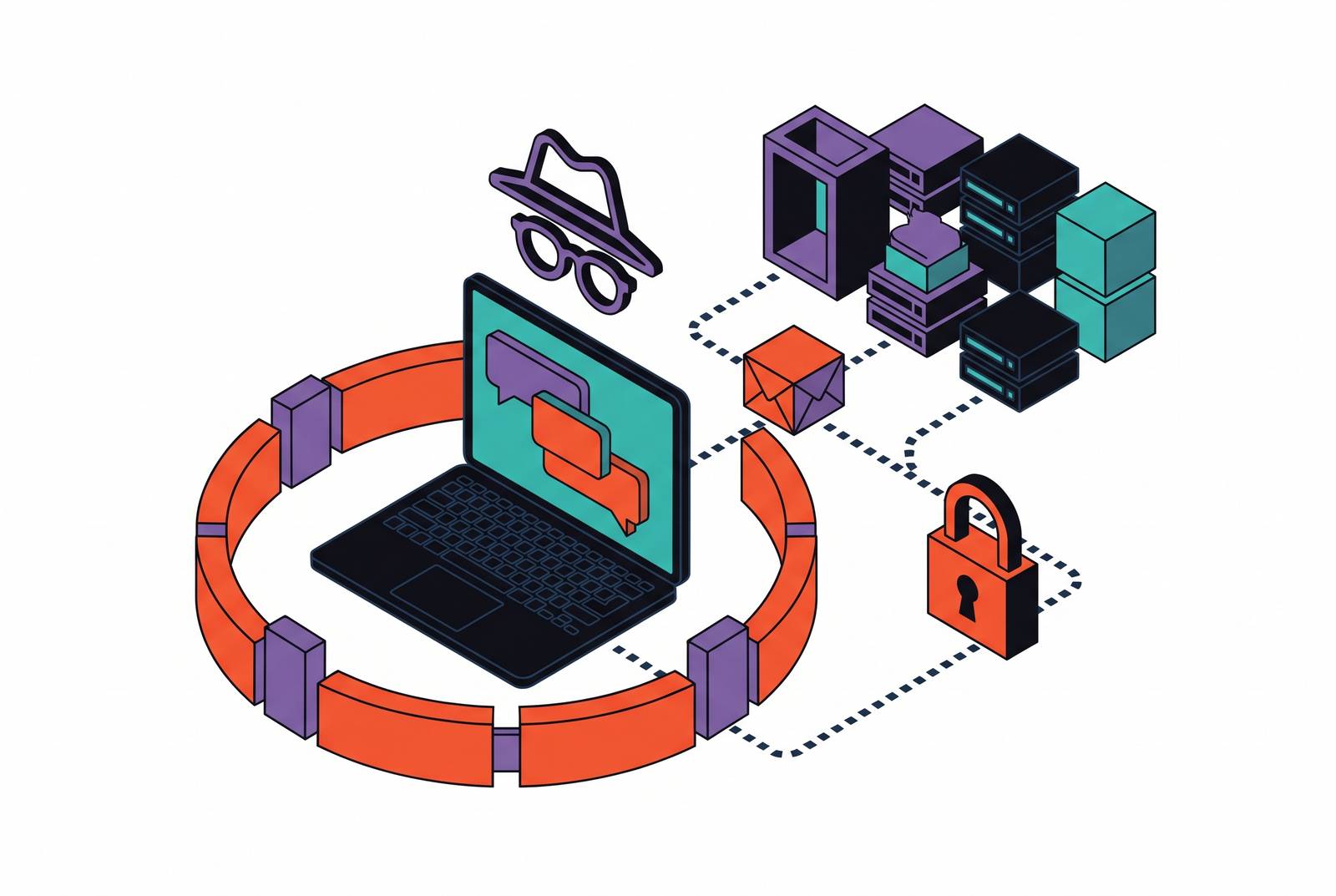
Off-the-record AI conversations require more than incognito mode. For readers seeking AI without data collection or monetization, the key distinction is between local tools, hosted services with retention policies, and systems that prevent the provider from accessing conversation content. Browser incognito and training opt-outs do not establish that protection, and content privacy alone does not answer what metadata a service collects or how it uses it.
What browser incognito mode actually does, mechanically
Browser incognito mode creates a temporary, isolated browser profile. It inherits neither cookies nor logins from the normal profile, and discards that compartment when the last private window closes. Bookmarks and downloaded files survive the session. The tool is designed to limit what someone can discover afterward on a shared laptop, borrowed phone, or colleague’s computer.
Google’s support language makes the boundary explicit by saying incognito does not make the user invisible to websites, including Google’s own services, or to network administrators. A website still receives the requests needed to serve the page. The browser’s decision not to preserve local history does not determine what the other end retains. For this discussion, that distinction is decisive because almost nothing that makes an AI conversation risky happens on your own computer.
Where the conversation actually goes after you hit send
A prompt sent to a hosted AI service leaves the device and enters infrastructure controlled by the provider. The request includes the message text, timestamps, the chosen model, and the originating IP address. From that point, the provider’s systems and policies determine its treatment. Closing the private window sends no deletion signal to the server.
Users can still sign in to an account without using their normal browser profile. ChatGPT has a no-login tier, but its tighter limits and repeated prompts to register push users toward signing in. Account status is only one part of identifiability. Providers can log access times, IP addresses, device fingerprints, session duration, message volume, feature usage, and errors regardless of conversation privacy settings. Removing a local login does not remove these server-side signals.
Structural privacy therefore depends on what the recipient can access and retain. That exposure does not require a provider to behave improperly, because receiving and processing a prompt is how a hosted service answers it. A browser feature cannot set the rules for that processing.
What AI platforms' own "private" modes actually promise — and retain
In-product private modes reach further than browser incognito. They can exclude conversations from saved history and training, which are meaningful protections. But the server may still keep those conversations, and people may still review them for safety.
Anthropic’s Help Center states that Claude Incognito chats are retained for 30 days by default, or longer under an enterprise organization’s custom retention setting. These chats are not saved to history and are never used for training, but inputs and outputs flagged by automated trust and safety systems can be kept for up to 2 years. Profile information, including custom styles and personal preferences, can still be accessed during the session.
Gemini temporary chat retains conversations for a short period for safety and security. Conversations reviewed by human reviewers may remain for an extended period, disconnected from the user’s Google Account. ChatGPT presents a different complication for signed-out users. Its training opt-out preference is stored in a browser cookie, so clearing that cookie through incognito resets training to on at the start of each new private session.
These are different controls with different consequences. Claude specifies a default retention period, Gemini describes a short safety period with a longer review exception, and ChatGPT’s signed-out training preference depends on browser state. Opting out of training remains valuable. It simply does not answer the separate questions of retention, review, or exposure to legal holds.
Three ways retention windows become permanent records
A retention window says when data is meant to be deleted, though data can be kept beyond it under some conditions. Legal preservation requirements can override it entirely. A 2025 court order in the New York Times copyright lawsuit against OpenAI required preservation of certain ChatGPT and API conversations from May through September 2025, including conversations users had deleted. Discovery orders required output logs that would otherwise have been deleted to be preserved, overriding the normal 30-day deletion policy.
Anthropic’s Help Center states that incognito chats on Team and Enterprise plans are included in organizational data exports available to account Owners. Enterprise plans also include them in the Compliance API. An incognito conversation at work can therefore be absent from the sidebar without being hidden from the employer.
Deleting a chat or account within a provider’s stated window does not extract its content from a model already trained on it. Training opt-outs protect future conversations. AI conversations also lack the legal privileges attached to communications with doctors or lawyers, so sensitive subject matter does not itself create a shield against disclosure.
Samsung’s incident shows why these limits on privacy matter before information is shared. Confidential information was shared with an external AI tool despite policies against it, raising concern about information leaving company control and prompting corporate restrictions on AI use. The relevant failure was not merely a missing rule, but an interface that made external sharing easy.
Why the interface toggle approach fails even when it works as designed
The Samsung incident and ChatGPT’s cookie-reset problem expose the same mismatch. In one, a policy opposed the easiest action the interface offered. In the other, an action intended to improve privacy erased the preference that limited training. Neither problem requires a broken toggle. Both happen because the system is set up to share information by default.
Even when a training opt-out works exactly as designed, that path stays open. The provider still receives the conversation, and separate rules govern retention, review, and legal preservation. The user must understand those distinctions before choosing a setting. A single privacy label compresses several different questions into an apparently simple choice.
That burden also follows users between products. Browser incognito does not transfer to the ChatGPT desktop app, Claude and Gemini mobile apps, or AI panels inside code editors and office suites. Users may have to search again for the privacy controls in each one. A privacy habit tied to one browser window cannot govern all of them.
Could policy, training, and governance solve the problem instead? They can constrain use, but employees’ routine use of AI without employer knowledge makes governance alone unreliable. Architecture addresses a different question from whether people follow instructions, namely whether disclosure remains possible when they do not.
What architectural privacy for AI actually requires
Off-the-record processing requires that a conversation never reach a server capable of retaining, reviewing, or producing its content. Two architectures can meet that requirement in different ways. Local inference keeps the computation on the user’s device. Hardware-enforced confidential computing moves computation to a remote server while isolating it from the provider.
Local tools show that the first approach exists. The late-2026 options described here include Ollama, which can pull a model with one command and expose a local OpenAI-compatible API, and which also has a desktop app. LM Studio provides a graphical interface well suited to Apple Silicon. AnythingLLM combines private document chat with a full agents stack. In a local-inference setup, prompts and documents remain on the device because the model runs there.
Local operation has a real hardware cost. It requires investment and meaningful technical setup, making it inaccessible to many individual users without IT support. Hosted confidential computing addresses that constraint through Trusted Execution Environments, or TEEs. The model runs inside a hardware-isolated enclave whose contents are inaccessible even to the provider’s engineers. Cryptographic attestation lets people outside the provider check that the code running is what the provider says it is.
That isolation differs from a software-only promise not to read data. A policy can change, while the provider cannot unilaterally override correctly implemented hardware isolation. Zero Data Retention API agreements are another way to use a hosted service in which OpenAI does not keep conversation content, but their prices are set for organizations. They should not be confused with hardware-enforced inaccessibility. An agreement governs conduct, whereas isolation restricts capability.
What the Meta WhatsApp Incognito Chat launch proves — and what it doesn't
Meta’s WhatsApp Incognito Chat, announced May 13, 2026, demonstrates hardware-enforced AI privacy at consumer scale. The model runs and generates its response inside an enclave, inaccessible to Meta’s software infrastructure and personnel. Hardware attestation provides cryptographic evidence that the enclave’s code is unmodified. Meta has published a detailed technical white paper and designed the system for external verification.
That is a technical achievement. WhatsApp’s FAQ states that conversations disappear when the user exits by default, while also allowing users to keep chat history on their device. That local-history choice is separate from the enclave’s protection against provider access. The distinction shows why disappearance from an interface and confidentiality during processing must be evaluated independently.
The design also makes a consequential trade-off. Incognito Chat disables the real-time safety monitoring that flags users who may be at risk of self-harm. If a session contributes to a harmful outcome, there is no provider-accessible conversation record for investigators, families, or courts to subpoena, and no intervention window through that monitoring. Whether that balance is appropriate depends on the use case as well as how strongly the feature protects content.
The network may still show when queries are sent, how many there are, and how large they are. Users must also trust that Meta implemented the architecture correctly, introduced no backdoors, and will maintain its integrity. TEEs and the systems around them are still complex targets for attacks, so people outside the provider need to keep checking their security. The launch establishes feasibility without removing the need to scrutinize implementation.
How to evaluate which AI assistants don't store your personal data
For readers comparing AI assistants, five questions separate an architectural claim from a privacy label. The first is where the model runs and who can access the computation. Local execution and attested hardware isolation offer different protections from a software-only promise not to read conversations.
Second, evaluation must cover what gets retained, for how long, and under which exceptions. Training use, saved history, safety review, organizational exports, and legal preservation need separate answers. “Not used for training” answers only one of them. A claim about AI without data collection or monetization must also address what the provider collects and how it uses that data, rather than treating confidential content processing as proof that nothing is collected.
Third, evaluation must establish whether the privacy guarantee can be independently examined. Technical white papers and cryptographic attestation give researchers outside the provider more to check than a policy alone does. The fourth is what metadata remains observable. Timing, volume, and network signals belong in that answer even when conversation content is inaccessible.
Fifth, evaluation must establish whether the design survives the platform actually being used. A protection available only through browser behavior is not a system-wide guarantee for desktop apps, mobile apps, or embedded panels. Confidant is built on the architectural approach, with privacy designed into the system rather than dependent on activating a toggle before every session. That positioning makes it an example to evaluate through these same questions.
There is no single “best” answer independent of those requirements.