TEE TCB Updates and Patch Management in Production
SVN mismatches between patches and attestation can silently degrade production deployments.

Security Version Numbers are the primary signal connecting a platform's patch state to a remote verifier's trust decision. Their semantics matter: an SVN does not merely encode a version for feature tracking. It encodes security worthiness, a judgment about whether a component has received the updates necessary to be trusted. For microcode updates specifically, the SVN functions as an anti-rollback identifier. Once a security fix increments the SVN, the platform cannot load an older, vulnerable microcode image. The harder question is what happens when an SVN advances without the underlying vulnerability being fully addressed, and that question has practical consequences that tend to surface at the worst possible moments in a production deployment.
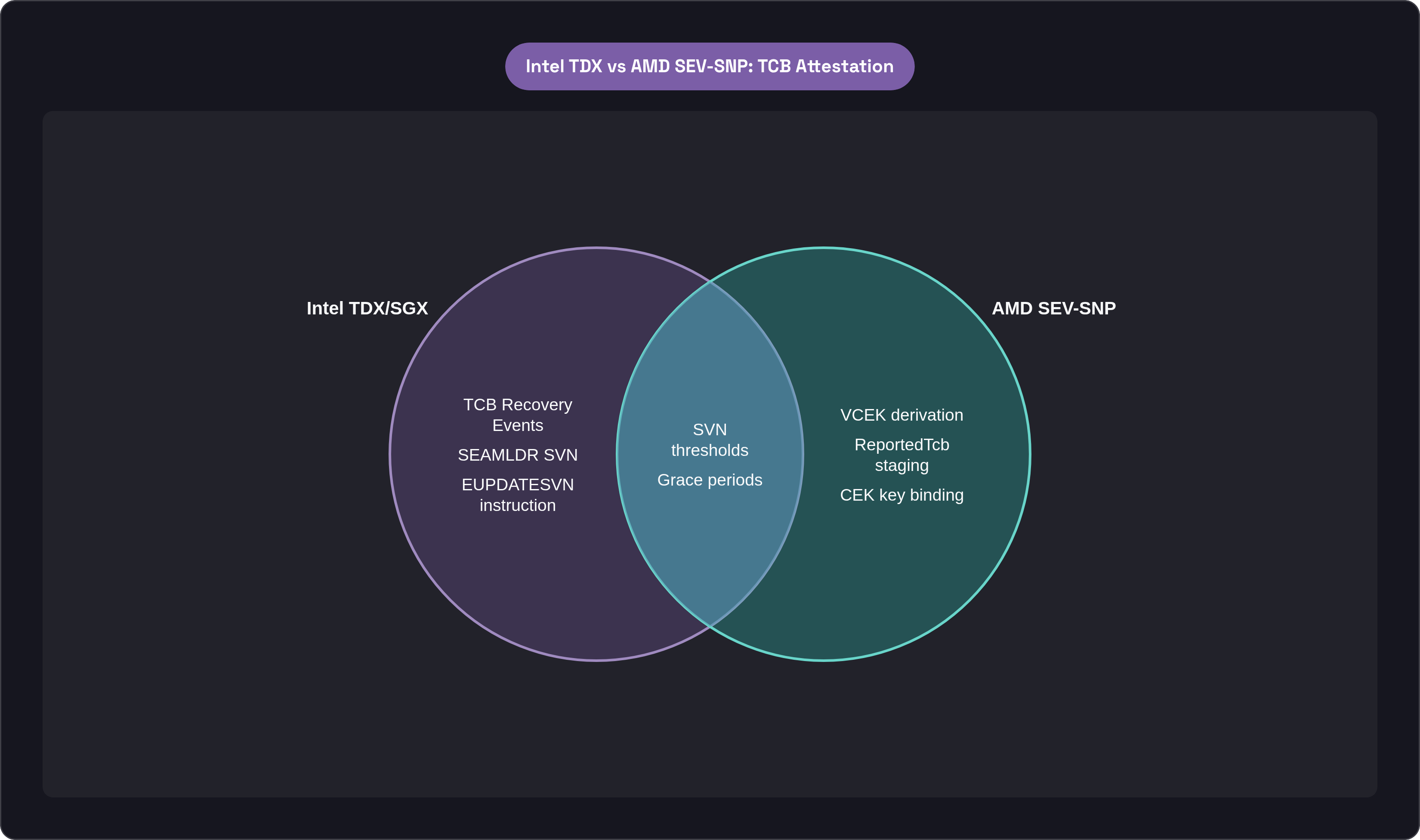
Intel TDX formalizes this into a threshold rule: a TCB is considered up-to-date only if all component SVNs meet or exceed the threshold published by the component author. The CPUSVN aggregates hardware-level SVNs, including the SEAMLDR SVN, into a single composite signal that a verifier can evaluate.
AMD SEV-SNP takes a cryptographically more rigorous approach than either of its predecessors in the SEV family. Rather than relying on self-reported version numbers, SEV-SNP combines all TCB component version numbers with the per-chip Chip Endorsement Key to derive a Versioned Chip Endorsement Key, or VCEK. The VCEK is a per-chip, per-TCB-version private ECDSA key; the cryptographic construction itself blocks any attempt to misrepresent a lower TCB version as higher, because the derived key simply will not match what an honest verifier expects. Earlier SEV and SEV-ES generations reported version numbers without this binding, leaving a meaningful self-attestation gap. SEV-SNP closes it structurally.
The operational consequence is precise: SVNs are the interface between what an operator does on the platform and what a remote verifier can observe. A patch that does not advance the relevant SVNs is, from a verifier's perspective, invisible. Patching discipline and attestation discipline are not two separate problems. They are the same problem, and treating them as distinct while managing them independently is where deployments tend to quietly degrade.
How Intel structures a TCB Recovery event, from vulnerability disclosure through re-provisioning
Intel's formal response to a vulnerability affecting mutable TCB components is a TCB Recovery event, abbreviated TCB-R. The structure is consistent across events: update the mutable components, whether that means a CPU firmware update, a new platform software version, or both, and produce a new TCB key set to drive re-provisioning of the platform's attestation identity.
The second element is non-optional and routinely underestimated. Intel SGX uses an asymmetric attestation key that cryptographically represents the state of the TCB at a specific version. When the TCB changes, the prior key no longer represents the current state. Re-provisioning is not a procedural formality; it is the mechanism by which the updated TCB state becomes attestable. Skipping it means the platform continues asserting an outdated identity to remote verifiers, which is precisely the category of error that attestation infrastructure exists to prevent.
TCB-R events have been issued since SGX launched in September 2015 and continue across the TDX generation. TCB-R 20 was initiated August 12, 2025; TCB-R 21 scopes specifically to Intel TDX. The sustained cadence is not a sign of weakness in the technology. It is evidence that the vulnerability discovery and remediation process is functioning as designed. A platform that has never received a TCB-R is not necessarily more secure; it may simply be less scrutinized.
The Q1 2024 event offers a concrete illustration of production scope. The March 2024 TCB-R covered fourth and fifth generation Intel Xeon Scalable Processors for both SGX and TDX, requiring coordinated updates across firmware and platform software simultaneously. For operators running DCAP-based deployments, Intel DCAP v1.14 was the minimum version required for PCS-based attestation to reflect the new TCB level. Late Q4 2025 brought DCAP v1.24, which included a fix to the ECDSA Quote Verification Library's advisory ID reporting. That detail matters more than it might appear: advisory IDs are used downstream in trust decisions, and a library that misreports them produces verifier logic reasoning from corrupted inputs.
The five mitigation update types and what each one actually requires operators to do
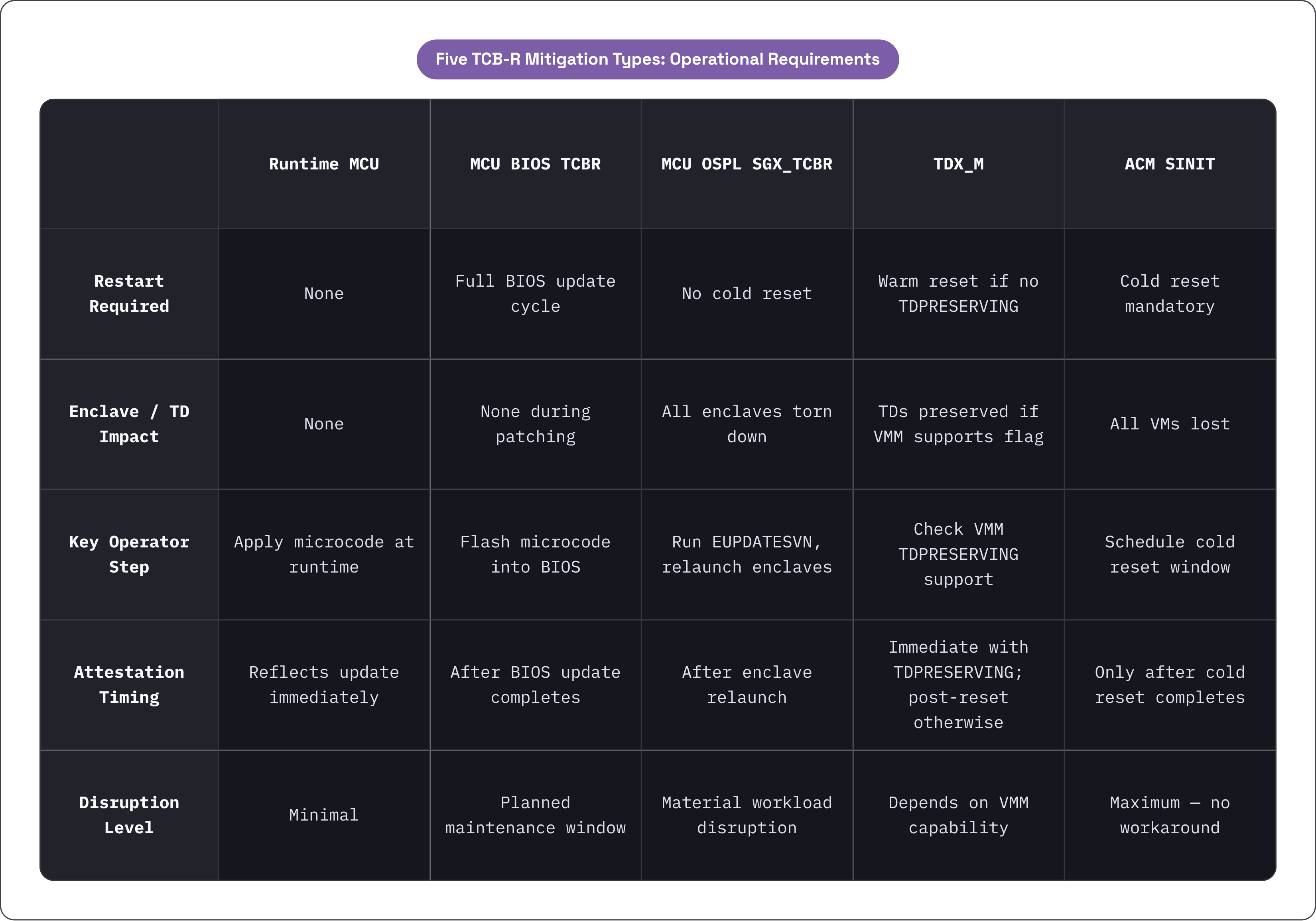
Intel categorizes TCB-R mitigations into five distinct types. The type dictates restart requirements, downtime, and attestation timing, and the differences are not subtle. Conflating them is a recurring source of operational error, made worse by the fact that heterogeneous fleets may encounter more than one type within a single TCB-R event.
The first type, the runtime microcode update (MCU), is the least disruptive. The microcode is applied at runtime, and attestation can reflect the new TCB level without a reboot.
The second type, MCUBIOSTCBR, is less accommodating. New microcode must be flashed into the BIOS and cannot be loaded at runtime. A full BIOS update cycle is required before attestation will reflect the updated TCB, which means a scheduled maintenance window.
The third type, MCUOSPLSGX_TCBR, offers a nominally reboot-free path for SGX workloads, but the steps are not trivial. The operator must apply OS Patch Loading, tear down all running enclaves, execute the EUPDATESVN instruction, and then relaunch the enclaves. No cold reset, but enclave teardown is a material disruption to any workload that was running.
The fourth type, TDX_M, covers TDX module updates and branches based on VMM capability. If the VMM supports the TDPRESERVING flag, the update is runtime-eligible and the new SVN becomes attestable immediately without losing running TD instances. If the VMM does not support TDPRESERVING, a warm reset is required before attestation reflects the update, and all TDs on that host are affected. The VMM's capability level is a first-order operational variable, not an implementation detail someone else on the team is tracking.
The fifth type, ACMSINIT, is the most disruptive. All VMs are lost, a cold reset is required, and attestation of the updated TCB cannot proceed until the cold reset completes. There is no mitigation path that avoids this for ACMSINIT events.
AMD SEV-SNP introduces a distinct coordination mechanism that creates its own operational surface. Hypervisors can install new firmware and then set the ReportedTcb value via the SNP_CONFIG command so that attestation continues to use the prior VCEK until guest owners have retrieved the new attestation certificate. This is a deliberate staging valve: it decouples the deployment of an update from the enforcement of that update in attestation, allowing operators to push firmware across a fleet before flipping the attestation baseline. Used intentionally, it prevents a race condition between deployment and verification. Left in place indefinitely, it becomes a deferred liability invisible to the workload owner.
A single TCB-R event may require different procedures on different nodes in the same fleet, depending on hardware generation and VMM capability. The operational runbook must account for that heterogeneity explicitly, not assume uniformity that does not exist.
Why grace periods exist, and why the 12-month window has become a point of genuine controversy
The core tension in TCB-R enforcement is straightforward. If a new TCB level is enforced immediately after an event, platforms that have not yet been updated will fail attestation. At fleet scale, that means denying service to a significant fraction of users whose operators are still patching. Some grace period is therefore a practical necessity. The harder question is whether a grace period long enough to accommodate slow operators also makes it impossible for a workload owner to distinguish a fleet that is actively patching from one that is simply not bothering.
Intel formalizes this through its update parameter model. The "early" channel publishes the latest TCB-R collateral immediately after an event. The "standard" channel, which is the default when no parameter is specified, returns collateral reflecting the TCB-R level that was made available on the early channel twelve months prior. Intel's explicit stated position is that it does not typically revoke platforms running unmitigated software; it publishes collateral and leaves trust decisions to the relying party.
That framing has faced substantive criticism. In 2024, Fortanix identified a specific and concrete concern: for the March 12, 2024 TCB-R event, Intel maintained the validity of outdated TCB information for up to six months after public vulnerability disclosure. For the November 12, 2024 TCB-R event, that window extended to twelve months. The practical consequence Fortanix articulated is not abstract. An infrastructure provider could delay installing security updates for a full year after public disclosure of a vulnerability, and a workload owner querying attestation on the standard channel would have no way to detect it. Fortanix raised this concern with Intel in September 2024.
Intel's response included publishing TCB Evaluation Data Numbers, signed by Intel's root of trust, so that verifiers can distinguish between different versions of TCB info and determine whether the version in use is sufficiently current relative to their own patching policy. This is a genuine improvement. Verifiers have a tool they did not previously have.
The gap it leaves is equally genuine. TCB Evaluation Data Numbers are useful only if verifiers actively check and enforce them. An operator who does not build that check into verifier logic receives no benefit from their existence. The mechanism shifts responsibility to the relying party, consistent with Intel's stated model, but protection is only as strong as the verifier's implementation. Whether that is the right allocation of responsibility probably depends on who you ask and what kind of workload they are running.
How cloud providers handle grace periods in practice, and where that leaves workload owners
Cloud providers do not set grace periods based on the security requirements of individual workloads. They set them based on fleet-wide operational risk, specifically the risk of triggering widespread attestation failures for customers who have not yet completed patching. The resulting baselines reflect operational caution at scale, not the strictest defensible patching posture. The question this raises for the workload owner is practical: if the provider's baseline is calibrated for fleet availability, what recourse does a workload with stricter requirements actually have?
Azure's approach illustrates the mechanics. For unplanned rotations including security updates, the Azure Attestation team communicates new values with a one-month grace period. The default TCB baseline served through Azure's Trusted Hardware Identity Management service may lag Intel's latest baseline deliberately, to prevent attestation failures for customers still updating their platform software. The intent is availability; the side effect is that the default baseline is not the most current one.
Google Cloud's approach reflects similar logic. A third-party attestation service may delay enforcing a new TCB reference number to prevent production outages even after a patch is available. One concrete downstream effect: after a firmware update, Confidential VM instances with AMD SEV-SNP may generate v4 attestation reports, which can break verification pipelines built to parse v3 report formats. The firmware update is the correct operational action. The parser breakage is an unintended consequence of not having tested for report format version changes before they reach production. It is the kind of failure that feels entirely avoidable in retrospect and is preventable in advance only if someone on the team has actually seen it happen before, which, in a field this young, is not a safe assumption to make.
Intel Trust Authority takes a policy-as-code approach that gives operators more granular control. The attestertcbdate claim can be checked against an acceptable grace period defined in policy, and attesteradvisoryids can be inspected to see which advisories are addressed by the current TCB level. This is the right architectural direction: it moves enforcement logic into the verifier, where the workload owner can actually govern it.
The structural problem for workload owners persists regardless of which provider is in the picture. A workload with patching requirements stricter than the provider's default grace window cannot rely on the provider's attestation baseline as its sole signal. The provider's baseline is calibrated for the provider's operational needs. An operator who does not independently check TCB Evaluation Data Numbers and advisory IDs is, in practice, delegating a security decision to an entity whose incentives are not perfectly aligned with their own.
Parser and tooling brittleness compounds this. Attestation verification pipelines are often written against a specific report format version and not revisited until something breaks, at which point the breakage tends to arrive at precisely the wrong moment. Silent failures are the more dangerous variant, because nothing alerts the team that the guarantee they believe they have is no longer being enforced.
What attestation status codes actually report, and what they leave ambiguous
The quote verification flow produces a status code summarizing a platform's TCB state relative to a known baseline. In the Intel SGX model, the client's quote is signed against a known TCB; the relying party uses the quote to assess patching status. The two most operationally significant status values are "OK," meaning the platform TCB meets the current expected TCB, and "GROUPOUTOF_DATE," meaning one or more TCB components do not meet the expected level and a TCB-R is required on that platform.
The non-obvious case deserves attention. A fully patched platform can return a status other than "UpToDate" because it supports a configuration that is technically valid but not the strongest security posture available. Being current is necessary but not sufficient to receive a clean status. This is not a defect in the attestation system; it is an accurate representation of a real condition. Interpreting status codes requires understanding what the configuration flags actually mean, not just reading the string value. A status code system offering this much nuance demands more sophistication from its consumers than most operational teams currently apply, and that gap tends to go unacknowledged until something downstream goes wrong.
Multiple-advisory scenarios compound the ambiguity. When more than one security advisory applies to a platform, the status response carries compound implications. Treating the status string as a binary safe/unsafe signal, rather than examining the advisory IDs individually, means accepting a lossy summary as a precise judgment. The status code tells you something is out of alignment; the advisory IDs tell you what, specifically, and whether that specific thing matters for your threat model.
Status codes are an input to a trust decision, not the decision itself. An operator who treats the absence of "GROUPOUTOF_DATE" as confirmation that the platform is safe, without checking advisory IDs and TCB Evaluation Data Numbers independently, is reasoning from incomplete information. The attestation infrastructure will not catch this error on their behalf.
The operational discipline that separates a functioning confidential deployment from a theoretical one
Keeping a TEE's TCB current requires synchronizing hardware microcode, firmware, BIOS, and platform software across a fleet where each layer has different update mechanisms, different restart costs, and different attestation timing implications. No single update covers all layers. No single team typically owns all layers. In practice, organizational friction is at least as significant as the technical complexity, and it is usually where things actually break down. I have watched competent teams run clean patch procedures on the hardware side while their verifier logic continued checking a stale baseline for months, with no one flagging the discrepancy because the system was not designed to flag it.
A mature patch management posture for TEE deployments has several characteristics distinguishing it from a nominal one. It tracks TCB-R events on both the "early" and "standard" channels and maintains an internal patching SLA shorter than the provider's default grace window. It validates TCB Evaluation Data Numbers in the verifier, rather than stopping at the isvEnclaveQuoteStatus string. It checks attesteradvisoryids on every attestation, not only at provisioning time, because the advisory landscape can change between initial deployment and a workload still running months later. It maintains attestation parser compatibility across firmware updates by testing for report format version changes before they reach production. And it treats AMD SEV-SNP's ReportedTcb staging mechanism as a coordination tool with a defined end state, not an indefinite deferral.
The architectural angle belongs alongside the operational one. Systems designed from the outset with a minimal TCB, where the trust boundary is as small as the security objective requires, reduce the number of mutable components that must be coordinated in the first place, Confidant AI, a privacy-preserving AI assistant built on privacy-preserving architecture from the ground up, takes this approach by limiting what needs to be attested and patched. Every component added to the TCB is a component that must be tracked, patched, and re-attested across every future TCB-R event. The appeal of a smaller TCB is not elegance; it is the difference between a manageable coordination problem and one that quietly exceeds the team's actual capacity to execute.
Grace periods, provider-level defaults, and status code ambiguity are not failures of the underlying technology. They are gaps in the practice that sits between the hardware and the trust decision. The runbooks, the verifier logic, the SLA commitments, the parser testing: these are what determine whether the hardware boundary actually holds. The security properties are only as current as the last successful TCB-R, and the people operating these systems decide, by the quality of their practice, whether the guarantee is real or merely stated.