AI Assistants That Do Not Store Sell or Train on Your Data
Privacy policies promise protection that payment doesn't actually deliver or guarantee.
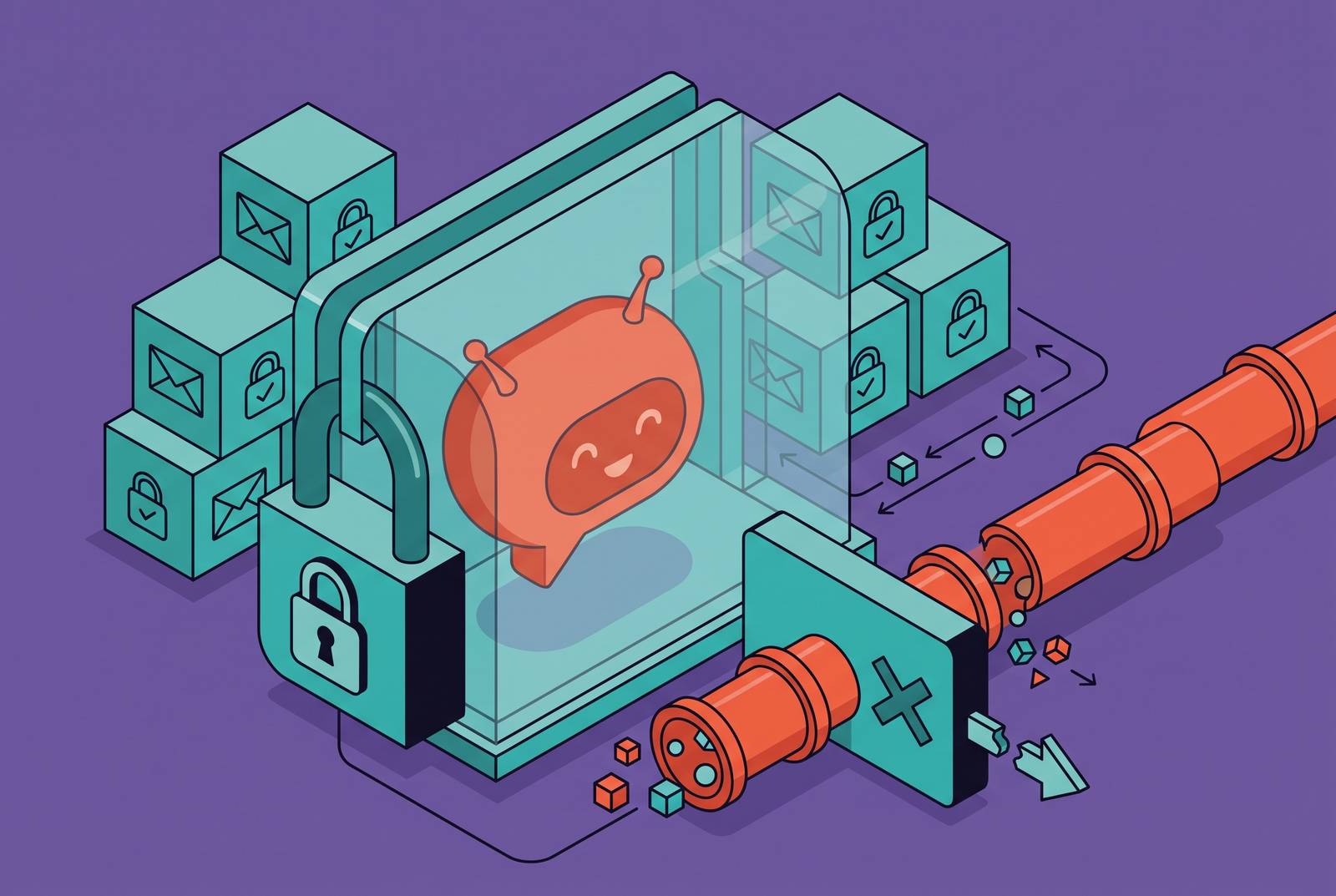
Most people who pay for an AI assistant assume the payment buys them privacy along with speed. Payment buys faster models and fewer rate limits, not privacy. The meaningful split in AI privacy today is not between free and paid tools, but between systems that promise not to store or train on your data and systems architecturally incapable of doing so, and almost no mainstream product sits on the stronger side of that line.
Mainstream AI privacy claims deserve more skepticism than most users apply
A reasonable assumption drives most subscription decisions: paying for a product means the product treats you as a customer rather than a resource. With mainstream AI assistants, that assumption breaks down quickly. The default posture across most of the mainstream market sends conversations, uploaded files, and sometimes embedded credentials to cloud servers as a matter of course, and stores the resulting context in ways the person who generated it cannot see, audit, or revoke on demand. Upgrading from a free account to a paid individual plan generally buys faster models, longer context windows, and fewer rate limits, not a different data-handling regime; training defaults on paid-individual tiers typically match the free tier's defaults, not the enterprise tier's. Claude illustrates the pattern directly: Free, Pro, and Max tier users are opted into training by default, a setting that also applies when Claude Code runs under one of these consumer accounts, while enterprise, government, and API users sit outside that default and data collected for training can be retained for an extended period. Google Gemini has a similar two-speed structure. Free-tier data may be used for model training, but Workspace enterprise data stays excluded unless an organization consents otherwise, and most individual professionals and freelancers end up living in the gap between those two tiers without realizing it.
The common rebuttal, "I'll just opt out," does less work than it sounds like it should. Opting out of training stops future data from being used to train a model, but it does not retroactively delete data already processed, and it does not touch safety-review retention: Google's own Gemini Apps Privacy Hub states that chats reviewed by human reviewers are not deleted when a user deletes their activity and are instead retained for up to three years, so conversations flagged for review can still be kept that long even after an opt-out. Opting out does stop future subcontractor or human-reviewer access to new conversations, which is a real protection, but it is narrower than most users assume. Moderators can still examine flagged conversations for safety violations regardless of training settings, and in the event of a data breach, plain-text logs can be exposed even for users who opted out of training long ago. None of this makes these companies dishonest. So the privacy claim on the pricing page is not the privacy outcome in practice, and you need the next section to see why.
The policy-vs-architecture distinction
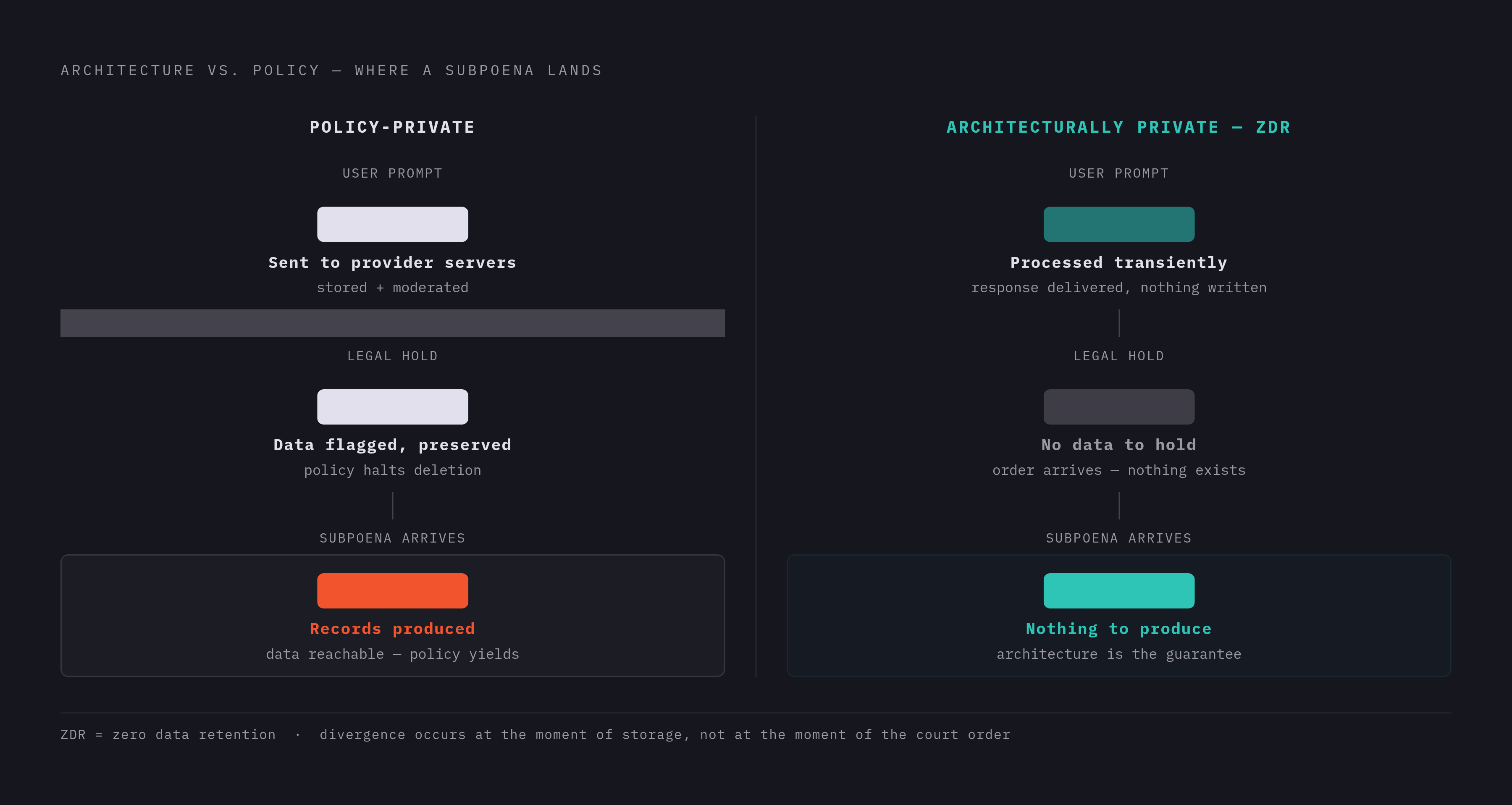
Every privacy claim an AI company makes falls into one of two categories, and the distinction between them determines what "private" actually guarantees. A policy-private system is one where the provider commits, in a terms of service document, not to train on, sell, or retain a user's data beyond a stated window. The commitment holds, but your data still has to travel to the provider's servers to be processed, it still passes through moderation and safety-review systems on the way, and legal hold orders can still reach it no matter what the privacy policy promises. An architecturally private system is often built around what the industry calls Zero Data Retention, or ZDR, and it processes a request transiently, so it cannot reconstruct what it saw afterward. That is a structural fact about how the system is built, a design the provider cannot walk back by changing policy.
A court order makes the difference concrete. If courts order an AI provider to preserve chat logs for an ongoing investigation, that overrides the provider's standard retention policy and can capture sessions a user believed had been deleted. A policy-private system has no architectural way to refuse that order: the data exists somewhere in a form that can be produced, so it gets produced. A ZDR-enforced system sidesteps that risk by design, because the data genuinely does not exist anywhere by the time a subpoena could reach it. Most providers also draw a distinction between "training data" and "interaction logs" that users rarely notice: opting out of training does not eliminate the underlying log of the conversation, and deleting a chat from a user-facing interface does not always purge it from backup systems or safety-review queues. Some will raise a fair objection here: architecturally private systems might sacrifice abuse monitoring, or run on smaller, less capable models, to get that incapability. Both concerns deserve a real answer, not a dismissal, so the sections ahead take each one in turn.
How regulatory pressure raises the floor without closing the gap
Regulation in 2026 is doing real work on AI privacy, but mostly by forcing disclosure, not by limiting retention. Separately, the Act's high-risk AI system obligations, covering risk management, data governance for quality and bias, and technical documentation under Articles 8 through 21, were extended from an August 2026 deadline to December 2027 by the AI Omnibus regulation. Neither track makes a provider disclose how long it keeps an individual user's prompts, and neither puts a limit on that retention window.
The EU AI Act is widely expected to function the way GDPR did for data protection: a baseline other jurisdictions gradually adopt, whether through direct regulatory pressure or through companies finding it simpler to apply one global standard. That expectation cuts both ways. If the Act becomes the global reference point, its transparency requirements travel everywhere a company operates, and so do its gaps. A provider can satisfy every GPAI disclosure obligation and pass every high-risk conformity assessment once the 2027 deadline arrives, and it can still keep a user's prompts for years, because none of those obligations touch how long an individual conversation can be retained. That gap between compliance and privacy is why architecture needs to matter more than paperwork. A system that cannot retain data has nothing for a regulator, a subpoena, or a breach to expose, regardless of what the compliance documentation says, and the next section maps where that kind of system actually exists in the current market.
Genuine AI privacy without data collection across the current tool landscape
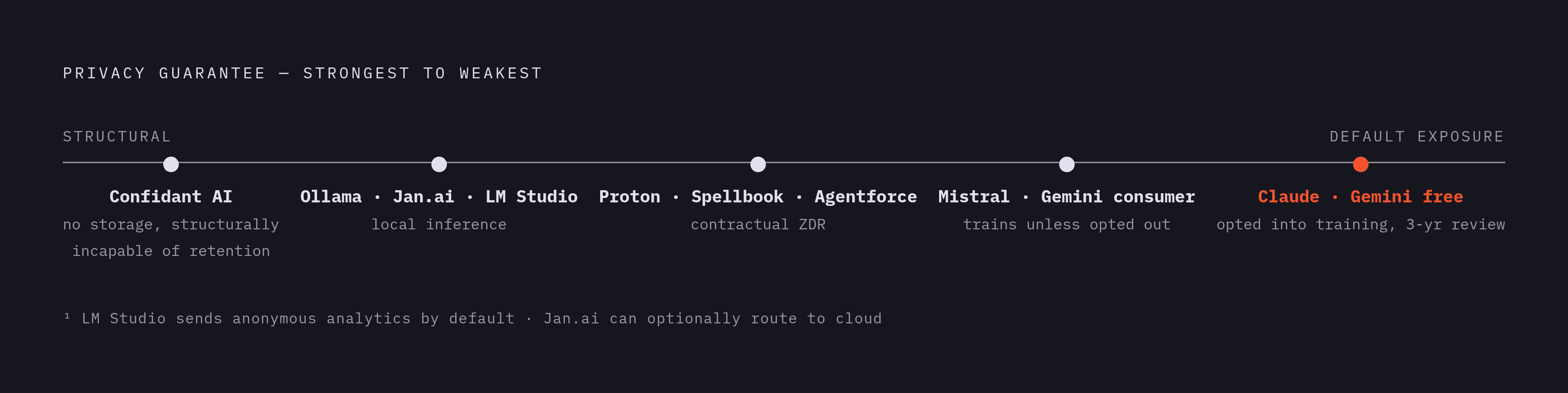
The strongest implementations of architectural privacy share one trait: the provider never receives a user's data in a form it could read, store, or act on beyond the immediate request that generated a response. Confidant AI is at the clearest end of that spectrum. It is built from the ground up on the premise that the system should be architecturally incapable of collecting or monetizing user data, rather than relying on a policy layer stacked on top of a cloud product that otherwise could collect it. No data is stored, no training occurs on user conversations, and there is no surveillance architecture waiting to be activated by a future policy change. For a user who needs real AI capability without accepting the usual data trade-off, this is close to a reference case for what architectural privacy means in practice, because the guarantee is a structural fact about the system rather than a promise the provider is trusted to keep.
Local-first tools occupy the next tier: they offer the strongest privacy posture available without enterprise-grade infrastructure. Ollama, Jan.ai, and LM Studio all run models on a user's own hardware, so no prompt or response has to leave the device. LM Studio sends anonymous usage analytics by default, reversible in Settings → Privacy, and Jan.ai can optionally route prompts to cloud providers if a user enables that feature, which quietly reintroduces the exposure local inference was supposed to eliminate. Local models in 2026 still trail frontier cloud models on genuinely hard tasks, and getting good performance out of them requires consumer hardware with real memory and compute headroom, not a budget laptop.
Its client code is open-source across mobile and web, though the server-side inference code, routing logic, and system prompts remain proprietary, so the architectural claim rests partly on trust in Proton's own infrastructure rather than something fully auditable end to end. Mistral's Le Chat, from the French company of the same name, offers a GDPR-native posture and European hosting, but its free tier trains on user data by default unless a user actively opts out, mirroring the consumer/enterprise split described earlier; only the Enterprise tier is opted out of training by default, with data isolation guarantees attached. Enterprise ZDR deployments like Spellbook for legal work and Salesforce Agentforce show what contractual architecture looks like at scale: Spellbook's ZDR terms ensure data exists only in memory for the duration of a single request, and Agentforce runs inference in a stateless mode through its Einstein Trust Layer, barring the underlying model provider from retaining customer data for training. These sit closer to the policy-private end of the spectrum described earlier, enforced by contract rather than by the inherent incapability that defines something like Confidant AI, but the contractual terms are specific and auditable, not vague.
Where the capability trade-off is real
The strongest objection to all of this is straightforward: does choosing architectural privacy mean accepting a worse assistant? It depends heavily on the task. Fully local inference on consumer hardware still trails frontier cloud models when the task is multi-step reasoning, complex code generation across large projects, or anything that needs a very large context window. That gap comes from available compute rather than any inherent flaw in privacy-preserving design, so it can narrow as hardware and smaller models both improve.
For a large share of what people actually use AI assistants for, the gap has already narrowed past the point of mattering. Writing, summarization, research assistance, document review, and general conversational tasks are areas where privacy-first tools, including those running on curated European infrastructure or behind anonymizing proxies, now produce results indistinguishable from mainstream cloud alternatives for most users. Part of that shift comes from the models themselves: Llama, Qwen, and Gemma all run well on consumer hardware in 2026, making fully on-device inference practical for everyday work without the dramatic quality sacrifice that defined local AI only a few years earlier. OpenAI's Private Safety Processing rollout, which arrived September 22, 2026, points in the same direction from the frontier side: it is designed to deliver frontier-model safety evaluation without storing user content, and if that holds up at scale, it undercuts the long-standing argument that frontier capability and strong default privacy cannot coexist in the same product.
The trade-off that remains real has less to do with any single model's quality and more to do with how organizations assemble AI tools. A multi-provider stack, where one model handles coding, another powers customer support automation, and a third runs analytics, compounds privacy risk because each provider carries its own retention defaults, its own training policy, and its own opt-out mechanics. Security teams end up stitching together a patchwork of policy documents rather than enforcing one consistent guardrail. An architecturally private tool sidesteps that problem by removing the thing that needed stitching together in the first place: there is no retention policy to reconcile across providers when no provider in the stack retains anything. That reframes the practical question for anyone choosing a tool, not "which assistant is smartest," but "which assistant's privacy guarantee actually survives contact with my real workflow," which is the question the next section turns into a usable checklist.
How to evaluate an AI assistant's actual privacy posture
The questions that actually separate a durable privacy guarantee from a marketing claim do not appear on a pricing page. They live in the privacy policy, the terms of service, and, where it exists, the architecture documentation, and knowing which four questions to ask accounts for most of the evaluation work.
First, where does inference actually run: on the user's own device, on infrastructure the vendor controls directly, or on a third-party model provider's servers the vendor merely routes through? Second, what is the actual retention window for prompts and responses, and does deleting a conversation in the interface purge it from safety-review queues and backup systems, or only from the view a user sees? Third, does opting out of training also stop human review, subcontractor access, and legal-hold preservation, or does it only stop the narrower thing it claims to stop? Fourth, is the no-training commitment a binding contractual guarantee, and at which tier does it apply, or is it a default setting a future policy update could quietly change?
That fourth question exposes the consumer/enterprise tier trap in its sharpest form. If a privacy guarantee only activates at a business or enterprise tier, a freelancer, a solo consultant, or an individual professional on a paid personal plan is not covered by it, and most providers do not make that distinction prominent anywhere a casual user would see it before signing up. Regardless of which tool someone ultimately chooses, certain material never belongs in a cloud-based chatbot under any provider's policy: passwords, API keys, unpublished legal or medical records, trade secrets, and credentials of any kind, because an opt-out from training does not encrypt messages end to end and does nothing to prevent exposure if the provider suffers a breach. Professionals in regulated fields face a stricter version of the same test. Privileged communications processed by a model that retains them can arguably lose their privileged status regardless of intent, so the real standard for a lawyer, a clinician, or a financial advisor is whether that vendor could be compelled to produce the underlying log.
That is why some professionals handling sensitive client material have gravitated toward assistants built to be incapable of retaining that material in the first place, instead of ones that merely promise to handle it carefully. A promise, however sincerely made, is still something a provider could break, be ordered to override, or quietly redefine in a future terms-of-service update. An architecture that was never capable of retention in the first place has nothing to break, override, or redefine: when evaluating any AI tool from here forward, the question to ask is whether its design, not just its policy, leaves it no other option.