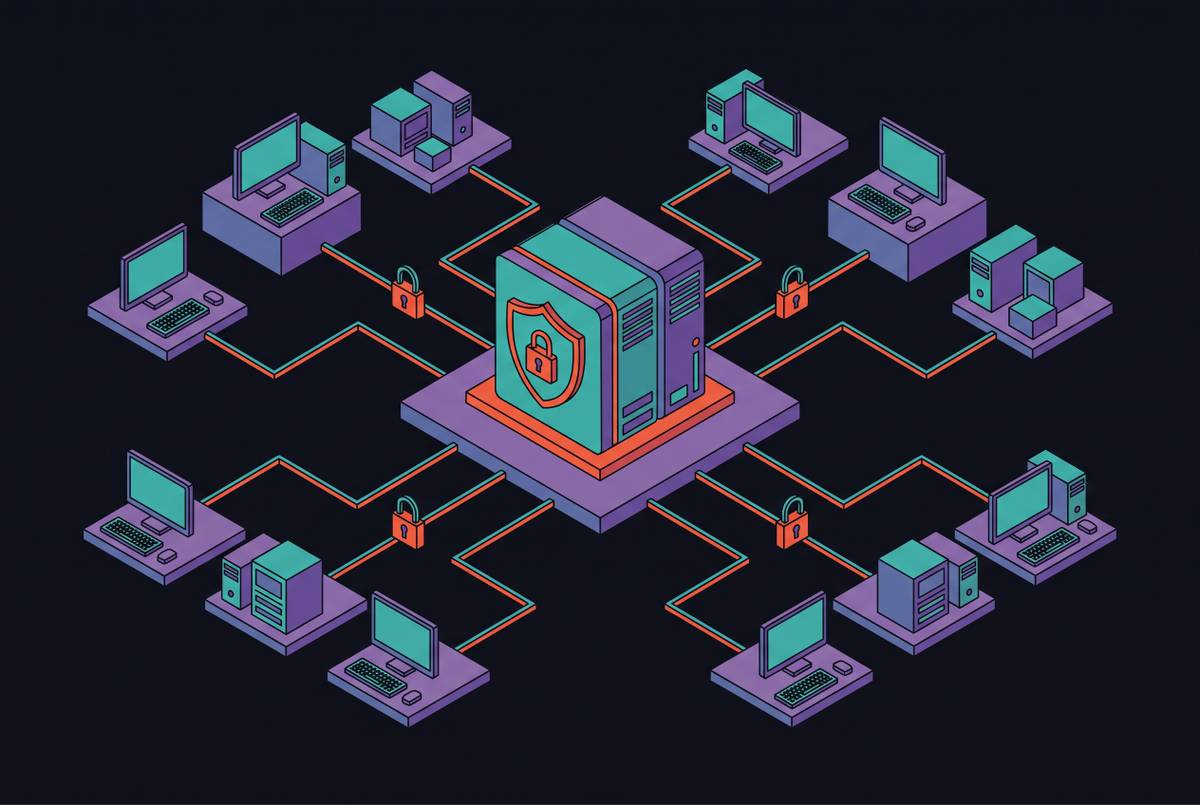
Data Sovereignty Controls Every Enterprise AI Platform Must Offer Before You Sign
Five controls enterprises need to enforce data sovereignty in AI deployments before signing.

Zero-trust AI architecture for enterprise requires enforceable controls over jurisdiction, inference routing, training use, derivative data, and audit access (not just regional hosting). Preventing a vendor from inspecting internal prompts also requires protection during processing, with cryptographic attestation in addition to a contractual promise. Before signing, procurement and technical teams must establish that the contract, architecture, and evidence support the same sovereignty boundaries.
Why "data stored in Europe" is not the same as "data governed by European law"
Data residency describes where data physically sits. Data sovereignty concerns whose law governs it. Data localization is a third concept, a government-imposed requirement that data remain within national borders. A European server location answers only the first question.
The US CLOUD Act exposes the distinction. US-headquartered providers can be compelled to disclose data stored abroad, including in EU data centers, despite regional contracts or Standard Contractual Clauses. Microsoft France’s director of public and legal affairs told a parliamentary hearing under oath in June 2025 that Microsoft could not guarantee EU customer data would never be accessed by US authorities. Every control below exists because choosing a region does not settle who can access the data.
The regulatory stack that makes these controls non-negotiable in 2026
GDPR Chapter V restricts transfers of personal data outside the EU, while sector rules govern what may enter an AI workflow and under which agreements. HIPAA requires Business Associate Agreements with every vendor in the inference path, including the LLM provider. PCI auditors are increasingly examining AI workflows for accidental inclusion of cardholder data.
The EU AI Act adds lifecycle governance, risk management, bias detection, conformity assessments, and automatic logging requirements for high-risk systems. Its timing needs careful distinction. The AI Omnibus regulation pushed back full Annex III high-risk enforcement to late 2027, while transparency and GPAI enforcement began August 2, 2026. Where high-risk logging duties apply, logs must be kept for at least six months.
Cross-border permissions also require a separate assessment. The EU General Court upheld the EU-US Data Privacy Framework on September 3, 2025, leaving DPF-certified US transfers valid under that framework. That does not resolve requirements under Australia’s CDR, India’s DPDP, Brazil’s LGPD, Canada’s PIPEDA, or China’s PIPL. These regimes impose distinct obligations around localization, encryption, and auditability. The procurement checklist must address their intersection.
How real deployments have failed sovereignty requirements at runtime
A hidden cross-region invocation begins with compliant EU compute. The SDK, however, includes a US-region fallback model, and a regional incident triggers a silent reroute. The audit log reveals the transfer afterward. By then, the disclosure obligation has already arisen, even though the primary endpoint never changed its residency setting.
A retraining feedback loop crosses a different boundary. A vendor promises not to train on customer data, but a product team enables a feedback API that sends prompts and completions through a separate flow with looser residency commitments. Customer data enters a dataset held by the vendor before the settings are fixed. The primary service agreement did not govern the whole path.
The subpoena gap requires no configuration mistake. A US-headquartered vendor remains subject to US court orders despite offering EU residency. The vector store failure is different again, with a residency-locked inference endpoint paired with embeddings stored in another region. These failure modes call for distinct fixes, namely governed fallback routes, comprehensive training prohibitions, jurisdictional scrutiny, and residency controls for derivative data.
The four deployment tiers and which sovereignty problems each tier actually solves
The deployment model sets the available control boundaries. Tier 1, multi-tenant EU SaaS, is a cost-effective choice for non-sensitive business workflows, but the data may be processed on shared infrastructure and by US parent companies. CLOUD Act exposure remains where the parent is US-headquartered. The sensitivity of the workload is decisive in assessing the tier’s suitability.
Tier 2 uses dedicated EU cloud infrastructure that keeps AI within the region, such as Vertex AI EU Data Residency. Prompts, embeddings, and outputs run within dedicated European boundaries, making this model relevant to regulated workloads that require frontier models. Regional isolation and contractual controls reduce exposure but do not remove a US parent’s legal obligations. Isolation and jurisdiction solve different problems.
Tier 3 uses infrastructure that European entities own and govern in full, with no US parent in control. It meets the needs of highly regulated public-sector, healthcare, and critical-infrastructure work where that legal separation is a must. Tier 4 moves deployment into private data centers or air-gapped infrastructure under the organization’s control, serving confidential R&D, core banking, and strict isolation needs.
The proposed EU Cloud and AI Development Act offers another reference point through four assurance levels. The European Commission published the proposal in June 2026, and it remained under legislative review in late October 2026. Procurement teams should map vendor claims against its proposed levels while recognizing that they are not a finally enacted standard. A vendor’s sovereignty label is not enough.
Jurisdictional clarity: what to verify before accepting any regional commitment
Which entity actually signs the contract, and which laws can compel it to disclose data? Procurement teams should put that question in writing. A separately incorporated local subsidiary with operational independence is not equivalent to a branch of a US parent. The review must establish the structure.
The next question concerns the legal basis for each cross-border transfer under GDPR Chapter V. Is it an adequacy decision, Standard Contractual Clauses, DPF certification, or a derogation? Where a vendor invokes the proposed CADA assurance framework, what documentation supports its claimed level? Each answer needs documentary support.
The concrete deliverable is alignment among the Master Service Agreement, the Data Processing Addendum, and the sub-processor disclosures. The DPA must state what the vendor promises for each region, and the disclosures must name every third party that touches the data. An EU-only clause has little force in practice if another document allows logging elsewhere. These documents establish the legal boundary that technical controls must enforce.
Inference-time data flow controls: the proxy, routing policy, and fallback rules
Every external inference request is a data transfer. Procurement teams should require an egress proxy that the organization controls and that every prompt passes through, because an endpoint setting alone cannot ensure residency. The proxy must redact PII, PHI, and PCI data before transmission, enforce permitted model and region destinations, and log prompts, completions, and metadata. If destination residency cannot be established, it must block the request.
Routing policy belongs at the orchestration layer. EU-tagged data must route only to EU-resident models, while requests whose data classification cannot be determined must be refused. Teams should not set these boundaries for each call. Technical verification must establish that the policy governs actual routing.
Cross-region fallback must be blocked unless the other target meets the same residency requirements, which prevents the silent reroute described earlier. The policy must also cover retries, observability, and feedback paths. Otherwise, the primary request can comply while a secondary flow crosses the boundary.
Model training boundaries: the opt-out that must become an explicit prohibition
Default terms may permit model improvement unless the customer opts out, so the required contract standard is an explicit, unconditional prohibition. It must cover training, fine-tuning, evaluation dataset construction, RLHF feedback, and any model improvement derived from customer inputs or outputs. A promise limited to “primary” training leaves other uses open.
Enterprise service tiers often promise no training on customer data, but procurement teams must choose the terms that make that promise and get written confirmation of what they cover. Every deployed API needs its own review. A feedback or analytics endpoint with its own contract may have different terms, which leaves room for the retraining feedback loop.
When the customer directs fine-tuning, ownership must also be clear. The resulting model weights, training datasets, and evaluation sets are sovereign assets subject to the data-use restriction. The contract must keep them exclusively under the organization’s control and prohibit vendor retention.
Vector store residency and embedding security: the sovereignty gap most teams miss
An embedding is not automatically an anonymous substitute. Research described in the brief indicates that high-dimensional embeddings of natural-language text can be partially invertible, particularly when the embedding model is known. A complete reconstruction is not possible from every embedding. Still, being derived from other data is no reason on its own to drop sensitivity protections.
The contract and architecture review must therefore cover the vector store under the same DPA and residency commitments as the primary data store. The embedding model needs equivalent jurisdictional controls. An EU-resident inference endpoint paired with a US-hosted embedding service leaves a separate transfer path open, even if the vector database itself is European.
The policy for data classification must treat embeddings as sensitive data. The same reasoning extends to inference outputs, logs, operational metadata, and model artifacts generated from sovereign data. Each requires explicit contractual and architectural coverage.
How do you prevent your AI vendor from seeing internal prompts during processing?
Encryption at rest and in transit leaves a distinct gap while data is processed in memory. AI inference operates in that state routinely. Trusted execution environments, or TEEs, protect execution within a hardware-enforced boundary that prevents even the cloud operator from inspecting the protected contents. Their scope can include prompts, model weights, training data, fine-tuning datasets, and outputs.
NVIDIA documents confidential computing support for GPU-accelerated inference and training. Gartner named confidential computing among its top-10 strategic technologies for 2026, citing its role in enterprise AI adoption where data protection requirements had blocked deployment. The vendor must demonstrate its own protection boundary.
Before signing, teams should establish whether TEE-based inference is the default or an add-on, and whether model weights receive protection as well as inputs. They should also require attestation on demand. Attestation provides cryptographic proof that the execution environment is what it claims to be, turning a promise about protected processing into verifiable evidence. It does not replace the routing and jurisdictional controls around that environment.
Sub-processor transparency and contract flow-down: why the chain matters as much as the vendor
The primary vendor is only one contracting boundary. Every sub-processor must be disclosed with its jurisdiction, processing purpose, and obligations mirroring the primary DPA. This includes observability tools, logging infrastructure, and feedback systems. They still have access to customer data when they are called operational infrastructure.
Procurement teams should require a current, complete sub-processor list and advance notification of changes, with a right to object before those changes take effect. Every party must be bound by the same residency restrictions, training prohibitions, audit rights, and deletion duties. The chain needs contractual continuity. If a logging provider is allowed to send data elsewhere, it can break a restriction that the inference provider follows.
This review extends the earlier document-alignment test. The MSA, DPA, and sub-processor list must set out duties that agree with one another, with no exceptions left scattered across separate agreements. What evidence shows that each downstream party is bound? Disclosure identifies the chain, but enforceable flow-down governs it.
Audit rights and immutable logs: the controls that make every other commitment verifiable
Audit access enables testing of these commitments. The contract must require immutable, append-only records covering prompt submission, routing decisions, inference execution, completion delivery, retention actions, and deletion confirmation. Each step needs metadata including timestamp, user identity, data classification, inference region, and the sub-processor involved.
The organization must have direct, programmatic access to those records without opening a vendor support ticket. Logs themselves need jurisdiction-compliant storage under the primary DPA. Where the EU AI Act’s high-risk logging requirements apply, the architecture must support at least six months of retention by default. That minimum is not a reason to disregard other applicable retention requirements.
Notice periods measured in months, annual-only access, or restrictions to security audits can prevent meaningful examination of data flows. Before signing, the organization must be able to connect each promised boundary to both an enforcement mechanism and accessible evidence.
The negotiation standard is alignment across jurisdiction, inference controls, training prohibitions, vector stores, protected processing, sub-processors, and audit rights, with no commitment left dependent on trust alone.