Confidential Computing Attestation vs TLS Certificate Trust Models
Attestation proves what code is running; TLS only proves who you're talking to.
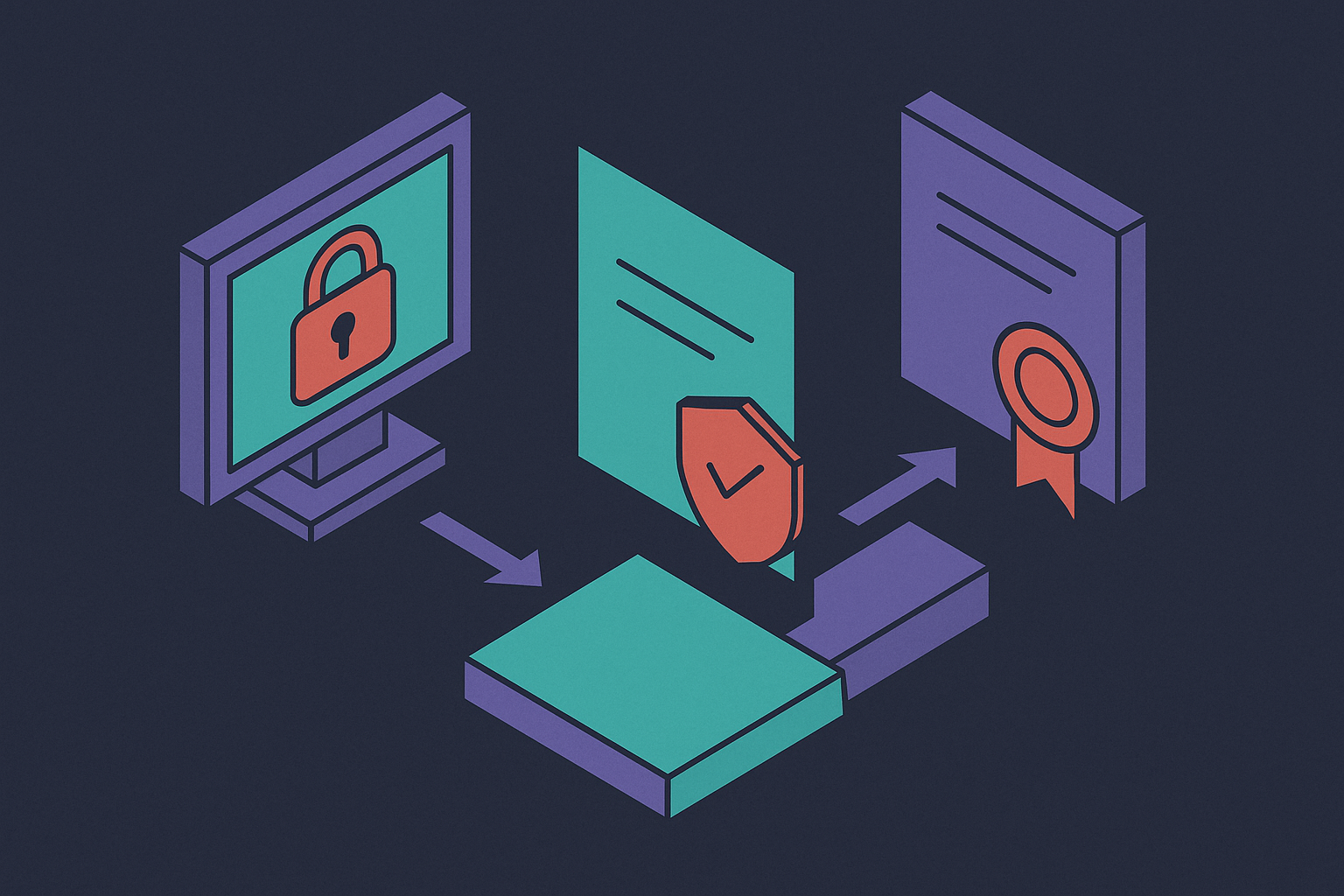
TLS certificates and confidential computing attestation get treated as interchangeable proof of "security," and that's a mistake with real consequences. TLS answers who you're talking to and whether the pipe between you is encrypted; attestation answers what code is actually running on the other end and whether it's been tampered with. Neither question covers the other, which means a server can present a perfectly valid certificate while running firmware nobody would trust for a second.
Data can exist in three states, and the gap gets clearer once you lay them out: at rest, in transit, and in use. Encryption for the first two has been table stakes for well over a decade; disk encryption and TLS handled that problem so thoroughly that most engineers stopped thinking about it. Data in use, the stuff actively sitting in CPU registers and memory while a program chews on it, stayed exposed until hardware trusted execution environments showed up. Confidential computing and attestation exist to close that gap, which is why the distinction between "encrypted connection" and "trusted execution" matters more now than it did five years ago. AI inference on private data is the sharpest version of this problem: a hospital sending patient records to a model provider needs to know the connection is encrypted, sure, but it also needs to know the model running on the other end hasn't been swapped for something that logs every prompt.
How TLS certificate trust is structured and what it actually guarantees
TLS trust runs on delegation. A handful of certificate authorities sit at the top of a hierarchy, and their authority exists only because browser and operating system vendors decided, at some point, to bake their root certificates into every device that ships. That's the whole foundation: institutional agreement, not mathematical proof of good behavior.
What does a valid TLS certificate actually tell you? That the entity holding it controlled a given domain at the moment the CA issued the cert. That's the claim, in full. It says nothing about what software is running on the server, whether the firmware's been patched, or whether the application layer has been quietly modified since deployment.
The chain itself looks like this: root CA, down through one or more intermediate CAs, down to the end-entity certificate your browser actually checks. Browsers trust a long list of root CAs directly and, through those roots, an even longer list of intermediates indirectly. Here's the structural weakness worth sitting with: any single CA anywhere in that chain can issue a valid certificate for any domain on the internet. Not just its own customers' domains. Any domain. Security researchers call this weakest-link trust, and it means the system is only as strong as its least careful participant.
The DigiNotar collapse in 2011 is the case study everyone in this field eventually learns. A Dutch certificate authority got compromised, and the attacker used that access to issue fraudulent certificates, including one for Google's domains. Detection took over a month. Once discovered, unwinding the damage, getting browsers and operating systems to fully distrust DigiNotar's certificates, took as long as six months across major vendors. That lag is the tell: this trust model is procedural and institutional, and institutions move slowly even when the thing they're protecting is a live cryptographic trust anchor.
Structural pressures currently straining the CA trust model
The DigiNotar story isn't ancient history repeating for dramatic effect; the same pattern keeps surfacing. Google announced in 2024 that Chrome would stop trusting new certificates from Entrust, citing a pattern of compliance failures stretching back years. Mozilla followed suit for Firefox. Then in September 2025, a Croatian certificate authority named Fina was found to have issued unauthorized certificates for Cloudflare's 1.1.1.1 DNS service. Nobody's automated monitoring caught that one first; an outside researcher did.
Two incidents, one pattern. Trust in the CA model is spread across dozens of authorities, and any one of them failing undermines the guarantee for everyone downstream, not just their own customers. The systemic brittleness worth naming plainly is architectural: the system has no way to contain a single point of failure, regardless of how careful any individual CA might be.
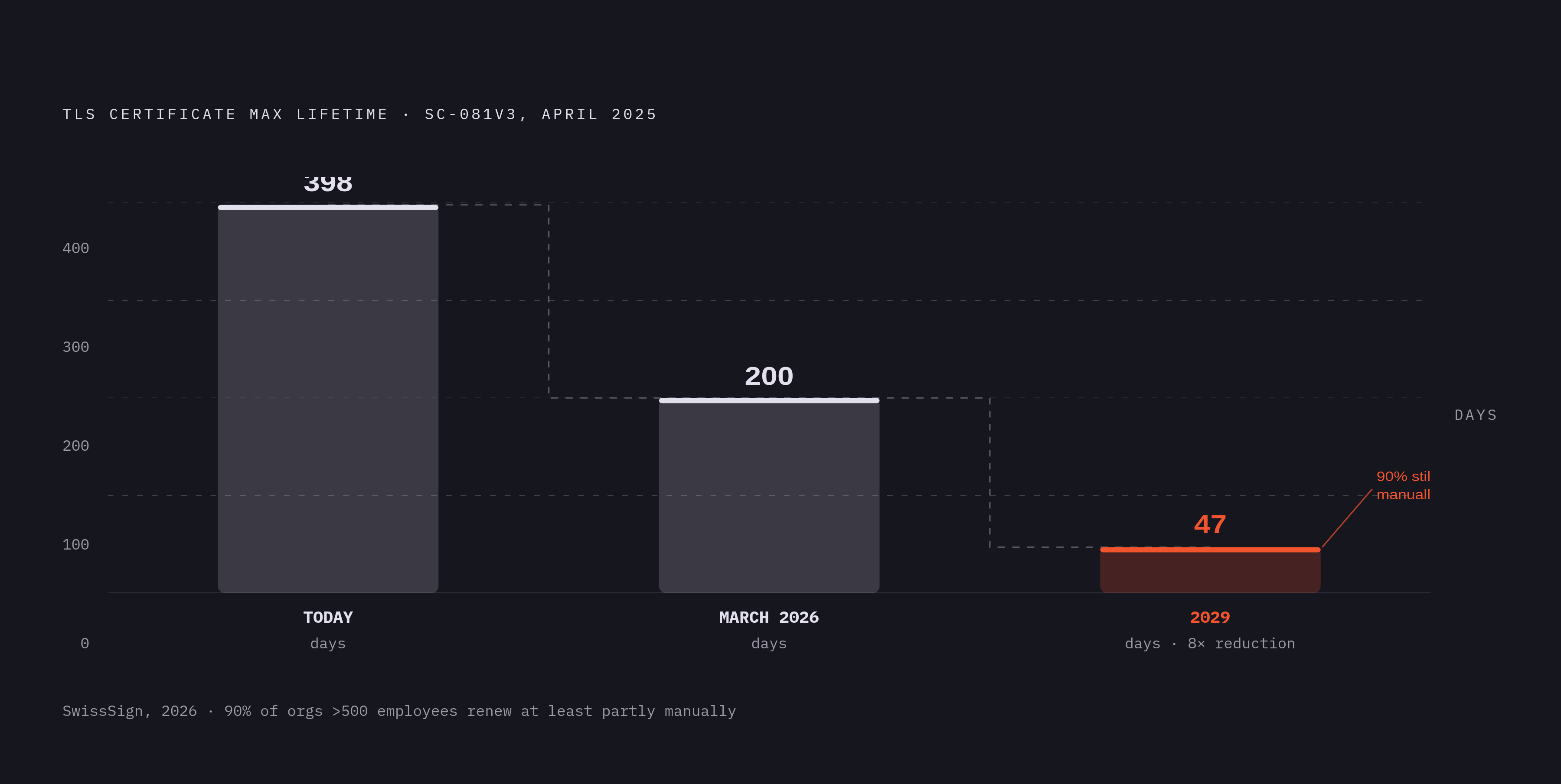
The industry's answer has been to shrink the window of exposure rather than fix the underlying weak-link problem. The CA/Browser Forum's Ballot SC-081v3, passed in April 2025, cuts the maximum TLS certificate lifetime from 398 days down to 200 days, effective March 2026, with further reductions down to 47 days by 2029. The reasoning is straightforward once you see it: a certificate that expires quickly behaves, in practice, almost like a certificate that got successfully revoked, without needing the notoriously unreliable revocation infrastructure to actually work.
Shorter lifetimes, though, push the burden somewhere else: onto the people who have to manage renewal. A SwissSign survey from 2026 found that 90% of organizations with more than 500 employees still handle at least part of their certificate management manually. Shrinking the validity window from 200 days to 47 doesn't remove that burden; it multiplies how often someone has to do the work.
Worth saying directly: none of this touches the actual gap. Certificate Transparency logs, shorter lifetimes, stricter browser enforcement: these make CA misbehavior more visible and cap how long it can go unnoticed. They do not make a certificate say anything new about what's running inside the server it's attached to. That was never the promise TLS made, and no amount of process reform changes the promise.
How hardware attestation roots trust in silicon rather than institutional authority
Attestation starts from a different question entirely, and it answers it with hardware. A trusted execution environment, or TEE, runs specific code and data inside a hardware-isolated region of memory called an enclave. The operating system can't read into it. The hypervisor can't touch it. Even a cloud administrator with full root access to the physical machine can't see or modify what's happening inside that enclave.
Here's the mechanism that makes this checkable rather than just asserted: when a TEE boots, the processor measures the entire chain of software involved, the bootloader, the firmware, the OS, the hypervisor, the enclave code itself, and compresses that into a cryptographic hash. That hash is the measurement, and it's a fingerprint of exactly what's running.
The processor then signs that measurement with a private key that never leaves the hardware. Software running on the same machine can't extract, copy, or exfiltrate it. The corresponding public key lives in the hardware manufacturer's own public key infrastructure. That infrastructure is the actual root of trust here, rooted in the company that fabricated the chip rather than in a consortium of browser vendors voting on which CAs to include.
The verification flow follows a specific pattern. A relying party, whoever needs to trust the workload, requests a quote from the TEE. The TEE produces a signed measurement report. That report goes to an attestation service, something like Intel Trust Authority, which checks the signature against the manufacturer's PKI and compares the measurement against a known-good reference value. The service returns a signed attestation result, and the relying party decides, against its own policy, whether that result clears the bar before sending anything sensitive.
Platform support has moved fast. Intel TDX, AMD SEV-SNP, and Arm CCA all offer TEE capability now, and GPU-level TEEs are emerging too, with NVIDIA's H100 supporting confidential computing modes. Intel Trust Authority's V2 policies can evaluate composite evidence spanning both a VM and a GPU at once, which matters enormously for AI workloads where the GPU is doing the actual inference work and the CPU-side VM is just orchestration.
The market's noticed. Confidential computing infrastructure spending hit roughly $5.8 billion in 2025, growing at a 38% compound annual rate, with projections putting the market above $28 billion by 2030. Enterprises are paying for a specific, hardware-rooted guarantee that certificate-based trust never offered.
What each model proves, side by side
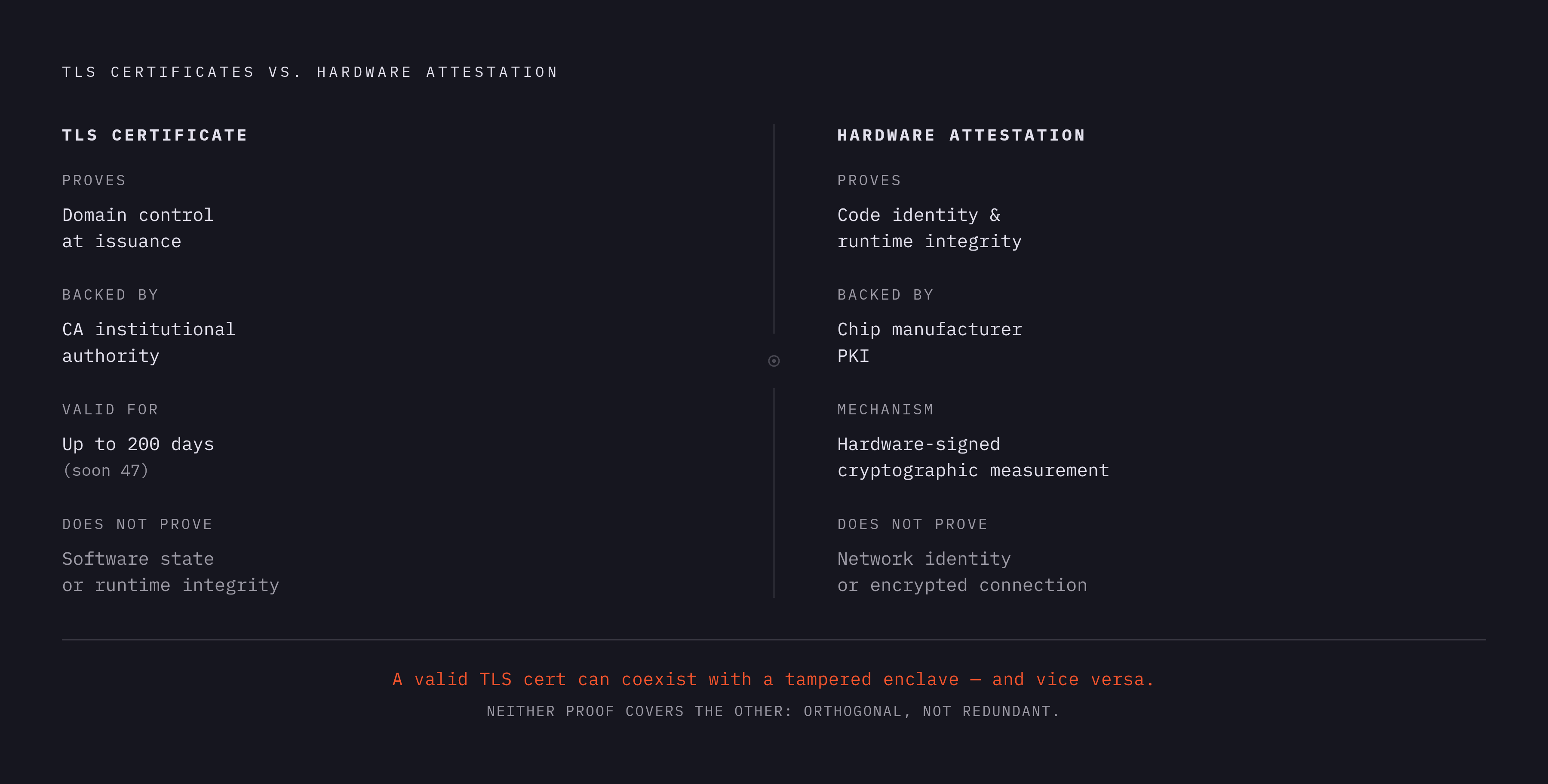
Put them next to each other and the asymmetry is obvious. A TLS certificate proves domain control at the moment of issuance, backed by institutional authority; it says nothing about software state. Attestation proves code identity and runtime integrity, backed by a hardware-signed measurement; it says nothing about network identity or whether the connection itself is encrypted.
These aren't redundant checks on the same thing. They're orthogonal, which is a word worth using precisely here: a server can hold a perfectly valid TLS certificate while running a tampered enclave, and a server can produce a completely valid attestation quote while presenting an expired or self-signed TLS certificate. Neither scenario is a contradiction, because the two systems were never checking the same claim. A deployment handling sensitive data needs both, not one standing in for the other.
Trust roots diverge sharply too. TLS traces back through browser vendors, to root CAs, through intermediates, to the end entity. Attestation traces back through the chip manufacturer, to a device key burned into silicon, to the specific measurement taken at boot. One is a chain of institutional decisions; the other is a chain of physical manufacturing and cryptographic signing.
Temporal scope differs as well. A TLS certificate is valid for a fixed window, soon capped at 200 days and eventually 47, and its proof is frozen at the moment of issuance. Attestation's measurement is taken at boot or launch time, and the proof reflects the state of the system at that specific instant, nothing before or after.
Failure modes look nothing alike, either. A compromised CA, or a CA that simply misissues a certificate through carelessness, can undermine identity claims for any domain globally, as DigiNotar showed. Attestation's failure mode would be a compromised hardware manufacturer key or an undisclosed backdoor baked into the silicon itself. Different threat surface. Equally serious, just not the same risk at all.
Why combining them in attested TLS is harder than it looks
The obvious next move is to fuse the two: give a client both proofs in a single handshake, so it knows the connection is encrypted and knows the workload on the other end is exactly what it claims to be, before any sensitive data goes anywhere. This is called attested TLS, and it sounds like a solved integration problem. It isn't.
The IETF laid out the formal architecture in RFC 9334, the RATS Architecture document, published in January 2023. It defines a clean flow: an Attester produces Evidence, a Verifier checks that Evidence and produces an Attestation Result, and a Relying Party consumes that result. Deliberately neutral about which specific protocol or hardware platform sits underneath it. Google Cloud's integration with Intel Trust Authority shows what production intent looks like here: attestation verification runs independently of the cloud provider itself, so a customer can confirm enclave integrity before releasing encryption keys, without having to trust the cloud provider's own say-so.
How does this actually bind together at the protocol level? That's the hard part, and it's where things start to break. The core difficulty is cryptographically tying the attestation evidence to the specific TLS session in front of you, proving that whatever produced that signed quote is the same entity sitting at the other end of this particular connection right now.
Two pieces of research from late 2025 and 2026 show this binding problem is not solved. A paper called "Identity Crisis in Confidential Computing," presented at AsiaCCS 2026 by Moustafa and Aura, describes a diversion attack: a connection meant for one specific server gets silently redirected to a different machine running identical software, potentially anywhere in the world. The protocol checks that the code is correct. It does not check where that code is running. The attack is invisible from the client's side, because everything it can verify checks out.
Separately, research published as "Intra-handshake.fail" at ESORICS 2026 used formal analysis, via the ProVerif protocol verification tool, to examine seven distinct industry proposals for binding attestation evidence into a TLS session. All seven failed to prevent relay attacks, where a client verifies genuinely valid attestation evidence but ends up encrypting its actual traffic to a different, malicious endpoint entirely. That finding produced CVE-2026-33697, with a CVSS score of 7.5, which is not a low-severity footnote.
Worth pausing on this: these aren't lab curiosities affecting hypothetical systems. The affected deployments include real production infrastructure carrying real traffic, built on binding schemes that formal analysis says don't hold up.
The IETF has responded. A Birds of a Feather session at IETF 123 in Madrid, in July 2025, led to the formation of the Secure Evidence and Attestation Transport working group, SEAT. That group wrote binding correlation properties into its charter as an explicit, mandatory requirement, not an optional nice-to-have. That's a tell in itself: the standards body chartered to fix this is treating the binding problem as open, not solved.
What the research vulnerabilities mean for teams deploying sensitive workloads today
None of this invalidates attestation or TLS individually. That distinction matters, and it's easy to blur if you read the vulnerability headlines too fast. A valid attestation quote still proves code identity and enclave integrity; the measurement mechanism itself is sound and unbroken by any of this research. TLS still gives you transport confidentiality and still stops passive eavesdropping cold. What's broken is narrower and more specific: the automated schemes that try to bind the two proofs together inside a single handshake, without a separate verification step.
So what should a team actually do? Verify attestation evidence out-of-band, through a dedicated attestation service, rather than trusting an intra-handshake binding claim to have done that work automatically. Treat the attested identity and the TLS endpoint identity as two separate claims, each needing its own independent check, rather than one continuous proof. And keep an eye on the IETF SEAT working group's output, because the gap it's chartered to close is exactly the gap the ESORICS and AsiaCCS research exposed.
For AI workloads specifically, the stakes sharpen. A relay attack against an inference server could route prompts and model responses through a malicious intermediary that has, on paper, passed every attestation check a client could run. The client sees a valid quote. Using current binding schemes, it has no way to know the entity that produced that quote isn't the entity actually reading its traffic.
Architectures that build attestation in from the start, rather than bolting it onto an existing deployment after the fact, are in a materially better position here. Nobody has solved the binding problem early; the advantage is that their trust model is already explicit and modular, which makes it far easier to swap in a fixed binding scheme once the SEAT working group ships one.
Zero-trust architecture treats confidential computing and attestation as a core enabler, and that's fair, but only conditionally. A zero-trust policy is only as good as the evidence it's built on, and right now, the evidence produced by intra-handshake attestation binding has a documented, formally verified gap. The sensible response is to verify the binding separately, watch the standards work closely, and avoid mistaking a passed attestation check for proof that nothing in between can still go wrong.