AWS Nitro Enclaves for Sensitive Data Processing
Protecting sensitive data by isolating cryptographic operations from the host operating system.
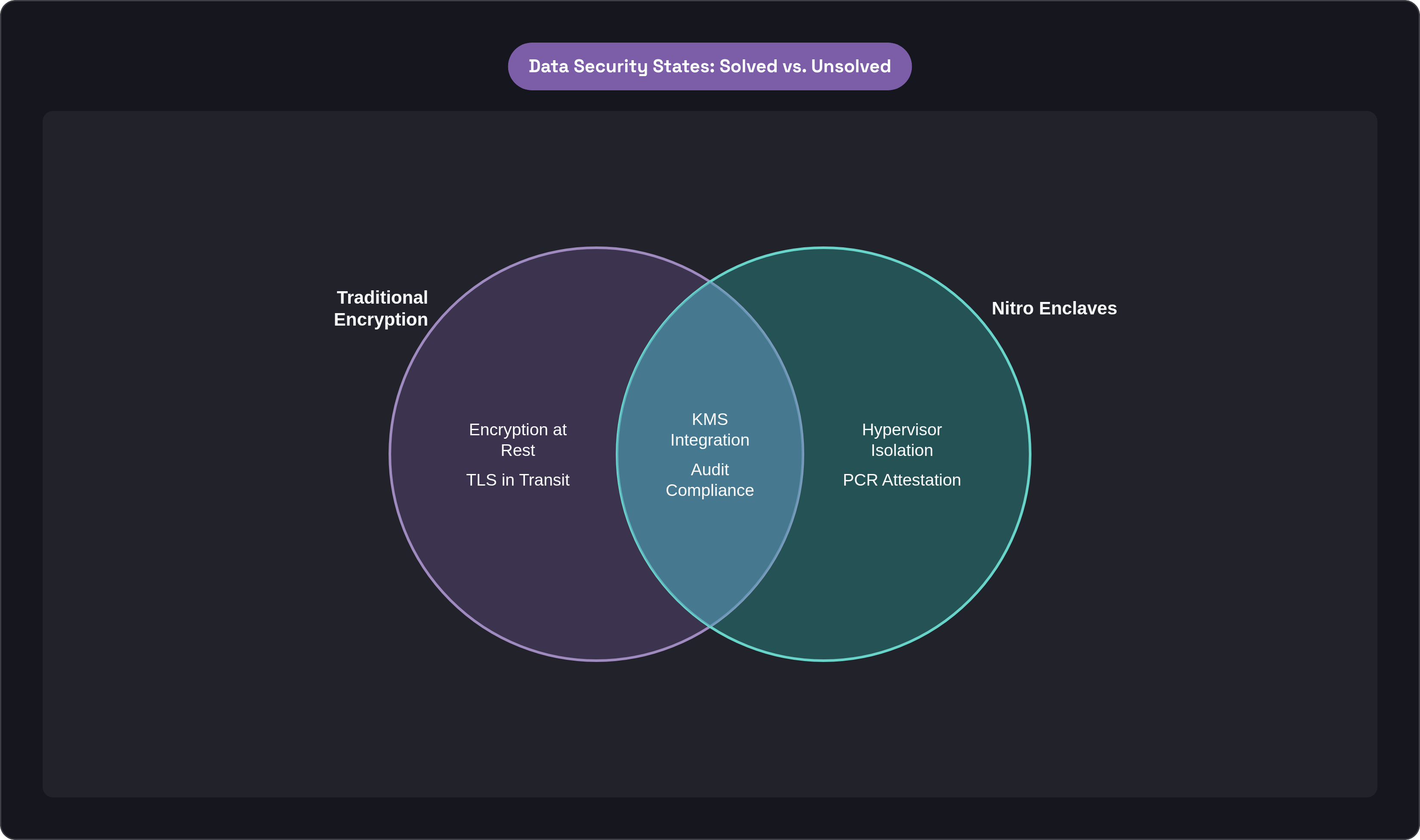
The security industry spent decades solving two of the three data states. Encryption at rest became table stakes after the first wave of cloud adoption; TLS made encryption in transit a baseline expectation long before that. The third state, data in use, received comparatively little attention, and solving it requires rethinking where trust lives in a computing stack, not layering a new protocol on top of an existing one.
But what if the exposure window is brief enough that it simply doesn't matter? That instinct is worth examining. When a workload decrypts a payment card number, a set of private keys, or a patient record to operate on it, that data exists in plaintext in memory. A privileged administrator on the host, a compromised hypervisor, or a capable co-tenant attack can reach that memory. The most consequential breaches of the past decade have repeatedly targeted runtime memory and privileged access paths, not ciphertext. Whatever encryption posture protected data at rest and in transit provides nothing at that moment.
Nitro Enclaves are not a separate AWS service in the conventional sense. They are an EC2 capability, carved out of a running parent instance's own compute resources, that creates an isolated execution environment for processing highly sensitive data: PII, protected health information, financial records, private cryptographic keys, proprietary model weights.
The mental model most engineers reach for first, a sandboxed container or a locked-down VM in a separate account, doesn't quite hold. The enclave runs alongside its parent EC2 instance on the same physical host, borrowing a portion of that instance's vCPUs and memory. The Nitro Hypervisor treats the enclave as a fully separate virtual machine with its own kernel, its own memory region, and its own lifecycle. The enclave boots from an Enclave Image File, an EIF, which bundles the operating system, libraries, and application at build time. Nothing is installed at runtime.
The premise the entire architecture rests on: the parent instance's root user cannot access the enclave. Not through SSH, not through /proc, not through any IAM policy however permissive. The isolation is enforced below the operating system, at the hypervisor layer, not by a software policy a sufficiently privileged user can override. This is what separates confidential computing as an architectural category from conventional access control.
Because this capability sits within the same Nitro System that has underpinned EC2 isolation since AWS redesigned its virtualization stack, teams do not need to procure custom hardware or operate outside standard cloud primitives. That matters for adoption in ways that on-premises confidential computing hardware cannot match.
How the Nitro Hypervisor Enforces Isolation the Parent Instance Cannot Override
Isolation claims are only as strong as the mechanism enforcing them. That raises an important question: what layer does the enforcement live at, and what would it take to subvert it?
For Nitro Enclaves, enforcement lives at the hypervisor layer, the same layer that prevents one EC2 instance from reading another's memory. The parent instance's kernel has no visibility into the enclave's kernel. The parent cannot observe the enclave's vCPU state or memory contents. This boundary is enforced by AWS's custom Nitro silicon, not by a software firewall or a permission check.
The design hardcodes several constraints. Treat them as closed exfiltration paths rather than missing features, because that is what they are in practice. There is no persistent storage inside the enclave, no interactive access, no external networking, no inbound IAM-based or root-privileged connections. The only communication path is a vsock channel, a virtual socket connecting the parent instance to its enclave. That channel is local to the host, analogous in structure to a TCP/IP connection but confined to the machine. It carries inputs in and outputs out; it does not carry administrative access.
Up to four enclaves can run per parent instance, and they cannot communicate with each other. All coordination must route through the parent. This shapes the architecture of any multi-enclave deployment in ways that matter early in design, and discovering it late is the kind of thing that turns a clean architecture review into an embarrassing retrofit.
Each removed surface is an attack path that simply does not exist. No persistent storage means data cannot be written to disk and retrieved later. No external networking means no outbound exfiltration channel. No interactive access means no operator, however credentialed, can observe what the enclave processes. When the threat model includes privileged insiders or compromised host-level access, these constraints are the architecture.
How Cryptographic Attestation Proves Which Code Is Running, Not Just Who Is Running It
Isolation establishes the boundary. Attestation addresses a subtler problem: an isolated enclave running modified or compromised code provides no real protection, because the attacker has moved inside the perimeter. What matters is the ability to verify, cryptographically, that the enclave is running exactly the code that was approved before handing it anything sensitive.
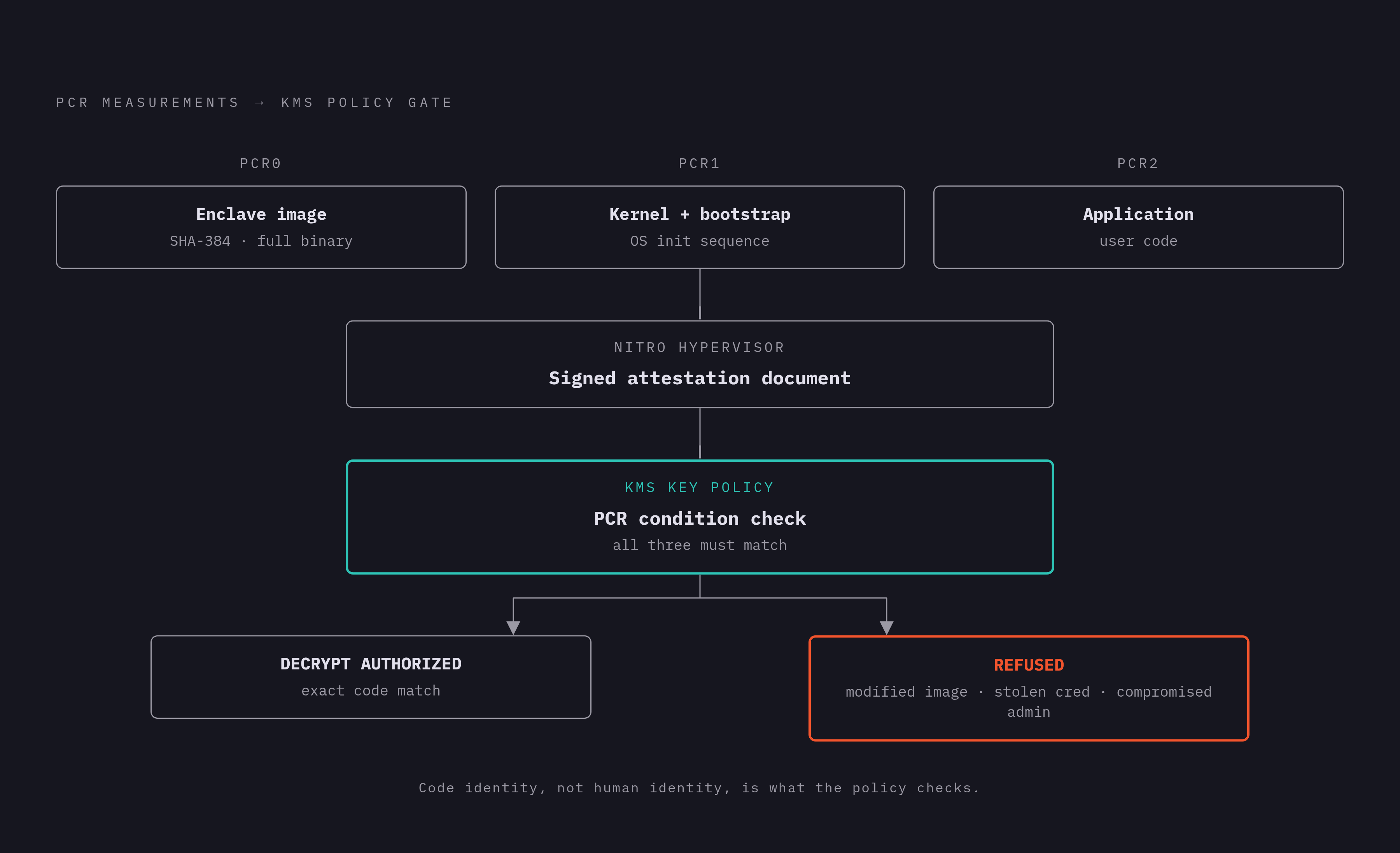
The Nitro Hypervisor generates a signed attestation document for each enclave. That document contains the enclave's public key, metadata, and a set of cryptographic measurements called Platform Configuration Registers, PCRs. Three are particularly relevant: PCR0 is a SHA-384 hash of the full enclave image; PCR1 covers the OS kernel and bootstrap process; PCR2 covers the application itself.
These measurements are computed at launch, before the enclave processes anything, and signed by the AWS Nitro Attestation PKI, rooted in a certificate for commercial AWS partitions. Any party with access to that certificate chain can verify that the attestation document is genuine and that the enclave is running on real AWS Nitro hardware. The Nitro Security Module, communicating over /dev/nsm inside the enclave, is the hardware component that produces these measurements.
It is also worth considering what the access-control logic that attestation enables actually changes. Traditional key management policies govern who can decrypt data, authenticated by identity. Attestation-based policies govern which exact code can decrypt data, authenticated by cryptographic measurement. A compromised administrator account, a legitimate but curious employee, a stolen IAM credential: none of these satisfy a PCR-based condition in a key policy. The code running in the enclave either matches the approved measurements or it does not. That binary is not achievable through identity-based access control, regardless of how carefully you configure it. It is not a stronger lock on the same door; it is a different kind of door entirely.
Third-party key management services can consume attestation documents, but doing so requires building a custom validation layer, which is non-trivial. AWS KMS supports this natively.
AWS KMS Integration as the Practical Lever for Attestation-Gated Decryption
AWS built PCR-based condition keys directly into KMS key policies. A team can specify, in a key policy, that a KMS key will authorize decryption only when the requesting enclave's measurements match an approved set of PCR values. No custom integration, no external validation service. This is where the attestation model stops being a theoretical property and becomes something you can actually deploy.
Consider what this means operationally. Encrypted data can flow freely to the parent instance, which is a normal EC2 instance accessible through standard mechanisms. Only the enclave, after presenting a valid attestation document with matching measurements, can ask KMS for the key to decrypt that data. If the enclave image has been modified, the measurements will not match and KMS will refuse. If someone attempts to call KMS from outside the enclave, they lack the attestation document the hardware produces. Both properties must be satisfied simultaneously; neither alone is sufficient.
The Nitro Enclaves SDK exposes three KMS operations for use inside the enclave: kms-decrypt, kms-generate-data-key, and kms-generate-random. The scope is intentionally narrow. The enclave is not a general-purpose compute environment for arbitrary AWS service calls.
AWS Certificate Manager extends this pattern to TLS certificates. With ACM for Nitro Enclaves, the private key for a TLS certificate is generated by ACM, distributed to the enclave, and renewed without ever existing outside an attested environment. The parent instance handles connection termination but never possesses the private key in a form it can read.
The result: the decryption boundary and the compute boundary become the same boundary. Sensitive data is never plaintext at a layer the parent instance, or anyone with access to it, can observe.
Workloads That Fit This Architecture and How Each One Maps to the Protection Model
Not every workload actually benefits from this protection model. Part of evaluating the architecture honestly is developing a feel for where it earns its complexity versus where it merely adds it.
Payment processing offers the clearest mapping. Card numbers arrive at the parent instance encrypted. Only the enclave decrypts them for processing. For PCI DSS purposes, this directly shrinks audit scope: systems that never see plaintext cardholder data are not in scope the same way systems that do are.
PHI processing under HIPAA follows the same pattern. The question auditors frequently ask is whether sensitive data was exposed to the broader cloud environment; the architectural answer here is demonstrably no, backed by cryptographic evidence rather than policy attestation.
Private key and signing operations represent a use case where the protection model is nearly perfectly matched. The parent sends data to be signed; the enclave performs the signing using a key that never leaves the enclave; the parent receives only the signature. An attacker who fully compromises the parent instance gains no useful cryptographic material. This is about as close to a solved problem as this class of threat gets.
Multi-party computation benefits from a different dimension of the model. Multiple parties send encrypted inputs; the enclave decrypts and processes all of them without any party seeing the others' inputs. Attestation gives each party cryptographic assurance that the code processing their data is what they agreed to; isolation gives them assurance that no other party can observe their data during processing.
Confidential ML inference addresses a problem that is becoming commercially significant. Proprietary model weights represent substantial intellectual property. The enclave receives inputs and returns inference results without exposing the weights to the parent instance or its operator. The converging pressures here are real: model owners want assurance their weights are protected, data owners in regulated industries want assurance their inputs are not exposed, and compliance frameworks for AI-processed health data are still forming. Both interests can be satisfied within the same enclave boundary, which is not something conventional access controls can achieve.
Blockchain key management rounds out the practical use cases. AWS guidance demonstrates using Nitro Enclaves alongside Secrets Manager for transaction signing. The smallest supported instance for this reference architecture is an M5a.xlarge, a constraint worth noting for capacity planning.
Across all of these, the workloads that map cleanly share a common feature: a definable boundary where plaintext sensitive data and the compute that processes it can be confined together. Workloads where sensitive data moves between multiple processing layers, or where the sensitive component is a small fraction of a much larger application, require more careful analysis before enclaves become the obvious answer.
How Production Deployments Actually Use This: Lessons from Fireblocks, Okta, Dashlane, 1Password, and Brave
Production deployments are more instructive than reference architectures. The companies that have publicly committed to Nitro Enclaves reveal something beyond the technology's capabilities: they reveal how attestation is being used as a commercial differentiator, not merely as a security control.
Fireblocks uses Nitro Enclaves for secure transaction signing in its MPC wallet product. Clients retain control over assets while Nitro isolation and attestation provide a cryptographic guarantee that only authorized signing code executes. The value proposition to Fireblocks customers is that the signing environment is verifiable, not simply trusted on Fireblocks' word.
Okta's use within privileged access management stores and manages customer infrastructure credentials inside attested enclaves. The attestation document answers the question that IAM policies alone cannot: not just who has access to the credential store, but what code is running it. For a company whose customers are acutely sensitive to credential compromise after the incidents of recent years, the architectural specificity of that claim carries real weight.
Dashlane presents a particularly interesting case. Encryption keys for customer data are fully isolated inside the enclave; the attestation architecture means Dashlane itself cannot access or observe customer keys. This is a zero-knowledge posture enforced by hardware and hypervisor, not by policy or contractual commitment. There is a meaningful difference between "we choose not to look at your data" and "the architecture makes it impossible for us to look at your data." Customers in the security-conscious segment understand that distinction, and it is a much harder position for a competitor to replicate through marketing.
1Password extends end-to-end encryption into cloud processing and uses attestation as a trust signal with enterprise customers. The claim that no one can access customer data during processing is cryptographically provable, not a statement in a privacy policy requiring the customer to take the company at its word.
Brave's approach to crypto payments adds a dimension worth examining: reproducible builds combined with attestation make every layer of the payment pipeline independently verifiable. External parties can confirm what code is running without trusting Brave's assertions. This is the audit model regulators and sophisticated enterprise buyers are increasingly asking for, even when they lack the vocabulary to specify it precisely.
Across all five, attestation functions as both a security control and a verifiable trust signal presented to customers. Evervault, quoted on AWS's product page, notes that Nitro Enclaves enable handling thousands of cryptographic operations per second without meaningful performance penalty beyond the underlying EC2 instance costs. The isolation model does not impose a significant cost or performance tax, which removes one of the common objections to adopting it.
Deployment Constraints and Instance Requirements Practitioners Need to Plan Around
The operational reality of deploying Nitro Enclaves includes constraints that are easy to overlook in an architecture review and genuinely disruptive to discover in production.
Nitro Enclaves are supported on most Intel, AMD, and AWS Graviton-based instance types built on the Nitro System. The minimum compute requirement is 4 vCPUs for Intel or AMD instances and 2 vCPUs for Graviton-based instances. Burstable instance types, T3 and similar, are not supported. Bare metal instances are excluded. Single-vCPU instances are excluded.
Geographic constraints matter for teams with edge, sovereign, or regulatory requirements. Enclaves are not available in Outposts, Local Zones, or Wavelength Zones. They are available in all standard AWS Regions, including AWS GovCloud (US), which is relevant for US federal workloads and for regulated industries requiring data to remain within US government-authorized infrastructure.
The parent instance can run Linux or Windows. Enclaves support Linux only. If the parent is Windows, the enclave workload still requires a Linux application and build pipeline. This detail catches Windows-native teams off guard, and it is the kind of thing that surfaces late if nobody specifically checks for it.
The four-enclave-per-instance ceiling and the absence of inter-enclave communication are architectural constraints, not just resource limits. Any design requiring coordination between parallel enclave workloads must route that coordination through the parent, which makes the parent instance part of the trust boundary analysis for inter-enclave data flows. Discovering this during load testing rather than during design is avoidable and, in practice, more common than it should be.
Kubernetes integration is available through the Nitro Enclaves device plugin for EKS, which allows enclaves to be managed from Kubernetes pods. For teams running containerized workloads at scale, enclave-based workloads can participate in existing orchestration patterns rather than requiring a separate operational model.
There is no additional charge for the enclave capability itself. The cost model is the underlying EC2 instance plus any other AWS services used.
Where Nitro Enclaves Fits Relative to Other Confidential Computing Approaches
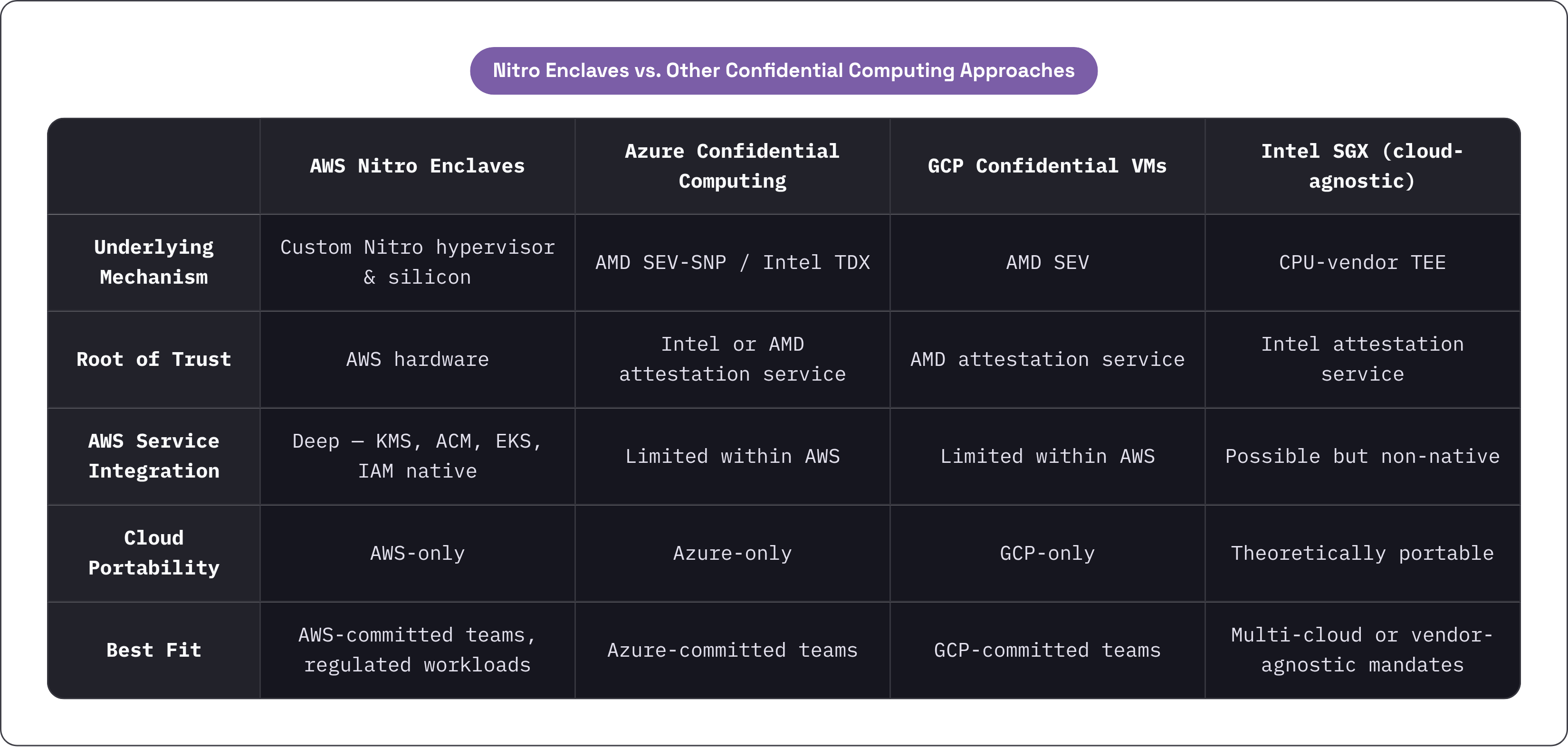
Confidential computing spans multiple vendors and underlying mechanisms. Azure Confidential Computing is backed by AMD SEV-SNP and Intel TDX; GCP offers Confidential VMs built on AMD SEV; hardware-native approaches using Intel SGX or AMD SEV exist independently of any specific cloud. Placing Nitro Enclaves honestly in that landscape requires acknowledging what it trades away alongside what it offers.
Nitro Enclaves' distinguishing characteristic is that isolation and attestation are enforced by Amazon's own custom hypervisor and silicon rather than by a third-party CPU feature. The root of trust is AWS hardware. On competing platforms that use CPU-vendor TEEs as the underlying mechanism, the root of trust is the CPU vendor's attestation service, Intel's or AMD's. Neither approach eliminates trust; both relocate it. Using Nitro Enclaves requires trusting AWS infrastructure. Using SGX via Azure requires trusting Intel's attestation service and Microsoft's hosting environment. A team that cannot accept AWS as a trust root needs a different approach, and that is a legitimate constraint rather than a criticism of either side.
A team that has already committed to AWS infrastructure and already places operational trust in AWS gains the most leverage from Nitro Enclaves' deep integration with KMS, ACM, EKS, and IAM. The integration density is genuinely difficult for CPU-vendor TEE approaches to match within AWS.
One might argue that teams requiring cloud-agnostic portability should simply use CPU-vendor TEE approaches, where the attestation model is at least theoretically portable across cloud providers offering the same CPU features. That is a real consideration for enterprises with multi-cloud mandates or for software vendors supporting customers across providers, and it reflects the design's priorities rather than a flaw in them.
For privacy-first AI workloads, where the commercial and regulatory pressure to demonstrate that user data never reaches the provider in readable form is intensifying, Nitro Enclaves offers a concrete infrastructure primitive. Attestation gives both the AI provider and the end user a cryptographic basis for the "we cannot see your data during inference" claim, backed by a verifiable attestation document rather than a contractual commitment. The open-source Nitro Enclaves SDK allows independent audit of the client-side libraries, which matters for teams or vendors who need to demonstrate due diligence to regulators or enterprise customers evaluating procurement risk.
What a Realistic Nitro Enclaves Implementation Requires from the Team Building It
The no-additional-cost pricing is genuinely attractive, and it has a tendency to make the technology look simpler to adopt than it actually is. Nitro Enclaves are more operationally demanding than deploying a standard EC2 workload. The complexity is not arbitrary; it follows directly from the security properties the architecture provides.
The first pressure point is architectural. The enclave must be a minimal, self-contained unit. Only code that genuinely needs to touch sensitive data belongs inside. This sounds obvious until you sit down to actually do it, at which point you realize most application teams have never drawn a precise boundary between sensitive processing and everything else. The vsock channel between parent and enclave becomes a de facto API contract. Defining what goes in, what comes out, and how errors surface without leaking information through error messages or timing differences is a design task that deserves its own review, separate from the broader system design.
The EIF must include everything the enclave needs at build time: OS, libraries, application. There is no runtime package installation, no interactive debugging session to diagnose a missing dependency. Build pipelines need to be deterministic, because PCR measurements are computed from the image. If the build is not reproducible, measurements will differ across builds and KMS attestation conditions will fail even for legitimate deployments. Teams that have not thought carefully about reproducible builds will encounter this at the worst possible moment, during a deployment rather than during development. That particular surprise is not subtle when it happens.
KMS key policy design warrants serious attention. The PCR-based condition keys that gate decryption are only as strong as their configuration. A misconfigured policy, one that specifies PCR values incorrectly or uses overly permissive wildcards, provides no attestation gate in practice. Testing this properly requires deliberately building and deploying a modified enclave image, verifying that KMS refuses the request, then verifying that the legitimate image succeeds. That test belongs in pre-production validation.
Observability is the operational challenge that surfaces last and bites hardest. There is no interactive access, no persistent storage. Logs must be emitted over vsock to the parent instance; tracing inside the enclave is limited by design. Teams accustomed to SSHing into an instance to diagnose a problem need to build deliberate logging and instrumentation before deploying. But how does this affect our original promise of operational simplicity? It doesn't change the security properties, but it does mean you either built the observability in or you did not. There is no retrofitting after an incident.
The workloads where this architecture is clearly worth it share a specific quality: a threat model that explicitly includes privileged insiders or compromised host-level access. That is the scenario the architecture was designed to defeat. Workloads where the threat model is primarily external attackers without elevated privileges, and where existing encryption posture already addresses the risk, will find the operational overhead difficult to justify. The technology is a precise answer to a specific class of problem. How well a team understands that specificity before they start building will largely determine how their implementation goes.